The 1971 genocide in Bangladesh is one of the most brutal, and yet most under‑recognised, mass atrocities of the twentieth century. More than five decades on, the international community – and the United Nations in particular – has still not found the political courage to name it for what it was. That silence undermines international law, corrodes the credibility of “never again,” and denies justice and dignity to millions of victims and survivors.
From March to December 1971, the military regime in Pakistan unleashed a campaign of extermination in what was then East Pakistan, aimed at crushing Bengali demands for autonomy and, ultimately, independence. It began in the night of 25 March with Operation Searchlight in Dhaka: student dormitories and university departments were stormed, professors and activists were dragged out and shot, and entire neighbourhoods were subjected to indiscriminate fire. This was not a chaotic descent into violence; it was a co‑ordinated operation against a national community that had dared to demand self‑determination.
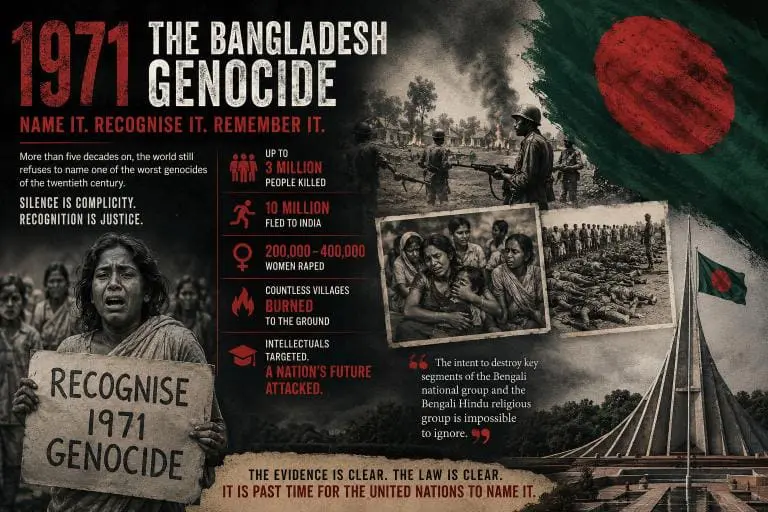
The months that followed saw a country‑wide pattern of atrocities. Estimates of the dead range from hundreds of thousands to as many as three million. Around 10 million people fled to India, and tens of millions more were displaced within East Pakistan. Mass graves around Dhaka, Chittagong, Khulna and Comilla testify to the scale of the slaughter. University campuses became execution sites. Rural areas that were thought to sympathise with the independence movement were subjected to scorched‑earth tactics: villages burned, crops destroyed, homes reduced to ash.
If there is one aspect of 1971 that should dispel any lingering illusions about the nature of this campaign, it is the systematic use of sexual violence. Between 200,000 and 400,000 women are believed to have been raped by Pakistani soldiers and allied militias. Many were held for weeks or months in what survivors accurately describe as “rape camps.” Sexual violence was deployed strategically – to terrorise communities, to stigmatise women for life, and to signal that the emerging Bengali nation itself was something to be violated and humiliated.
Religious minorities, especially Hindus, were singled out with particular ferocity. In practice, the labels “Bengali,” “Hindu” and “Indian” were treated as interchangeable. Hindus were branded “Indian agents,” and in some instances written orders instructed soldiers to kill them on sight. Although Hindus were a minority of the population, they formed a clear majority of those who fled into India, a stark indicator of targeted persecution. Temples such as the Ramna Kali temple in Dhaka were destroyed; scores of worshippers were massacred on sacred ground. Hindu women faced the double vulnerability of gender and faith: rape, abduction, forced conversion, and forced marriage were used to shatter their communities. Buddhist, Christian and other non‑Muslim communities were also attacked, even if on a smaller scale.
The targeting of intellectuals and professionals added another chilling dimension. As the war drew to a close in December 1971, death squads worked from prepared lists of journalists, teachers, doctors, artists and other prominent figures. Many were abducted, tortured and killed in those final days, their bodies dumped in mass graves on the outskirts of Dhaka. The aim was transparent: to decapitate the future leadership of the new state of Bangladesh, to ensure that its best minds would not live to shape an independent national project.
By any reasonable reading, these crimes meet the legal definition of genocide under the UN Genocide Convention. The convention speaks of acts such as killing members of a group, causing serious bodily or mental harm, and deliberately inflicting conditions of life calculated to bring about the group’s destruction, when committed with intent to destroy a national, ethnic, racial or religious group in whole or in part. In 1971, there was organised, large‑scale killing and rape of Bengalis and a clearly disproportionate targeting of Bengali Hindus. There was explicit dehumanising rhetoric from elements of the Pakistani leadership, orders and practices that singled out specific groups, and a systematic assault on their cultural and religious sites. The intent to destroy key segments of the Bengali national group and the Bengali Hindu religious group is impossible to ignore.
Bangladesh has not been silent. Successive governments, and especially that of Prime Minister Sheikh Hasina, have repeatedly called on Pakistan to issue a formal apology for the crimes of 1971 and to address questions of reparations and pre‑1971 assets. Civil‑society organisations and survivor groups have campaigned tirelessly for international recognition. Genocide‑focused organisations, including leading NGOs and academic bodies such as the International Association of Genocide Scholars, have adopted resolutions and statements recognising the events of 1971 as genocide, crimes against humanity and war crimes, and urging states and international institutions to do the same. National parliaments have begun to move: resolutions in the United States House of Representatives explicitly condemn the atrocities committed by elements of the Pakistan Army and their local collaborators and call them by their proper name – genocide.
At the United Nations, however, the wall of reluctance remains largely intact. There is, as yet, no General Assembly or Security Council resolution formally recognising the 1971 atrocities as genocide under the convention that the UN itself shepherded into existence. Bangladeshi diplomats, supported by international NGOs, have used Human Rights Council sessions and side events in Geneva to present evidence, legal analyses and survivor testimony. They have argued that the crimes of 1971 are among the worst mass atrocities seen since the Second World War and that they fully meet the legal threshold for genocide. And yet, the UN’s official record remains evasive.
Why? The answer lies in politics, not in law or evidence. Confronting 1971 means confronting the role of Pakistan, an important state in a volatile region. It means revisiting Cold War alignments and uncomfortable truths about how major powers responded at the time. It means acknowledging that the international system that emerged after 1945 failed millions of Bengalis in 1971, just as it has failed victims in other genocides since. For some states, it is simply easier to look away.
But the price of looking away is high. For survivors and families of the dead, the absence of formal recognition deepens the wound. It leaves space for denial and revisionism, for textbooks that downplay or distort, for public narratives that reduce genocide to “excesses on both sides.” For the international system, it sends a dangerous signal: that even the clearest cases of genocidal violence can be quietly filed under the heading of “history” when they become inconvenient.
Recognising the 1971 genocide in Bangladesh would not, in itself, deliver full justice. It would not bring back the murdered intellectuals, the women whose lives were shattered in rape camps, the communities burned out of their villages. But it would do three essential things.
First, it would validate the lived experience of those who suffered and of their descendants, affirming that the world has listened and understood. Second, it would strengthen global norms against mass atrocities by showing that the Genocide Convention applies consistently, not selectively according to current geopolitical interests. Third, it would help inoculate the future against denial and distortion, ensuring that what happened in 1971 is properly taught, commemorated and integrated into the world’s collective memory.
For an organisation that quite rightly invokes the lessons of the Holocaust and repeats the mantra “never again,” the United Nations’ continued failure to recognise the Bangladesh genocide is a profound moral and institutional contradiction. It is time to resolve that contradiction. The evidence is available, the legal criteria are met, and the victims have waited long enough.
Unresolved atrocities reverberate across generations and borders. The 1971 genocide in Bangladesh is not only a matter for Dhaka and Islamabad; it is a test case for the credibility of the entire international system of human rights and humanitarian law. If the world cannot bring itself to name this genocide, it is failing both past and future generations.