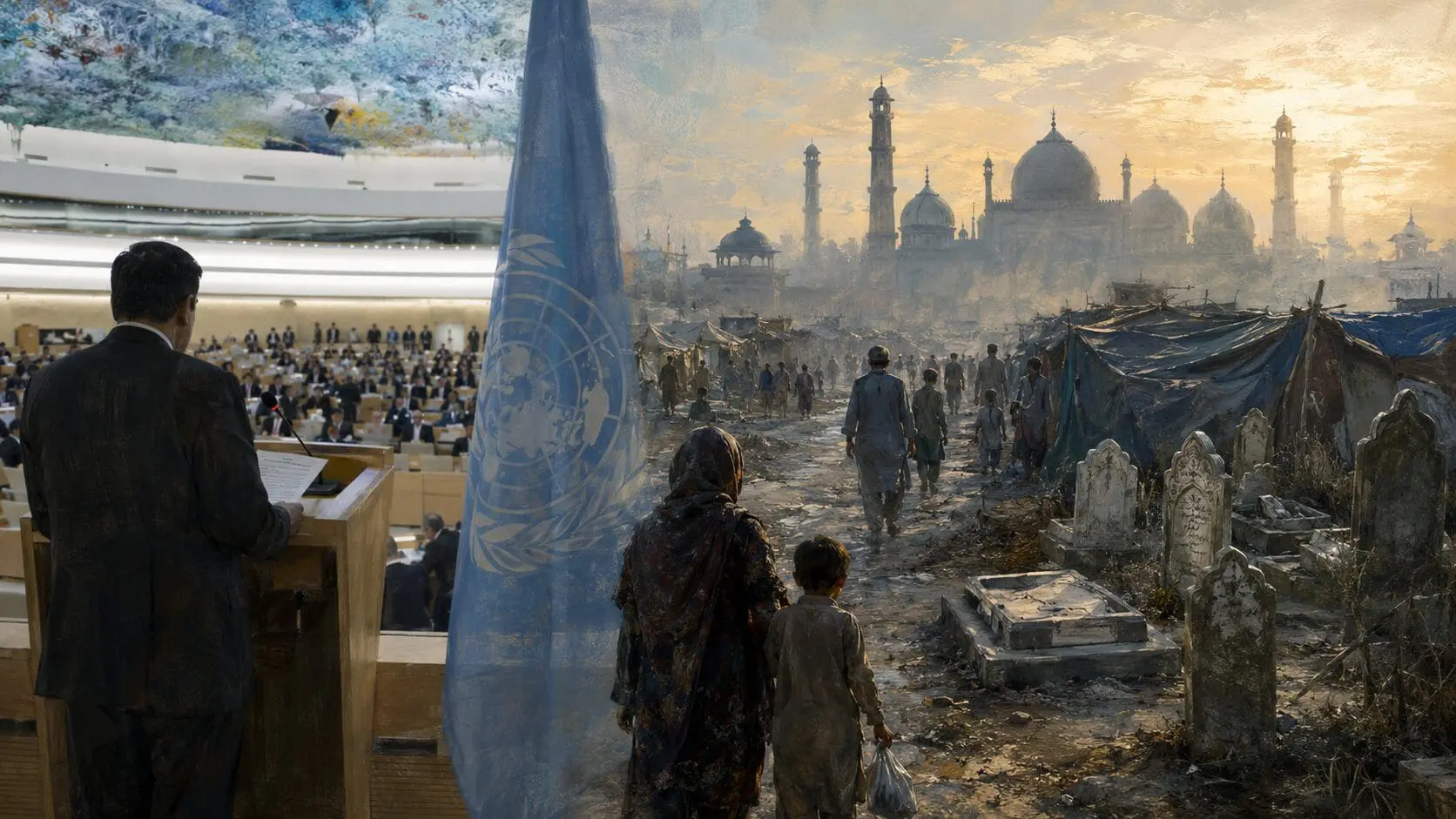
In a 6 March statement to the United Nations Human Rights Council, Muneeb Ahmed of the Delegation of Pakistan made the following assertion: “Pakistan ensures comprehensive protection for religious rights of minorities.”
In plain language, the statement is a lie. The speaker knew it was a lie, and every diplomat listening in the Palais d’Nations in Geneva knew it was a lie. The Pakistani Delegation knew that everyone knew they lied, and everyone knew that they knew this. This is the level of hypocrisy and cynicism to which Pakistan has sunk, and indeed, they share this swamp of falsehoods with most other members of the Human Rights Council, because most are autocratic regimes that violate human rights as a matter of policy, in order to preserve their power.
The statement was made in response to a report by the UN Special Rapporteur on Freedom of Religion or Belief, Nazila Ghanea, on “How freedom of religion or belief relates to death and honouring the deceased.” The Report states:
In Pakistan, Ahmadis are constitutionally declared “non-Muslim” under the Constitution (Second Amendment) Act, 1974, and criminalized under Ordinance No. XX of 1984 for identifying as Muslim. That legal framework legitimizes discrimination, extending even to death and burial. The authorities reportedly frequently deny Ahmadis access to public graveyards, desecrate their graves and side with violent mobs that obstruct funerals.
The Report goes on:
The country’s local government acts grant administrative control of graveyards to union councils; however, implementation remains discriminatory, including for Hindus and Sikhs. 21 Ahmadiyya graveyards are often reportedly encroached upon and authorities routinely deny burials or fail to protect graveyards from mob desecration….Ahmadi funerals under the pretext of maintaining the peace, effectively criminalizing burial rites. Ahmadis are reportedly even criminalized for using Islamic epitaphs on their graves.
The Special Rapporteur’s Report is scrupulously sourced, citing court cases, and reports from independent groups. In his statement, Ahmed cast doubt on the veracity and authenticity of these sources, some of which were anonymous. Why? Because to reveal them would likely put the informants in danger of prosecution.
In fact, religious persecution in Pakistan has been documented by the world’s most respected human rights groups and government agencies.
According to Human Rights Watch, “there has been an increase in attacks on religious minorities in Pakistan and their places of worship. The persecution of the Ahmadiyya community is embedded in Pakistani law and encouraged by the Pakistan government.”
FIDH, the International Federation for Human rights, noted “growing incidents of violence, intolerance and discrimination towards members of religious and sectarian minority communities across Pakistan.”
The Pakistani government not only tolerates, but actively encourages violence against members of minority religions. The United States Commission on International Religious Freedom noted “its lack of willingness to address associated mob violence.” Amnesty International writes that, “vicious mob attacks are just the latest manifestation of the threat of vigilante violence which anyone can face in Pakistan after a blasphemy accusation – with religious minorities disproportionately vulnerable to the same.”
In Thailand, Malaysia and other lands, many thousands of Pakistani Christians, Ahmadi Muslims and others, who have fled discrimination, mob violence, torture, and murder in their homeland, languish in squalid refugee camps hoping for resettlement in states that respect religious freedom. Pakistani policies have destroyed their lives, and overwhelmed the United Nations High Commission for Refugees.
The Pakistani regime has shown not a shred of sympathy for these victims. Its statement to the Human Rights Council, couched in diplomatic flourishes, reveals bigotry that has no place in a civilized country. And it shows that for Pakistan, the United Nations Human Rights Council is nothing but a propaganda platform for pursuing political ends in the manner of a totalitarian state.
Aaron Rhodes was formerly Executive Director of the International Helsinki Federation for Human Rights (1993-2007), and President of the Forum for Religious Freedom-Europe (2014-2025). He is the author of The Debasement of Human Rights (Encounter Book, 2018) and Human Rights Without Illusions (Academica Books, 2025).