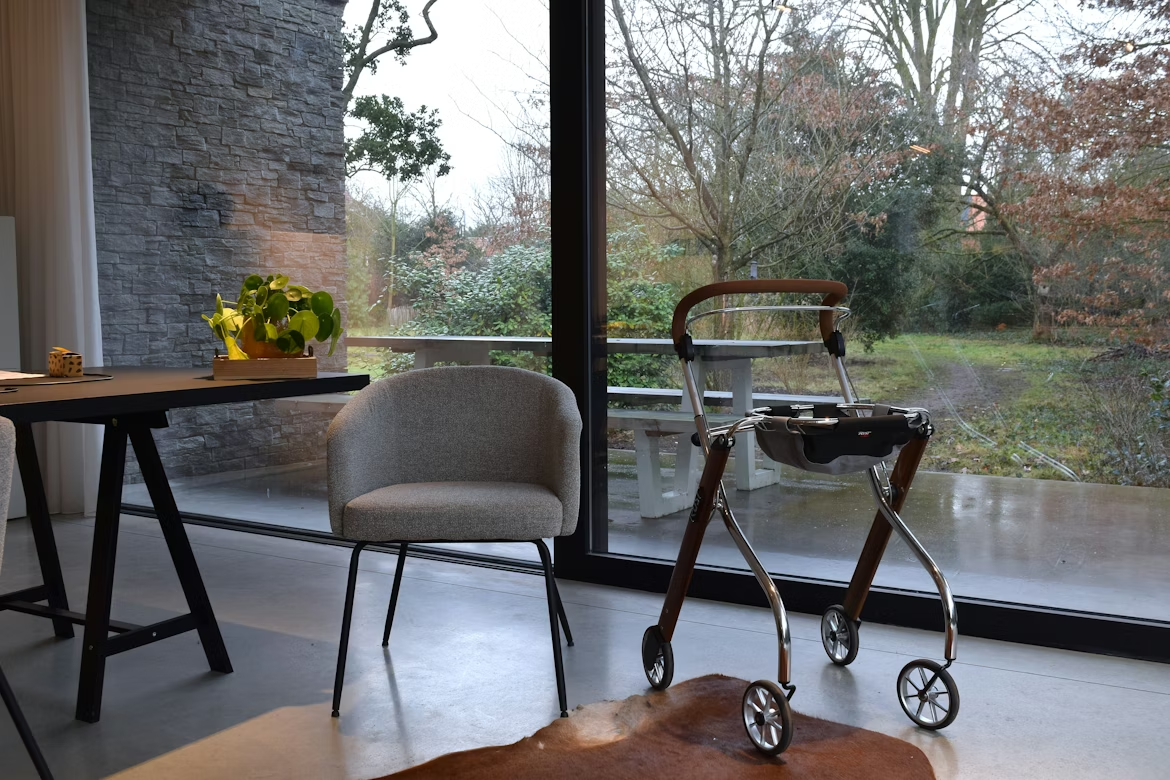
Europe endures an ageing population. In early 2025, more than 22 per cent of its population were people above the age of 65 (European Commission 2025). Pension ages across Europe vary roughly between the ages 65 and 67. With a mean age of 44+ years, a falling fertility rate, and an ever increasing life expectancy, more and more Europeans become pensioners and enjoy life without having to work. What is more, as people grow older, many of them begin to experience difficulties when it comes to taking care of themselves. Many of them become in need of help, in need of care. Question is, who provides that care?
As opposed to elderly care, the case of childcare is relatively simple. Childcare is provided everywhere! All of it for a reason. If viewed as human capital (something that could be invested in and bring more returns than the invested amount), then it makes sense for the politico-economic (the interplay between state and economy) to invest into providing education for children. In simpler terms, if the politico-economic invested in a child now, the labourer this child would become in the future would be way more beneficial to the politico-economic than in the case of no investment. Hence, there exist public kindergartens, middle schools, high schools, you name it. Such is not the case with the elderly. At least in the present.
With the introduction of the process of deinstitutionalisation of care, we see an interesting phenomenon. Deinstitutionalisation is an idea and reality practiced in the EU ever more nowadays. Simply put, it aims to replace existing institutional care facilities with more humanitarian ones. It aims to create facilities providing warmer person-to-person care, as opposed to the colder, hospital-like institutional care. This comes, of course, with the withdrawal of the state in terms of funding for public or semi-public care institutions which have existed for years (such as nursery homes for the elderly, or hospices), and the allocation of EU funds for the restructuring of (some) old or creation of new care facilities. In theory, this sounds great! If properly executed, it could be practically sustainable as well! Yet, the process has issues.
What is the difference and why do it? Institutional care is believed to be unable to provide the quality life one deserves. A nursery home for elderly people cannot be as good for a person in need as would their family be. So why not stay with the family? In brief, not all families can take care of their elderly members. Logically so sometimes. Also, the fundamental role of elderly care institutions was to indeed ‘free’ familial members from taking care of someone. In formerly socialist European states, the reason for that was simple – ‘liberate’ the woman from her familial activities, so that she can join the workforce. After all, every able-bodied person had to contribute to the state-led production process. In other European states such institutions also developed, for similar or different reasons.
Nowadays, these institutions are the target of deinstitutionalisation. EU states aim to close them and offer the recipients of care an alternative – more humanitarian, community-based care, which would contribute to improving the quality of life among the elderly in need of care. While this is amazing, the process is not as smooth as one would like it to be. In the process of slowly reducing the number of recipients of care in institutions, this creates a vacuum that is yet to be filled by the creation of facilities for non-institutional care.
The world we live in does not stand vacuum. Neither does the economy. The vacuum is immediately filled with something. In the case of free-market economies, of course this is a great space for private enterprises to emerge. Therefore, with the withdrawal of the state in the provision of elderly care (in terms of institutions and the funding for them), a niche for private elderly care provision begins to exist. Since deinstitutionalisation takes time and the transition from institutional to community-based care cannot happen immediately, this offers a perfect environment for the establishment of private enterprises. And in times where the economy has come to the forefront of our lives and turned into a way of life, these private elderly care facilities fill the vacuum, making the deinstitutionalisation process ever more difficult.
In the case of childcare, we see that it is perceived by the economy as a sphere to be invested in for the development of human capital. Yet, childcare could also be purely viewed as an economic activity. After all, a school – be it public or private – provides employment for a number of people. Not only. It also produces future workers. Elderly care, however, albeit necessary for the sustainment of society, hence the economy, remains somewhere on the fringes. Investment in elderly care does not mean investment in human capital from an economic perspective. Hence, it is less favoured by the politico-economic.
This is showcased with the process of deinstitutionalisation. The state withdraws (arguing that state-funded institutions are not in favour of improving the lives of care recipients), creating a vacuum in the elderly care regime. While this vacuum is to be filled by deinstitutionalised facilities, this transition takes time. In the meantime, private investors seize the opportunity and establish private elderly care facilities. Due to the low number of such facilities before the deinstitutionalisation practice, however, regulations for private facilities have been loose. This, in turn, allowing for the creation of facilities which do not at all contribute to the aim of deinstitutionalisation, namely the improvement of the quality of life of recipients.
This whole process could be well illustrated using an example. Bulgaria, among other EU states, is currently undergoing the deinstitutionalisation process and more than a year and a half ago many private facilities were in the centre of attention because of the poor conditions they were functioning in. A historical overview of the elderly care regime in Bulgaria is useful when one tries to understand who cares for the elderly and whose responsibility it is to provide elderly care. In the article to follow I shall briefly discuss the case of Bulgaria, offering an example of how elderly care remains hidden from the economy.



![[Press Release] Scientology Volunteers provide needed humanitarian help after natural disasters in Venezuela](https://i2.wp.com/www.scientologyeurope.org/wp-content/uploads/2026/07/IMG-20260701-WA0262.webp?resize=128,96&ssl=1 "[Press Release] Scientology Volunteers provide needed humanitarian help after natural disasters in Venezuela")