


As Denmark prepares for its upcoming Universal Periodic Review (UPR) in Geneva on 7 May 2026, it will present itself as a country that has finally taken a decisive step against racism. In 2025, the Danish government adopted its first-ever National Action Plan Against Racism—a long overdue initiative comprising 36 measures across multiple sectors.
At first glance, this appears to be a milestone. And to some extent, it is. But a closer look reveals a more troubling reality: Denmark’s approach to combating racism remains selective, uneven, and incomplete. Most notably, it fails to adequately address one of the most pressing forms of discrimination in Denmark and Europe today—anti-Muslim racism, or Islamophobia.
Bashy Quraishy
Secretary General – European Muslim Initiative for Social Cohesion – Strasbourg
Thierry Valle
Coordination des Associations et des Particuliers pour la Liberté de Conscience . France
Gregory Christensen
Chairman -Youth for Human Rights – Denmark
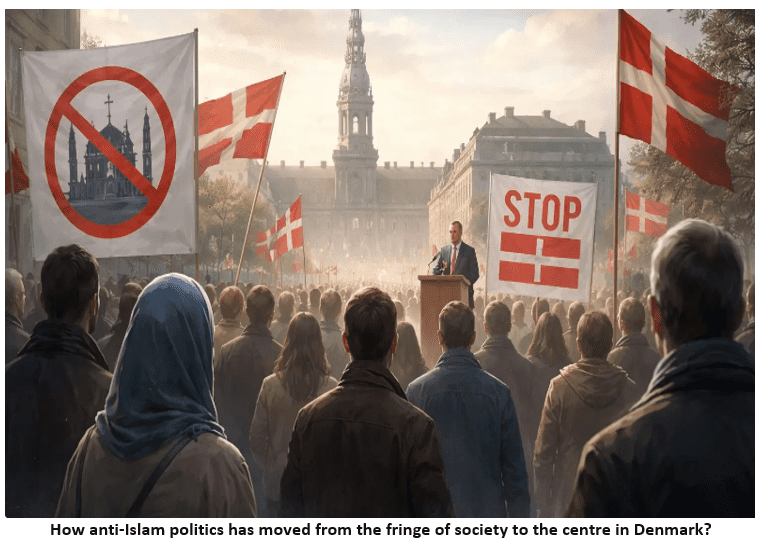
At a time when anti-Muslim rhetoric is becoming increasingly normalized across Europe, Denmark’s new National Action Plan Against Racism should have marked a turning point. Instead, it risks becoming yet another example of selective anti-racism—a model that acknowledges some forms of discrimination while sidelining others.
As Denmark heads into its Universal Periodic Review (UPR) in Geneva on 7 May 2026, European policymakers should resist the temptation to applaud too quickly. Because behind the language of progress lies a deeper problem: a political reluctance to confront Islamophobia head-on.
A Plan that recognizes some, but not all – looks like a convenient omission
Denmark’s action plan deserves recognition for explicitly addressing certain forms of discrimination. It includes targeted measures to combat anti-Semitism and places significant emphasis on racism experienced by Greenlanders, a group that has long faced structural marginalization within the Kingdom.
These are important and necessary steps. But they also expose a fundamental flaw: the plan does not apply the same level of recognition or protection to all groups. Despite years of recommendations from international human rights bodies, the Danish plan does not explicitly recognize Islamophobia as a distinct form of racism. Nor does it introduce targeted measures to address discrimination against Muslims in key areas such as employment, education, housing, or public life.
This omission is not a minor oversight—it reflects a deeper policy imbalance.
Denmark’s 2025 action plan includes 36 initiatives and, on paper, signals long-overdue recognition that racism is a structural issue. It explicitly addresses anti-Semitism and devotes significant attention to discrimination against Greenlanders—both important and necessary priorities.
But when it comes to anti-Muslim racism, the silence is striking. This is not an oversight. It is a political choice.
What is missing in the Action Plan?
- Islamophobia is not explicitly named.
- There are no targeted measures addressing discrimination against Muslims in employment, housing, or education.
- No dedicated strategy to tackle anti-Muslim hate crime.
- No clear acknowledgment that Muslims—one of Europe’s most scrutinized and politicized minorities—face systemic barriers.
The politics of selective recognition makes hierarchy of racism a reality
When governments address some forms of racism in detail while treating others only in general terms, they risk creating what can be described as a hierarchy of protection.
In Denmark’s case:
- Anti-Semitism is explicitly named and addressed
- Racism against Greenlanders is prioritized with dedicated initiatives
- Anti-Muslim racism remains largely implicit, if acknowledged at all
For policymakers across Europe, this should raise a red flag. Human rights frameworks are built on the principle of universality—that all individuals are entitled to equal protection without discrimination. Selective recognition undermines that principle and weakens the credibility of anti-racism efforts as a whole.
Unfortunately, governments across Europe and in Denmark have become increasingly comfortable condemning some forms of racism while avoiding others. Anti-Semitism, rightly, receives sustained attention and policy commitment. But Islamophobia is too often treated as politically inconvenient—entangled in debates on migration, security, and national identity.
Denmark’s action plan reflects this broader trend. By failing to explicitly address anti-Muslim racism, it reinforces a dangerous message: that not all victims of racism are equally worthy of protection. This is how a hierarchy of racism takes hold—not through explicit exclusion, but through selective prioritization.
Normalization, not neutrality
The consequences of this approach extend far beyond policy documents.
Across Denmark and Europe, Muslims face:
- Disproportionate levels of hate speech and hate crime
- Persistent discrimination in the labor and housing markets
- Public narratives that frame them as outsiders, security risks, or cultural threats
When governments fail to name and address Islamophobia directly, they are not remaining neutral—they are allowing these dynamics to continue unchecked. Silence, in this context, is not impartial. It is enabling.
Why this matters now?
The timing of Denmark’s UPR is critical. The review is not merely a procedural exercise; it is an opportunity for states—and their European partners—to reaffirm a shared commitment to equality and non-discrimination.
If Denmark’s plan is accepted without scrutiny, it risks setting a precedent: that anti-racism strategies can be considered adequate even when they leave significant forms of discrimination insufficiently addressed. For European policymakers, the message should be clear: partial approaches are no longer enough.
A European pattern of avoidance
Denmark is not an outlier. It is part of a broader European pattern where political courage falters precisely where it is most needed.
While strategies against anti-Semitism have rightly become more robust and coordinated at the EU level, equivalent frameworks addressing Islamophobia remain fragmented, underdeveloped, or absent altogether. This imbalance is not only unjust—it is strategically short-sighted. Ignoring anti-Muslim racism does not make it disappear. It deepens social divisions, fuels polarization, and undermines trust in democratic institutions.
The UPR as a political test
The upcoming UPR is more than a technical review—it is a test of political honesty.
Will European states acknowledge that Denmark’s plan, while a step forward, is fundamentally incomplete? Or will they endorse a model of anti-racism that tolerates glaring omissions?
If the latter prevails, it will send a troubling signal across Europe: that governments can meet international expectations without addressing one of the continent’s most pervasive forms of discrimination.
What should be done?
Denmark must move beyond selective frameworks and adopt genuinely inclusive strategies.
This requires several concrete steps:
First, explicit recognition.
Islamophobia must be acknowledged as a specific and distinct form of racism. Naming the problem is a prerequisite for addressing it effectively.
Second, targeted policy measures.
Governments should introduce concrete actions to combat discrimination against Muslims in employment, education, housing, and public institutions.
Third, stronger responses to hate crime.
Law enforcement must be equipped to identify, record, and prosecute anti-Muslim hate crimes, while ensuring that victims feel safe to report incidents.
Fourth, better data.
Without disaggregated data on discrimination and hate crime, policymaking remains reactive and incomplete.
Finally, inclusive governance.
Muslim communities and civil society actors must be meaningfully involved in shaping, implementing, and monitoring anti-racism policies.
Above all, they must recognize that anti-racism cannot be credible if it is conditional.
The cost of inaction
Europe is at a crossroads. The rise of exclusionary politics, identity-based polarization, and normalized prejudice is no longer abstract—it is shaping laws, institutions, and everyday life.
In this context, failing to address Islamophobia is not just a policy gap. It is a democratic failure.
Denmark’s action plan could have set a standard for inclusive, principled anti-racism. Instead, it exposes the limits of political will. The question now is whether Europe is prepared to confront those limits—or continue to look away.
A test of Europe’s commitment
Denmark often positions itself as a champion of human rights. Its adoption of a national anti-racism plan is a step in the right direction. But leadership requires more than symbolic progress—it demands consistency, inclusivity, and courage.
The upcoming UPR session offers a chance not only to improve Denmark’s policies but also to send a broader signal across Europe: that all forms of racism must be addressed with equal seriousness.
Failing to do so risks leaving one of Europe’s largest minority groups inadequately protected—and undermining the very foundations of the human rights system European states have pledged to uphold.