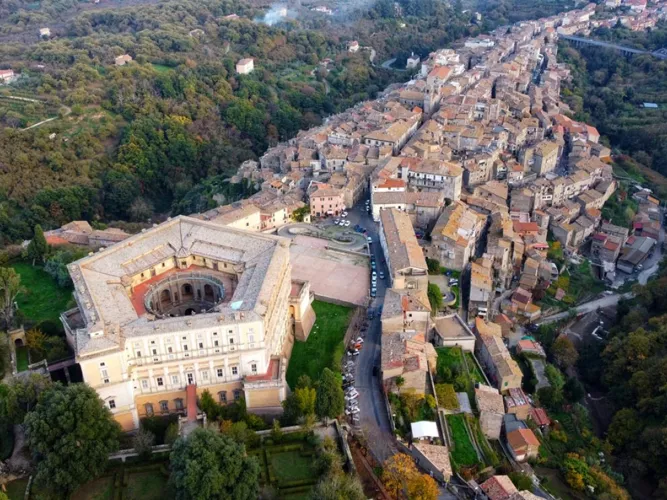
Few people know that the real Pentagon, the original one, is located in Italy, about sixty kilometers northwest of Rome. Yes, the first building in the world to receive this was built in the village of Caprarola 500 years ago and in the heyday of the Italian Renaissance. It is still there, beautiful, majestic and well maintained by the authorities to the delight of thousands of tourists and moviegoers inspired by it.
And the Pentagon in the USA was erected in 1941 in order to gather all the employees of the then Ministry of Defense in one place. Hitler was already rampaging through Europe, the American nation was anxiously watching his aggressive raids and was beginning to prepare for war. Yes, but the 24 thousand employees of the military department were scattered in 17 different buildings, coordination between them was difficult, and Congress assigned the special construction division to find a place and quickly build a building that met the current needs of the army. The young lieutenant Hugh Casey, who was a graduate architect-engineer, in love with the architecture of Renaissance Italy, was tasked with proposing a specific project. And inspired by the medieval Pentagon he studied at the university, he assigned his wards architects and designers to create a unique plan for a building in the shape of a rectangle. Where each of the five sides would have enough space for offices for 40 thousand personnel, which would be connected by corridors and make military analyses and the corresponding decisions lightning fast. Of course, the plan for the pentagonal building had opponents, especially among the members of the Congressional Committee on Fine Arts. They claimed not only that the building would be huge and therefore an easy target for the bombers of the Third Reich, but also very ugly.
The disputes reached President Franklin Roosevelt, who in the meantime was familiar with the functionality and beauty of the Italian architectural masterpiece, and snapped: “Pentagon!”
And the famous Italian palace with a pentagonal shape, known as the “Farnese”, was designed half a millennium ago by the most famous Italian architects at the request of two famous members of the powerful Farnese family – Alessandro Farnese the Elder, who later became Pope with the name Paul III, and his nephew Alessandro Farnese the Younger.
The former entrusted the design to the Florentine architect Antonio da Sangallo the Younger, who came up with the famous pentagonal plan, but for a fortress castle, and not for a palace for the residence of an aristocratic family. Work began in 1530, but was stopped four years later when Alessandro Farnese became pope. Not long after, his nephew Alessandro Farnese arrived in Caprarola and decided to complete his illustrious uncle’s project, entrusting it to the architect Jacopo Barosi, already known in half of Europe by the name of Vignola. It was he who redrawn the initial plans, transforming the fortress he had begun into a palace, which is still considered an absolute masterpiece and of the movement in architecture – the so-called Mannerism, of which Vignola was one of the most prominent representatives along with Michelangelo Buonarroti, Giulio Romano and Andrea Palladio.
And the impressive Renaissance palace became the summer residence of popes and cardinals, who enjoyed the beautiful nature around from the corner bastions turned into large terraces, and in the heat they rested in the circular courtyard formed in the middle, consisting of two overlapping porticoes. The interior architecture is also amazing, characterized by elegant stairs and columns, as well as the frescoes on the ceilings and walls, all by famous Renaissance artists.
Until 1941 – just when the construction of the Pentagon in Washington began, this one, the original one in Caprarola, was private property, but was nationalized in favor of the state by the fascist leader of Italy Benito Mussolini. It is curious that after the war the Farnese Palace became a favorite of the first president of Republican Italy – Luigi Einaudi, who loved to rest in the special … “House of Pleasures”! That is, in the rooms and terraces with gardens, where the concubines of popes, cardinals and archbishops once worked. Today, in addition to being a favorite destination for thousands of tourists from all over the world, the Renaissance architectural masterpiece is a preferred “location” for more than one filmmaker. For example, notable films such as the third part of “The Godfather” by Francis Ford Coppola, “The Trial and Abduction” by Marco Bellocchio, “The Man from U.N.C.L.E” by Guy Ritchie, etc. have been filmed there.
Illustration: Caprarola in the province of Viterbo, in the Lazio region of central Italy and is dominated by the imposing Palazzo Farnese, built in the 16th century.