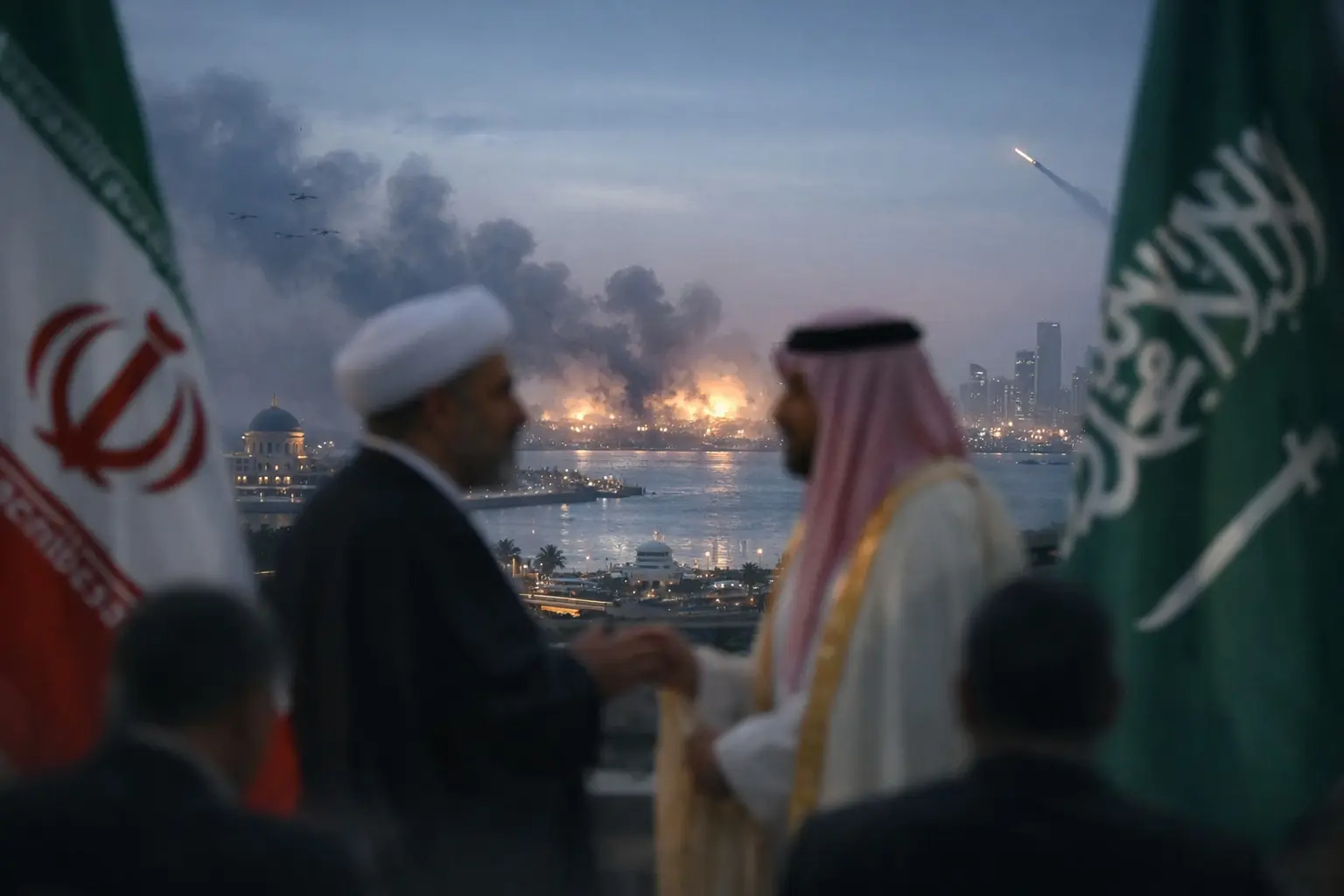
As the conflict between the US-Israel and Iran has widened around the region, with Iran attacking neighbours across the Gulf, Tehran has launched significantly less missile and drone strikes at Saudia Arabia, with the Kingdom falling into a “third tier” behind other Gulf states in terms of how much fire has been received. The United Arab Emirates has been attacked by far the most.
Iran’s retaliation after the lateFebruary US–Israeli strikes has targeted multiple Gulf states that host or support US assets: primarily the UAE, Saudi Arabia, Qatar, Bahrain, Kuwait, and to a lesser extent Oman. Opensources explicitly state that Iran continues to launch the highest number of attacks against the UAE, while Saudi Arabia has faced smaller share of the total salvos.
A detailed tally exists for the UAE: by 3–4 March, the UAE Ministry of Defence reported roughly 189 ballistic missiles, 941 drone attacks and several cruise missiles launched against it since the start of the war; most were intercepted but many caused damage via debris and a handful of direct hits.
The precise count for the UAE is in the high hundreds to low thousands of projectiles, while Saudispecific counts only appear in incidentbased reports (waves of “several” or “dozens” at a time), which confirms that Saudi Arabia has been attacked much less intensively than the UAE in raw volume of projectiles.
As the conflict between US-Israel and Iran has become region-wide, it is clear that Saudi Arabia has suffered far less retaliation than their Gulf neighbours. What explanation could there be for Iran sparing Saudi Arabia, when traditionally that territory was thought to be their biggest rival? Given the almost primal lashing out that Iran has inflicted across the Gulf, there has to have been an objective that reined Tehran in when it came to Saudi Arabia. The Iranian regime must have calculated that there was more to be gained from restraint.
Could this selective Iranian restraint have its roots in the détente engineered by China between Iran and Saudi Arabia in 2023? That rapprochement offered mutual benefits, including a deal around the Houthis and, apparently, that Iran would not involve Saudi Arabia in any retaliations against Israel. If Iran had attacked Saudi Arabia with the same ferocity it unleashed on other Gulf states, especially the UAE, Tehran would surely have jeopardised much that had been agreed with Riyadh via the back channels and secret deals.
The Saudi–Iran deal was mutually beneficial by deescalating their proxy confrontation, especially via the Houthis, in exchange for security and political gains each regime wanted at home and in the region. Saudi Arabia needed that to in order to try and refocus some of its spending away from security towards Vision 2030, which has made Saudi Arabia more expensive to run. Riyadh is having to bear down harder on deficits, debt and thecommitments of its sovereign wealth fund to keep the project moving.
While of course no one wants to see any increased aggression between Iran and Saudi Arabia, commentators are wondering what the extent of the secret talks and back channel deals might have been, when the Kingdom of Saudi Arabia continues to get off so slightly amidst the Iranian violence towards Gulf states, none of whom allowed US-Israeli attacks from their territory.
One way and another, Crown Prince Mohammed bin Salman might be pleased the brunt of Iran’s anger was diverted elsewhere in the region. But he should expect questions from his fellow members of the Gulf Cooperation Council on how come they got it in the neck while he got off almost scot-free.