Europe spent Tuesday confronting a familiar strategic weakness in real time: its exposure to imported energy. As ministers weighed emergency options and EU leaders focused again on competitiveness, the latest external shock also revived one of the bloc’s deepest internal arguments — whether Europe moved too far away from nuclear power.
Europe’s most consequential story on 10 March is not a single summit line or market move, but the way several developments suddenly converged into one political reality. The G7 stopped short of immediately releasing strategic oil reserves and instead asked the International Energy Agency to prepare scenarios. At the same time, EU institutions and governments sharpened their focus on energy prices, inflation risks and industrial competitiveness. Then, in Paris, European Commission President Ursula von der Leyen used the IAEA Nuclear Energy Summit to argue that Europe had made a “strategic mistake” by reducing nuclear power.
Another external shock, the same European vulnerability
The immediate trigger is the wider Middle East crisis and renewed concern that disruption around the Strait of Hormuz could once again transmit geopolitical conflict into European bills, industrial costs and political pressure. According to European Council President António Costa’s speech to EU ambassadors on Tuesday, the Union must make 2026 “the year of European competitiveness,” linking economic resilience directly to sovereignty. That ambition becomes harder to sustain when each external shock immediately raises questions about supply security, affordability and industrial survival.
This is why today’s energy story is bigger than oil prices alone. It touches the core of Europe’s economic model. The continent remains more exposed than the United States to imported fossil fuels, and that exposure feeds directly into manufacturing costs, transport, food prices and household anxiety. When energy becomes scarce or volatile, Europe does not experience it as an abstract market problem. It experiences it through weaker industry, tighter public budgets and renewed pressure on families still carrying the effects of recent inflation.
Von der Leyen reopens the nuclear fault line
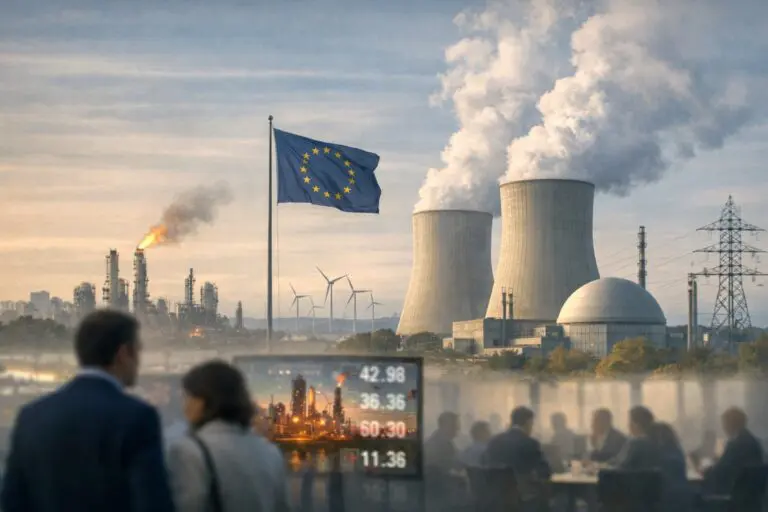
That is what gave unusual weight to von der Leyen’s intervention in Paris. As reported on Tuesday, she said Europe’s decision to reduce nuclear energy had increased dependence on imported fossil fuels, noting that nuclear’s share of European electricity generation has fallen sharply since 1990. She also announced a new €200 million EU guarantee for private investment in small modular reactor technology, signalling that Brussels wants to be more active in the sector even if member states remain divided.
That intervention does not settle Europe’s nuclear argument. It intensifies it. Germany’s environment minister pushed back the same day, defending wind and solar as cleaner and safer. Austria and Luxembourg have long resisted a stronger EU embrace of nuclear, while France sees it as central to industrial resilience and low-carbon electricity. What is changing now is the political frame. The debate is no longer only about climate targets or technology choices. It is increasingly about sovereignty, price stability and the cost of relying on events far beyond Europe’s borders.
In practice, the emerging European argument is more complex than a simple nuclear-versus-renewables contest. Europe has expanded renewable energy quickly, but it still needs stable generation, stronger grids, more storage, faster permitting and lower-cost electricity for industry. Nuclear is returning to the centre of the conversation not because the debate is finished, but because the stress test has returned.
Climate policy is also being pulled into the emergency
The same pressure is now reshaping the EU’s carbon-market debate. According to draft summit conclusions seen by Reuters, EU leaders are set to ask the European Commission to present a review of the Emissions Trading System by July, with the aim of reducing carbon-price volatility and limiting its impact on electricity prices while preserving the ETS’s central role in the transition.
That is a revealing signal. Brussels is not abandoning climate policy, but it is under growing pressure to show that decarbonisation can coexist with affordability and industrial survival. If energy prices are seen as punitive, support for the transition weakens. If climate tools are seen as untouchable while households and factories absorb the shock, political backlash grows. Europe is therefore entering a more difficult phase: not whether to decarbonise, but how to do so without turning vulnerability into discontent.
A test of sovereignty — and of social fairness
There is also a deeper political message in the timing. Europe has spent months speaking the language of defence, competitiveness and strategic autonomy. As The European Times reported this week, Costa has been making the case for a more sovereign Europe able to defend itself, compete economically and act with greater independence. Today’s energy shock shows where that ambition still runs into reality.
The social dimension should not be overlooked. High energy prices hit hardest where resilience is weakest: lower-income households, small businesses, rural communities and energy-intensive workers. Energy policy is never only about megawatts, carbon markets or industrial planning. In Europe, it is also about dignity, social peace and whether the green transition is experienced as protection or punishment.
That is why this story deserves to lead the European agenda today. It is about markets, but also about citizens. It is about power generation, but also about trust in institutions. The immediate panic may ease if oil prices stabilise, but the deeper lesson will remain. Europe cannot build real strategic autonomy while every major external crisis threatens to raise its bills, weaken its industry and reopen its internal energy wars.
Today’s shock has not resolved Europe’s energy debate. But it has made it impossible to postpone.