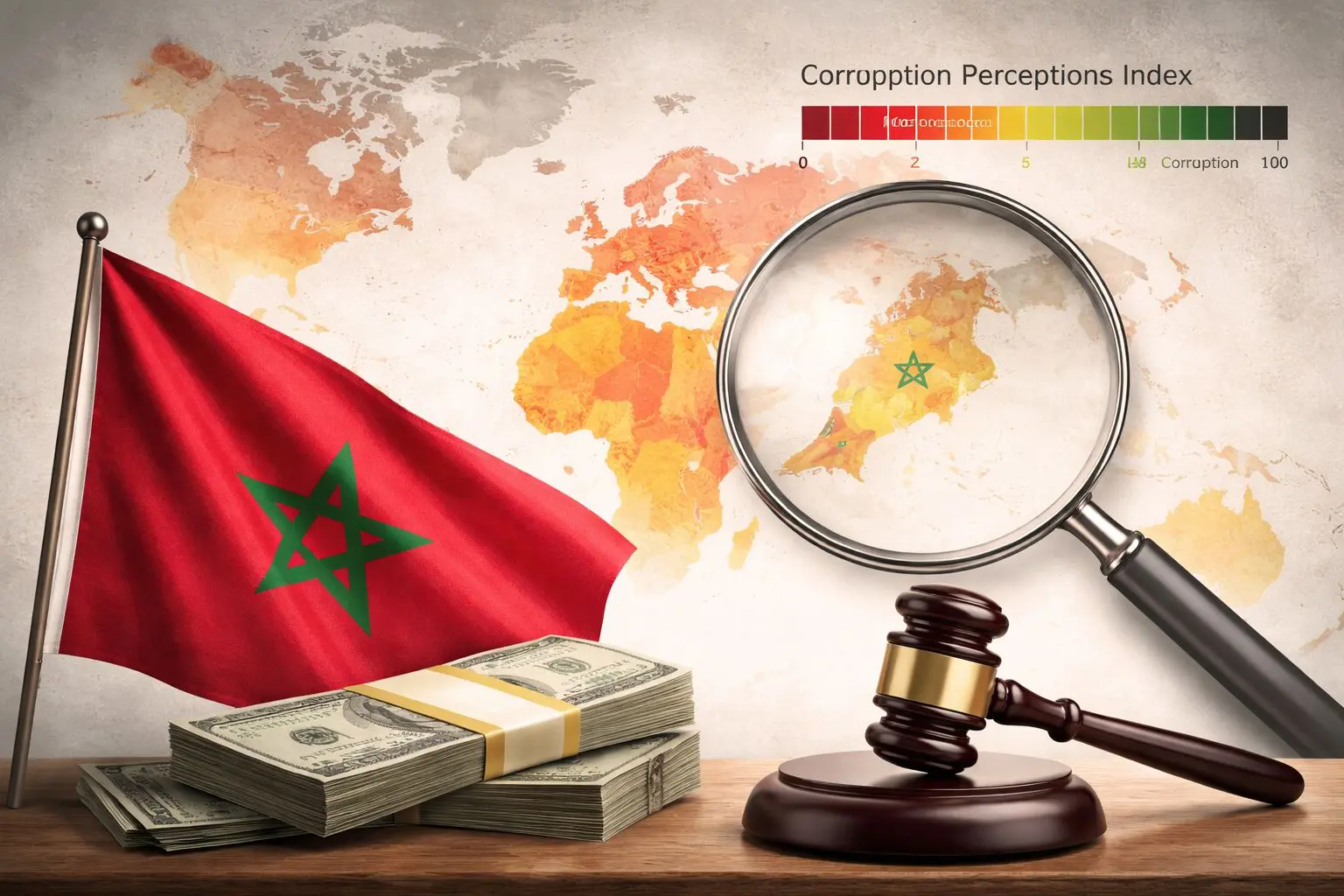
Each year, Transparency International publishes the Corruption Perceptions Index (CPI), now one of the most closely monitored global governance indicators. It is scrutinized not only by investors and credit rating agencies, but also by multilateral lenders, European institutions, and strategic policymakers.
The 2025 CPI confirms a structural global trend: institutional credibility has become a component of power.
The index ranks 182 countries and territories on a scale from 0 to 100, where 0 reflects a perception of extreme public-sector corruption and 100 indicates very high integrity. The global average now stands at 42. More than two-thirds of countries score below 50, meaning that institutional fragility is no longer the exception — it is the norm.
The CPI does not measure “real corruption” in a criminal-law sense. It does not count prosecutions or scandals. It aggregates expert assessments and business surveys to measure perceived institutional reliability: judicial independence, transparency in public procurement, strength of oversight mechanisms, safeguards against conflicts of interest, and the ability to sanction misconduct. In international economic decision-making, perception of reliability is often as decisive as objective reality.
In this global landscape, Morocco occupies an intermediate position.
- Morocco scores 39/100, ranking 91st out of 182 countries.
- Algeria scores 34/100, ranking 109th.
- Tunisia also scores 39/100, ranking 91st, tied with Morocco.
The ranking therefore places Morocco neither in a crisis category nor among institutional leaders. It situates the country in what could be described as a structural grey zone: politically stable, economically active, but institutionally perceived as average.
Over the past decade, Morocco’s score has fluctuated between 36 and 40. There has been no collapse — but no structural breakthrough either. For a country that aspires to strengthen its position as a European partner, an African industrial hub, and a regional diplomatic actor, stagnation carries strategic implications.
At the bottom of the global ranking, the contrast is stark. Venezuela scores 10 (180th), Somalia and South Sudan score 9 (joint 181st), Yemen scores 13, Libya 13, and Syria 15. In these cases, corruption is not a dysfunction — it is systemic, often intertwined with conflict, institutional breakdown, or political capture. The state becomes an instrument of survival rather than a regulator.
At the top of the ranking, institutional robustness translates into strategic advantage. Denmark leads with 89, Finland follows with 88, Singapore ranks third with 84, followed by New Zealand, Norway, Sweden, Switzerland, Luxembourg, the Netherlands, and Germany — all above 77. These countries are not free of corruption, but they are perceived as structurally reliable. Judicial independence, transparent budgeting, active oversight, and enforceable accountability mechanisms create predictability. Predictability creates trust.
The Middle East offers an instructive comparison.
- The United Arab Emirates scores 69/100, ranking 21st globally.
- Saudi Arabia scores 57/100, ranking 45th.
- Qatar scores 58/100, ranking 41st.
- Bahrain scores 50/100, ranking 56th.
- Kuwait scores 46/100.
- Iraq scores 28/100, ranking 136th.
The gap between the UAE and Saudi Arabia — 12 points — reflects differences in perceived administrative efficiency and regulatory predictability rather than regime type. The UAE has invested heavily in digital governance, streamlined public services, and administrative execution capacity. Saudi Arabia has undertaken modernization reforms under Vision 2030, yet remains perceived as more centralized and less institutionally transparent in certain decision-making spheres. The CPI rewards reliability and predictability more than formal political structure.
Why does this matter for Morocco?
Because institutional perception influences economic and diplomatic positioning.
Investors rarely withdraw from a country solely because of a CPI score. But a score below 40 typically triggers enhanced due diligence, stronger contractual safeguards, longer negotiation cycles, and potentially higher risk premiums. Over a decade, these micro-adjustments accumulate. The cost of capital, the speed of project approval, and the selection of regional headquarters can all be subtly influenced by institutional credibility.
For Morocco, the implications extend beyond investment.
The Western Sahara issue has evolved into a multi-layered geopolitical arena. Rabat has invested heavily in infrastructure and development in its southern provinces, asserting sovereignty while expanding economic integration. Meanwhile, the Polisario Front has increasingly shifted the battleground to European legal institutions, challenging EU–Morocco agricultural and fisheries agreements before the Court of Justice of the European Union.
In this context, the conflict is no longer confined to territorial dispute. It has become intertwined with legal arguments about representation, consultation mechanisms, and resource governance. The European Parliament, particularly attentive to rule-of-law and governance indicators, plays an influential role in shaping the political climate around such agreements.
Institutional perception therefore becomes part of the geopolitical equation.
The CPI does not determine court rulings. But it influences the broader interpretative environment in which legal and political debates unfold. A country perceived as institutionally robust benefits from narrative credibility. A country perceived as institutionally average may face greater scrutiny, particularly in contested territorial contexts.
Looking toward 2035, Morocco faces two plausible trajectories.
In the first scenario, Morocco improves its score toward 45–50, crossing the psychological threshold of the global average. Such progress would strengthen its European partnerships, enhance its diplomatic argumentation regarding Western Sahara, and improve its competitive standing in attracting strategic investment.
In the second scenario, stagnation persists below 40. Stability would remain intact, but Morocco would continue to operate within a zone of moderate institutional credibility. The risk would not be immediate crisis, but relative erosion — especially in comparison to regional competitors combining financial capital with stronger governance perception.
The Corruption Perceptions Index does not dictate a country’s destiny. It shapes how that destiny is perceived.
In the contemporary international system, perception of institutional reliability is a component of power. Morocco’s challenge is not to escape instability — it is to transcend mediocrity.
Isaac Hammouch is a Belgian-Moroccan journalist and writer. Author of several books and opinion pieces, he focuses on governance issues, societal challenges, and the structural transformations shaping the contemporary world.


![[Press Release] Groundbreaking Date for the Coeur d’Alene Idaho Temple](https://i1.wp.com/newsroom.churchofjesuschrist.org/media/960x720/CoeurdAlene--Idaho-Temple-.jpeg?resize=1,1&ssl=1 "[Press Release] Groundbreaking Date for the Coeur d’Alene Idaho Temple")