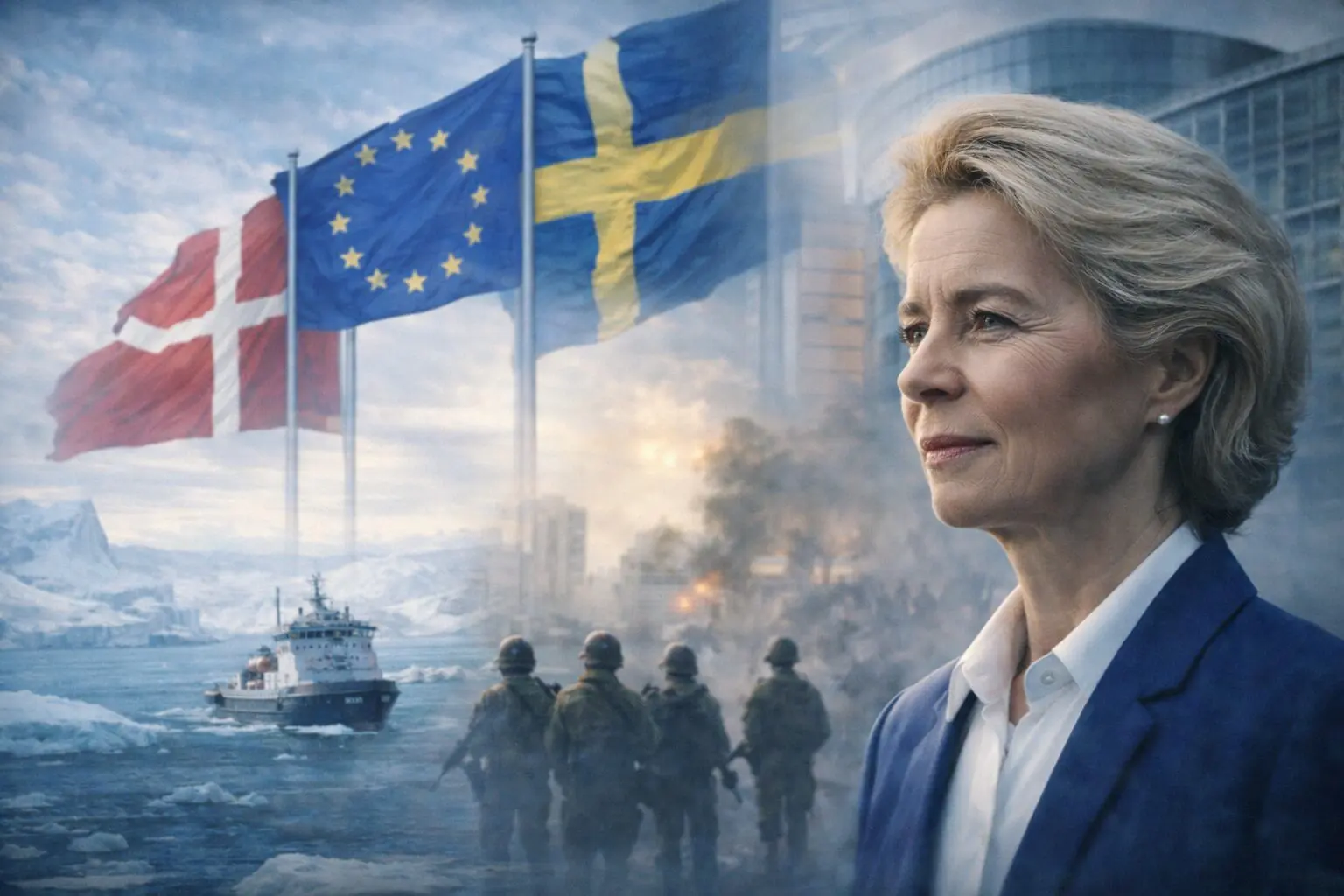
Commission president links Arctic security, transatlantic ties and a new “prosperity framework” for Kyiv ahead of an EU leaders’ retreat.
In a video statement published by the European Commission, President Ursula von der Leyen argued that Europe “stood firm” on Greenland’s sovereignty while moving to deepen transatlantic coordination on Arctic security—and pledged that the European Union will “deliver on Ukraine” as the war with Russia continues to reshape Europe’s strategic landscape.
The remarks, delivered in late January, place two geographically distant issues—Greenland and Ukraine—inside the same political frame: Europe’s security, resilience and ability to act with partners without surrendering core principles. According to a widely reported account of the Commission’s position, von der Leyen has stressed that the sovereignty and territorial integrity of Denmark and Greenland are “non-negotiable,” while the EU works on a broader package to reinforce Arctic security and investment. Reuters reported that this includes steps to strengthen European capabilities—such as icebreaker capacity—amid growing geopolitical competition in the High North.
Greenland: sovereignty, investment and Arctic security
Greenland’s strategic profile has risen sharply in EU debates on security and supply chains, as Arctic routes, energy and critical minerals draw increasing attention. In her latest messaging, von der Leyen’s emphasis is twofold: Europe will not accept pressure that undermines Greenlandic and Danish sovereignty, and it wants stronger cooperation with the United States in the region—paired with European investment and security capabilities.
That line echoes a wider pattern The European Times has tracked in recent weeks, as Brussels reacted to renewed tensions around Greenland with calls for “respect” and a firmer posture on economic and strategic resilience. (See: EU demands respect after Trump’s Greenland tariff threat.)
Ukraine: “deliver” now, shape the post-war future
On Ukraine, von der Leyen’s statement focuses not only on immediate support but also on longer-term architecture—how to anchor Ukraine’s recovery, reforms and future economic viability. A summary of her intervention published by Openrijk notes that she spoke about intensifying European support amid Russian aggression and described progress toward a “prosperity framework” that would align reforms, EU integration objectives and donor coordination.
In practical terms, the message is that the EU wants to move beyond recurring emergency packages toward a more unified framework that can reassure investors and partners, help coordinate international financing, and bind Ukraine’s reconstruction to governance benchmarks. That approach also reflects a broader EU political reality: sustaining support over time will likely depend on credible plans for oversight, predictable funding and measurable outcomes, alongside continued military and humanitarian assistance.
Why Brussels is tying these files together
By placing Greenland and Ukraine in the same speech, von der Leyen is signalling that the EU sees today’s security challenges as connected: the Arctic is no longer a remote frontier, and Ukraine is not only a battlefield but a test of Europe’s credibility and staying power. The EU’s underlying argument is that sovereignty—whether in the Arctic or in Eastern Europe—cannot be negotiated away by coercion, and that Europe needs both partnerships and its own capacity to defend that principle.
Von der Leyen also pointed to upcoming political moments—reported as including further discussion at a leaders’ retreat in February—suggesting the Commission wants member states aligned on what “delivery” means: sustained support for Ukraine, stronger European capabilities, and a clearer transatlantic posture in strategically contested regions.