
HISTORY is opening a new page to be dominated by private businesses with more power than a number of UN member states.
What will be the place of human rights?
By Willy Fautré
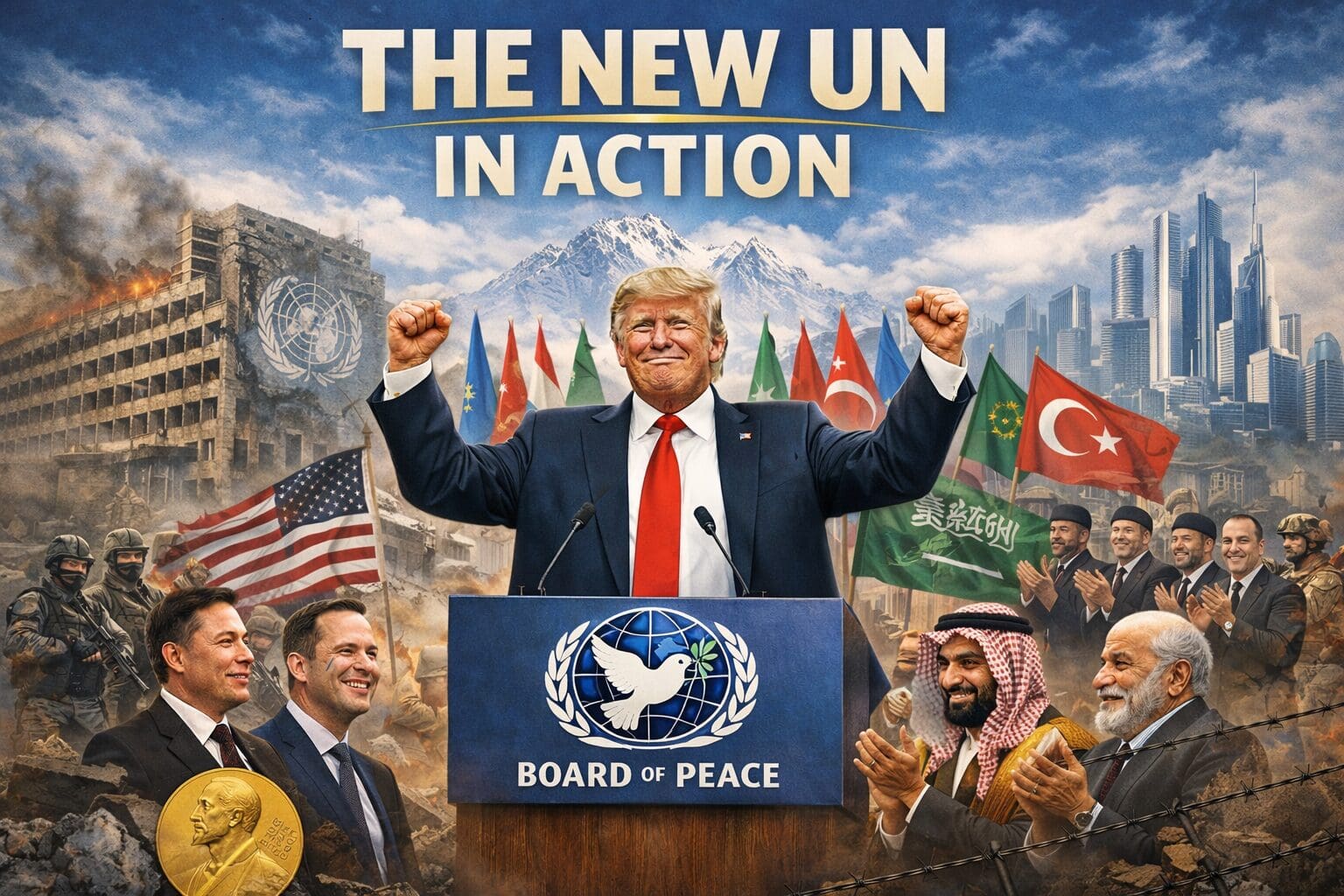
Trump made the buzz in Davos this week when he announced the creation of HIS Board of Peace to which a entrance fee has been fixed at $1 billion. No less than 25 UN member states publicly adhered to it on the very first day. An obvious challenge to the inability of the UN to resolve conflicts as in his mind, the UN only revels in words. Hence, between the lines, his message is with his well-known hubris: ”I will be the new UN, the UN in action.”
No doubt this initiative and bombshell announcement is also part of his campaign for the next Nobel Prize but if we look further to the horizon, we can see a new dawn breaking that announces heavy dark clouds.
We have just seen what Trump wanted to do with the huge territory of Greenland, a democracy, and its minerals: to buy it or to occupy it militarily by force.
More than half of UN member states have an annual gross domestic product (GDP) that is inferior to the financial power of top billionnaires and wealthy businesses, which makes them vulnerable to such predators.
Corruption by foreign powers has always existed but Trump’s last move about Greenland is a dangerous signal sent to billionnaires and wealthy private businesses. It says there is no limit to impunity under the flag or the umbrella of Trump’s administration. It shows there are many ways of buying and keeping many countries in a state of dependence or even vassalage, self-censorship, self-restraint and inaction, including in democracies.
Democracy, rule of law and human rights are words that are rarely used in the declarations and speeches of US President Donald Trump.
Trump mute about human rights in Davos
Human rights were not on Trump’s agenda at Davos. No vision for expanding or strengthening human rights globally (e.g., rights protections, civil liberties, international human-rights law). No relevant statements about the future of global human rights norms.
Some analysts and global voices have stressed that his tone and focus — on national security, sovereignty, and economic nationalism — contrast sharply with traditional human-rights-oriented leadership at forums like Davos. Calls from non-governmental organizations and some world leaders emphasized the need for a reaffirmation of rights and global cooperation after Trump’s remarks but these are just declarations.
Instead, his remarks were overwhelmingly focused on geopolitical and economic issues such as territorial claims, alliances, and criticism of European policy.
Trump and the United Nations
At Davos 2026, Trump did not focus his speech directly on the United Nations Security Council or specific UN policies, and he did not lay out a broad UN reform agenda in the primary speech that grabbed headlines.
His key remarks touching on the United Nations came through his creation of his Board of Peace, which he said would work “alongside” the UN. However, his Board of Peace which is initially supported by over 25 UN member states clearly appears to be a competitor to equivalent UN peace agencies.
Knowing Trump and his hostility towards multilateralism, it can be expected that he will follow his own agenda in priority and instrumentalize the UN if this institution is useful for himself and the US. It is only in words that he positioned his initiative as complementary to existing multilateral structures.
No vision can be expected from Trump to strengthen or reform the UN. It is unrelated to his personal and political interests.
Trump’s Board of Peace, the UN of “non-democracies”?
Members of Trump’s Board of Peace, the committee that was announced to be the overseer of the reconstruction of Gaza, will receive a permanent seat if they pay $1 billion, according to a US official.
While there is be no requirement to contribute funds, the board members who do not make a $1 billion payment will have a term limited to three years, an official told CNN.
As of 22 January, leaders from about 25 countries joined the public signing of the founding charter at Davos: Albania, Argentina, Armenia, Azerbaijan, Bahrain, Belarus, Bulgaria, Egypt, Hungary, Indonesia, Israel, Jordan, Kazakhstan, Kosovo, Kuwait, Mongolia, Morocco, Pakistan, Paraguay, Qatar, Saudi Arabia, Turkey, United Arab Emirates, United States, Uzbekistan, Vietnam.
Quite a number of these countries are not parangons of democracy, the rule of law and human rights.
Thirty other countries had been invited to join but as of the Davos Summit had not signed the membership document. Others quickly refused: France, Germany, Italy Norway, Slovenia, Sweden and United Kingdom. Others will certainly follow.
Many other UN member states had not positioned themselves before the Davos Summit.
About 120 countries and territories are potential preys of billionaires
Wealth of top 15 billionaires: From ~$342 billion to ~$101 billion
The top 15 world billionaires are, according to Forb ranking, Elon Musk, Mark Zuckerberg, Jeff Bezos, Larry Ellison, Bernard Arnaud & Family (Fr), Waaren Buffet, Larry Page, Sergey Brin, Amancio Ortega (Sp), Steve Ballmer, Rob Walton & Family, Jim Walton & Family, Bill Gates, Michael Bloomberg and Alice Walton. Apart from a French and a Spanish billionaire, all of them are American. (The Richest People in the World. See detailed statistics here: Forbs Ranking).
Wealth of top 10 richest private companies: From ~$500 billion to ~$50 billion
The top richest global private businesses are Open AI (~$500 billion), Tether (~up to $500 billion), Space X (~up to $400 billion), Bytedance (~$220–300 billion), Anthropic (~$183 billion), Databricks (~$100 billion), Stripe (~$70–92 billion), xAI (~$50–200 billion), Revolut (~$45–75 billion), SHEIN (~$45–66 billion). Source: Mainly investing.com)
The Gross Domestic Product (GDP) of 121 countries under ~$50 billion
121 countries and territories have a GDP of under ~$50 billion and can be preyed by a number of top bilionnaires and private businesses.
76 countries and territories have a GDP from close to ~$1 billion (Taiwan) to about $52 billion (Macao)
21 countries have a GDP from $30 trillion (USA) to $1 trillion (Switzerland).
Source: Worldometer)
Conclusion
The global community of private businesses has a world leader who implicitly allows them, by his own example, to disrupt the international order and to impose its law. The future of human rights looks grim and Europe is up against the wall.
The daunting mission of Europe and the 400 million Europeans is to take up the challenge, not in words but in action, with an unwavering political will and courage.