
Many animals other than birds are capable of some form of flight. Let’s take a look at some of these amazing species and their ways of soaring above the ground.
Gliders
First, let’s clarify something important – the animals in this first group can’t actually fly actively, but can only be so-called gliders. Thanks to various evolutionary adaptations, they slow their fall to the ground. However, this does not make them any less impressive.
Flying fish (Exocoetidae)
At least 40 different species of fish can “fly”. They have elongated bodies that help them gain speed underwater, and well-developed wing-like fins that allow them to glide above the ocean surface.
These fish are relatively small – they reach a maximum length of about 45 cm. Depending on the species, they have two or four “wings” and can reach speeds of up to 16 km/h in the air. This behavior is thought to have evolved as a way to avoid predators. The longest recorded flight of a flying fish was recorded off Kagoshima, Japan, lasting 45 seconds. During this time, aquatic predators such as tuna simply lag behind in pursuit.
Wallace’s flying frog (Rhacophorus nigropalmatus)
If trekking through the dense forests of Borneo isn’t adventure enough, travelers should also watch out for… flying frogs. Named after biologist Alfred Russel Wallace, this frog lives high in the trees of the tropical jungle.
When it spots prey, it spreads its webbed toes and launches itself into the air, “flying” up to 15 meters. Its huge toe pads help it land safely in its chosen spot. At about 10 cm long, Wallace’s frog is the largest of several hundred species of “flying” frogs.
Flying squirrels (Pteromyini)
It’s not just fish and frogs that can soar, some mammals have also mastered the art of gliding. This group includes about 50 species of flying squirrels.
They have a special skin membrane that stretches between their front and back legs. When they jump from a tree, the membrane stretches and traps air, allowing them to glide smoothly down.
They come in both miniature and gigantic species (up to almost a meter long from head to tail). All are nocturnal, tree-dwelling animals that rarely, if ever, touch the ground.
TRUE FLYERS
True flight, with active wing flapping and prolonged hovering, has only evolved three times outside the bird kingdom. The ancient pterosaurs were amazing, but they are long gone, leaving only two modern groups.
Bats (Chiroptera)
Bats are the only mammals that truly fly. Over 1,500 species are known. This extremely diverse group includes insectivores, fruit eaters, nectar eaters, and even three species that feed on blood.
Their wings resemble human hands – between the “fingers” is a stretched membrane. The numerous joints in the wing provide them with incredible maneuverability in the air.
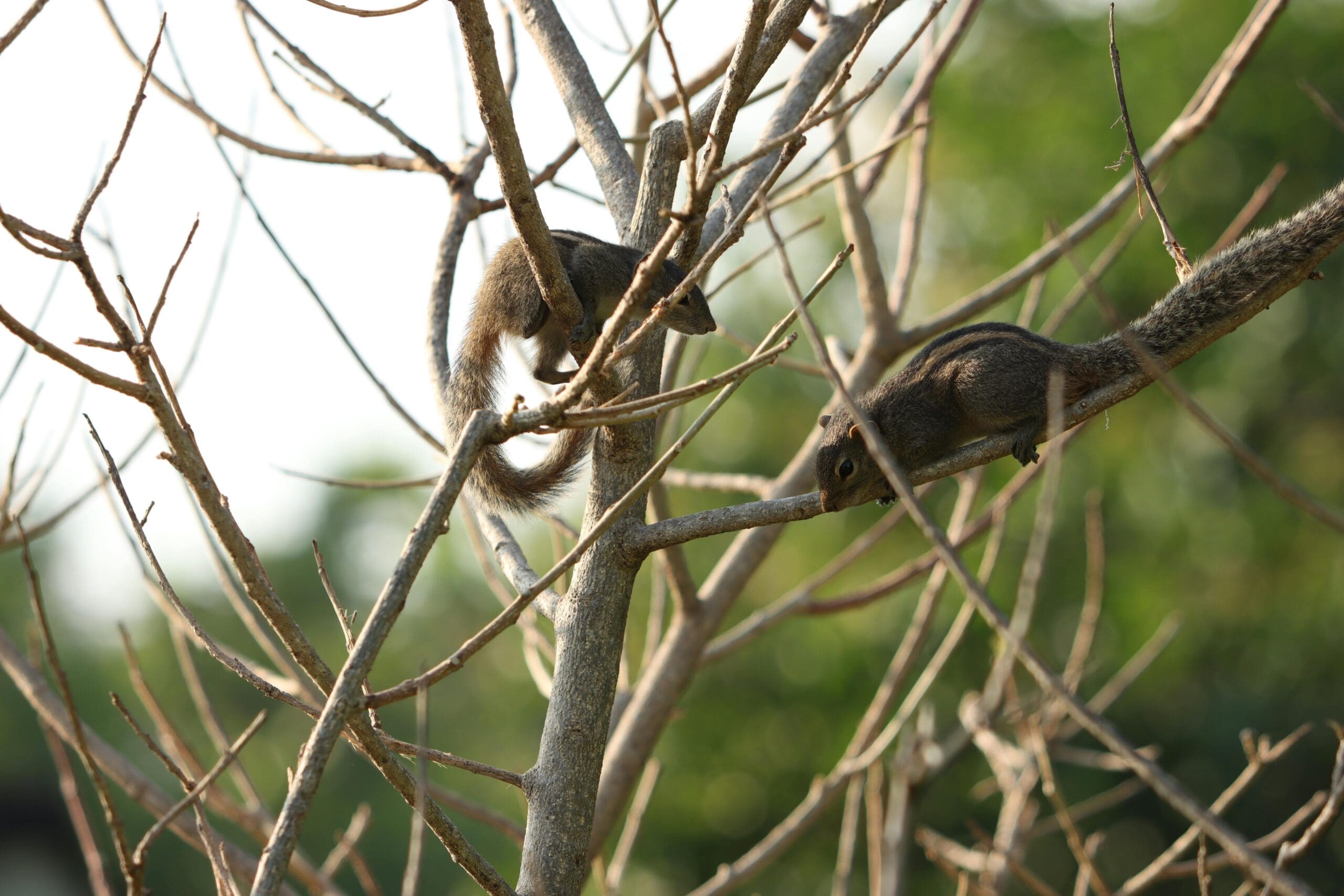
Illustrative Photo by Sampath Liyanage: https://www.pexels.com/photo/brown-squirrels-on-branches-10683775/