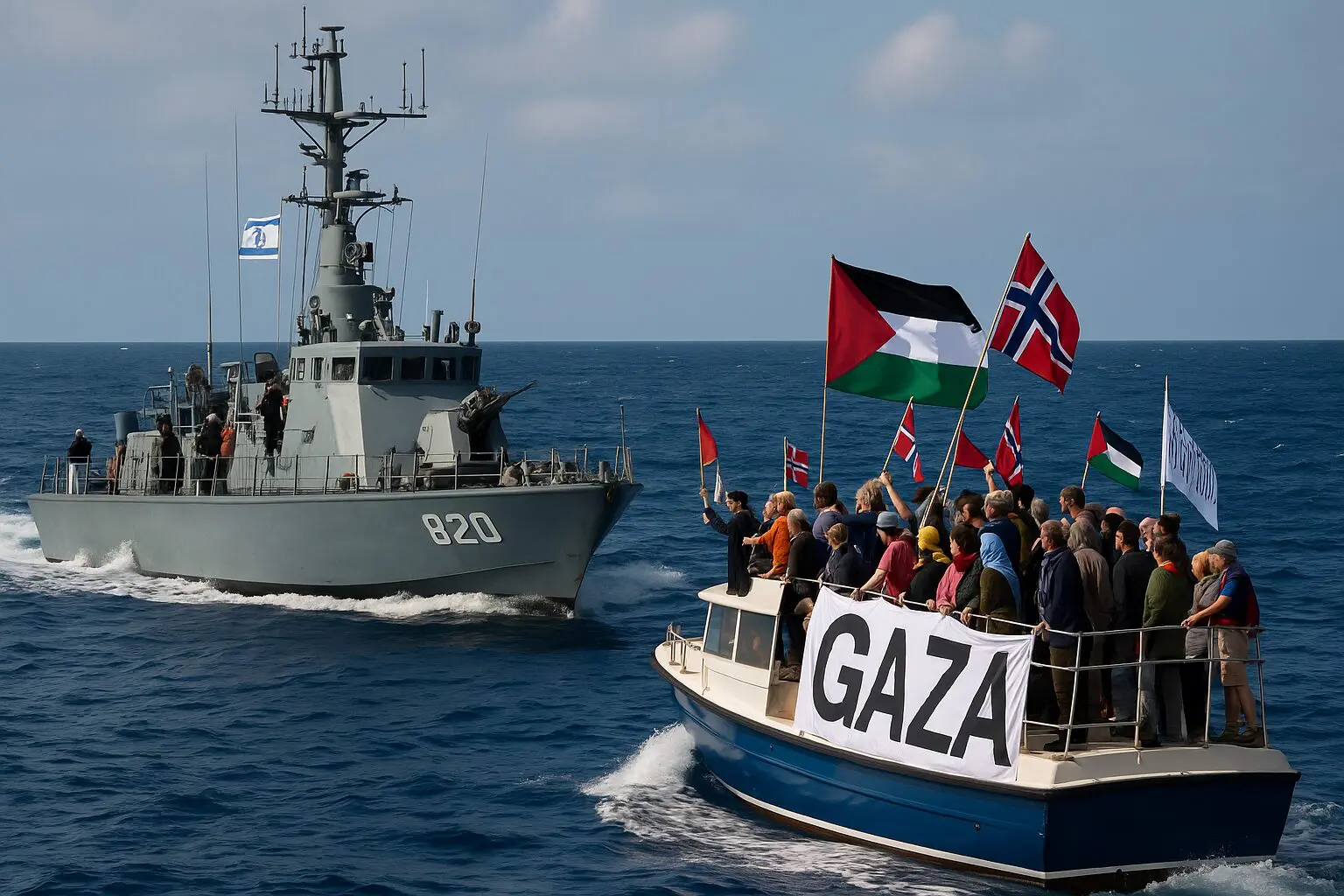
A convoy of more than forty civilian boats that set sail for Gaza under the banner of the Global Sumud Flotilla has reignited international debate about Israel’s maritime blockade and the blurred lines between humanitarian aid and political protest.
The flotilla, carrying activists, doctors, and parliamentarians from over twenty countries, aimed to challenge the blockade and deliver symbolic aid to Gaza. But within days of leaving European ports, nearly every vessel was intercepted by the Israeli Navy in the eastern Mediterranean.
Israel says it acted “in accordance with international law and security obligations.” Organizers claim excessive force and allege that hundreds of passengers were detained under harsh conditions.
Latest Developments: Arrests, Deportations, and Allegations
According to Israeli officials, the final vessel — the Marinette — was stopped about 40 nautical miles off Gaza last Friday, marking the end of the flotilla’s voyage. All passengers were detained and transferred to the southern Israeli port of Ashdod.
In recent days, Israel has deported dozens of those arrested — at least 170 activists so far — while others remain in detention awaiting flights home. Among them are citizens of Spain, Italy, Australia, and New Zealand, as well as former Barcelona mayor Ada Colau.
Several detainees have alleged degrading treatment in custody — claims that Israeli authorities strongly deny. “All detainees are treated according to the law and international standards,” said a spokesperson for the Israeli Prison Service.
Meanwhile, flotilla organizers have announced that a second, smaller group of vessels is already preparing to sail, insisting that “the sea cannot be blockaded forever.”
Israel’s Position: Security and Sovereignty
Israel maintains that its maritime blockade, in place since 2007, is a security measure designed to prevent weapons and military materials from reaching Hamas. Officials argue that the flotilla’s attempt to breach the blockade “was a deliberate provocation disguised as aid.”
Prime Minister Benjamin Netanyahu described the operation as necessary to “protect Israeli civilians from arms smuggling and terror infiltration.”
Israel also notes that humanitarian supplies can enter Gaza through approved land crossings, provided they undergo inspection. “No one is preventing aid from reaching Gaza,” an Israeli Navy statement read. “We are preventing weapons.”
Activists’ View: Humanitarian Conscience and Moral Symbolism
For the flotilla participants, however, the mission was a statement of conscience. They describe the blockade as collective punishment that has crippled Gaza’s economy and trapped more than two million people in dire conditions.
“We sailed to show the world that Gaza is not alone,” said one European lawmaker on board before departure. “This is not a political act but a human one.”
Organizers insist that all boats were inspected and carried only food, medicine, and water filters. Some accuse Israel of “criminalizing solidarity” and violating maritime law by intercepting vessels in international waters.
Global Ripples and Diplomatic Reactions
The incident has provoked strong diplomatic responses. Spain and Italy summoned Israeli ambassadors after reports that their citizens were detained and allegedly mistreated. The European Parliament is expected to hold an emergency debate later this week on freedom of navigation and humanitarian access to Gaza.
In contrast, several governments — including the United States and Germany — reaffirmed Israel’s right to defend its borders and expressed concern about the flotilla’s safety risks.
The conflicting statements reveal how the flotilla has once again become a mirror reflecting broader international divisions over Gaza — humanitarian urgency on one side, and national security imperatives on the other.
What the Flotilla Achieved — and What It Risked
Achievements:
- Renewed attention to the humanitarian situation in Gaza and the ongoing blockade.
- Global solidarity among citizens and NGOs across continents.
- Diplomatic momentum, pushing governments and media to re-examine a long-frozen issue.
Risks and Costs:
- Personal danger for hundreds of participants now facing deportation or legal consequences.
- Political backlash, with Israel framing the mission as provocation.
- Limited material impact, as the aid never reached Gaza’s shores.
An Unfinished Voyage
As the last detainees prepare to be sent home and new boats reportedly plan to depart, the Mediterranean remains both stage and witness to an unresolved story.
Was this flotilla an act of humanitarian courage — or a reckless challenge to a nation’s security line?
Does the blockade protect Israeli citizens — or perpetuate suffering in Gaza?
And can either side’s narrative ever capture the full truth at sea?
For now, the waves have settled, but the questions — moral, legal, and human — continue to drift, waiting for the world to decide which direction the next tide will take.