

By Martin Hoegger
In 2025, the Church commemorates the 1,700th anniversary of the Council of Nicaea, a decisive moment in its history marked by the confession of Jesus Christ as “true God” and “true man.” This anniversary is an opportunity not only to celebrate the faith we have received, but also to revisit the grey areas that this council left in relations between Jews and Christians. Two speakers at the Sixteenth International Congress of the International Research Network in Ecclesiology (Thessaloniki, 17-19 September 2025) addressed this issue from complementary angles: Kevin Brown, professor at Gonzaga Catholic University (USA), by questioning the possibility of an “supersessionism” (or “replacement theology”), and myself, by calling for a commemoration of Nicaea informed by Jewish-Christian dialogue. All the while keeping in mind that the current tragedy in Gaza also has profound repercussions on this dialogue.
A Church without substitution: towards a new ecclesiology
Kevin Brown starts from the observation that, sixty years after Nostra aetate, Catholicism has officially rejected “supersessionism” – the idea that the Church would replace Israel as God’s chosen people. However, even so-called “post-supersessionist” theologies remain marked by a Christocentric interpretation of Jewish salvation, risking reducing Jewish identity to a form of assimilation. Brown therefore advocates for a theology in which Christians and Jews can enter into real and profound solidarity, each being recognised in their own identity.
To shed light on this question, he points out that the boundary between Judaism and Christianity remained blurred for a long time. For centuries, there was a continuum ranging from Jews who saw no role for Jesus to pagans who “feared God” and confessed him, including hybrid identities (Jews who recognised Jesus as the Messiah of Israel). It was only in the 4th century, with imperial support and the Council of Nicaea (325), that clear boundaries were imposed.
In seeking to affirm doctrinal unity, Nicaea helped to define Christianity in opposition to Judaism and to marginalise Jews who believed in Jesus Christ. Supersessionism then became a constituent part of ecclesiology, with tragic consequences in history, fuelling contempt for Judaism and paving the way for the subsequent excesses of colonialism and Christian racism.
Vatican II attempted to break with this model. The conciliar document Nostra aetate proclaimed the irrevocability of the Covenant, and Lumen gentium emphasised the category of “people of God”. But an ambiguity remains: speaking of the Church as the people of God perpetuates the implicit exclusion of the Jewish people. To overcome this tension, Brown proposes a radical reinterpretation: the Church should not understand itself as the people of God, but as the sacrament of the people of God. It is not a replacement for Israel, but a community grafted onto it, a sign and instrument of God’s universal plan.
This approach is based on three axes: recent works that situate Paul in his Judaism and emphasise his fidelity to the Torah; a Johannine and Nicene Christology that keeps together the Jewishness of Jesus and his divinity; and a sacramental ecclesiology in which the Church is not the exclusive depositary of salvation, but a witness to God’s faithfulness to his people. Such a vision calls on the Church to recognise itself as a community of “God-fearers” in communion with Israel and to work for concrete solidarity between Jews and Christians in the search for justice, peace and brotherhood.
Reading Nicaea in the light of Jewish-Christian dialogue
In my own lecture, I recalled that Nicaea was a founding council, decisively affirming Jesus Christ as “true God” and “true man”. This confession, received and confirmed by the Reformation, remains essential to the Christian faith. But I also emphasised that this council marked a painful stage in Jewish-Christian relations. Far from the Pauline ideal of a Church bringing Jews and pagans together in a living reconciliation, Nicaea deepened the separation: refusal of conviviality between Jews and Christians, rejection of the Sabbath and Jewish festivals, break with the “Church born of the circumcision,” accentuation of an ecclesial identity constructed in opposition to Judaism.
Thus, the Christology confessed at Nicaea, while remaining faithful to Scripture, paradoxically erased Jesus’ Jewishness and his roots in the history of Israel. The absence of any mention of the Jewish people in the creed illustrates what Mark Kinzer calls a “substitution by omission.”
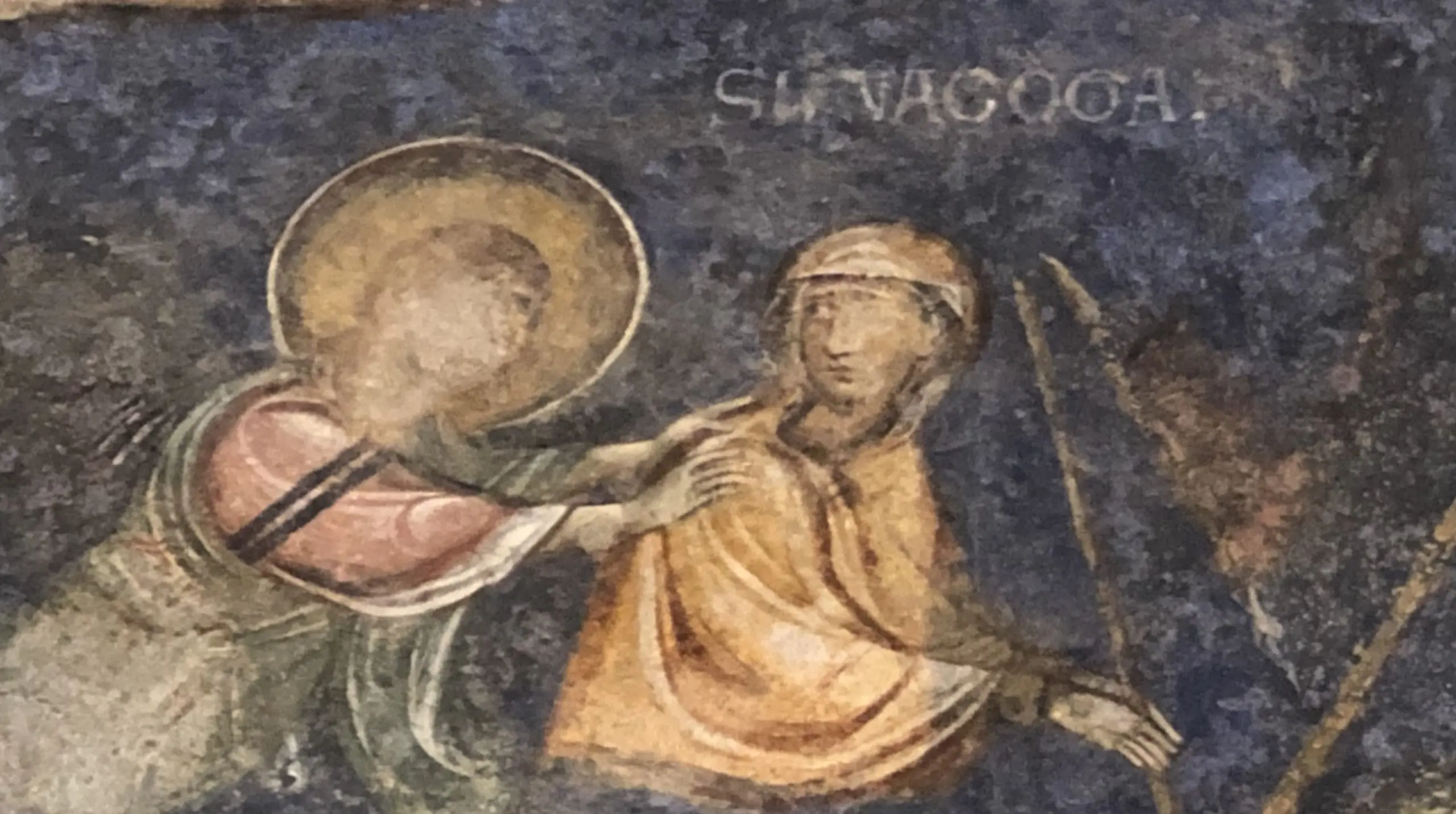
In the church built by the Crusaders in the 11th century at the Benedictine monastery of Abu Gosh, near Jerusalem, there are many frescoes to be seen. One of them struck me: that of an angel pushing away a woman holding a broken spear, her face marked by fear and distress. With the inscription “Synagoga”, it represents Judaism excluded by Christianity, as at the Council of Nicaea.
«As I contemplate the Synagogue, my thoughts carry me through time. Photos of Jews from the 20th century with the same look of fear and distress alongside those who hate and chase them away without the slightest hesitation,» writes Jewish painter Peter Maltz about this fresco.
But in light of the relationships P. Maltz had with the monks and nuns of Abu Gosh, he drew this sketch expressing what he truly feels. The angel now embraces the synagogue!
«My experience of the Christian religion has been marked by healing and compassion, not by a desire to reject,» said the painter following his companionship with the monks and nuns of Abu Gosh [Peter Jacob Maltz, ‘Synagoga,’ – In: Jean-Baptiste Delzant, L’église d’Abu Gosh. 850 ans de regards sur les fresques d’une église franque en Terre Sainte (The Church of Abu Gosh: 850 Years of Views on the Frescoes of a Frankish Church in the Holy Land), Tohu-bohu – Archimbaud, Paris, 2018, p. 218].
Commemorating Nicaea today therefore involves a work of remembrance and repentance: recognising the wounds inflicted, denouncing past and present manifestations of anti-Judaism, and restoring the place of the “Church born of the circumcision”, whose rebirth in recent decades is a prophetic sign for all Churches.
The jubilee of 2025 must be an opportunity for such a penitential and fraternal approach. But it must also open up a new horizon: preparing for the jubilee of 2033, which will mark 2000 years since the resurrection. This jubilee journey should lead the Church to correspond more closely to the Pauline vision: a communion in Christ between Jews and nations. As the apostle reminds us: “Welcome one another, then, as Christ has welcomed you, so that you may glorify God. Indeed, I assure you, Christ served the Jews to prove that God speaks the truth. In doing so, he confirmed the promises God made to their ancestors. At the same time, those who are not Jews praise God for his goodness.” (Romans 15:7).
Rediscovering an indissoluble bond
These two conferences, one from Catholicism, the other from the Reformed world, converge on the same conviction: we can no longer celebrate Nicaea without acknowledging its ambiguous legacy towards the Jewish people. The 1700th anniversary commemoration must be marked by repentance, brotherhood and a profound theological review. For, as Paul proclaims, “the gifts and calling of God (addressed to Israel) are irrevocable” (Romans 11:29). Rediscovering this indissoluble link between Christ, the Jewish people and the nations is the condition for the Church to be faithful to its vocation and to bear witness to God’s love for all.
Illustration: The expelled synagogue, symbolising the exclusion of Judaism in Nicaea. Fresco from the monastery of Abu Gosh, near Jerusalem
![[Press Release] Open House Begins for the Belo Horizonte Brazil Temple](https://i1.wp.com/noticias-br.aigrejadejesuscristo.org/media/640x480/ab4n68iom9si0notxvwgp6eso1k0epr22mgqj513_w3840.jpeg?resize=1,1&ssl=1 "[Press Release] Open House Begins for the Belo Horizonte Brazil Temple")
![[Press Release] AI Can Further, Not Replace, Human Relationships, Elder Gong Teaches in New Vid](https://i3.wp.com/newsroom.churchofjesuschrist.org/media/960x540/10zyjkn861765jqtreddns3ylqkdgjo9iak8r8of.jpeg?resize=1,1&ssl=1 "[Press Release] AI Can Further, Not Replace, Human Relationships, Elder Gong Teaches in New Vid")

![[Press Release] 14,600-plus US Congregations Join Sunday to Discuss Constitution, Freedoms](https://i1.wp.com/newsroom.churchofjesuschrist.org/media/960x540/48aaf5dd29b2f4f36f421163442fee3717a9485a.jpeg?resize=1,1&ssl=1 "[Press Release] 14,600-plus US Congregations Join Sunday to Discuss Constitution, Freedoms")
![[Press Release] 2025 LWF annual reports: faithful witness and committed service](https://i3.wp.com/lutheranworld.org/sites/default/files/styles/card/public/2026-06/LWF-AR-2025.png.webp?h=d1cb525d&itok=Bldgsr6l&resize=1,1&ssl=1 "[Press Release] 2025 LWF annual reports: faithful witness and committed service")