
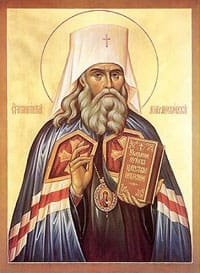
Saint Innocent (Veniaminov), Metropolitan of Moscow (August 26, 1797–March 31, 1879) the first bishop of Kamchatka, Yakutia, the Amur region and North America, a missionary, contributed to the development of the Far East and the education of its indigenous peoples.
Feast days: March 31 (April 13), June 10 (23) (Cathedral of Siberian Saints), September 23 (October 6) (Glorification), October 5 (18) (Cathedral of Moscow and All Russia Miracle Workers)
The future saint was born on August 26, 1797 in the remote Siberian village of Anginskoye, in the Irkutsk province, to the sexton of the Church of St. Elijah the Prophet, Eusebius Popov. But it was not his saintly labors in the Moscow cathedra that brought him the crown of a saint of God, although the bishop carried out this service worthily. Moreover, the metropolitan was glorified for his apostolic feat, for his zealous missionary work in the field of Christ among the peoples of the Amur region, Yakutia, Kamchatka and Alaska. Vanya Popov was not even five years old when his father began to teach him to read and write. The boy turned out to be unusually smart. By the age of eight, he was already reading the Apostle during the service in the church, and in such a way that he brought great comfort to the parishioners. At the age of six, Vanya became an orphan – his father died, and his mother, having three more little orphans on her hands, was forced to give Vanya to be raised by her late husband’s brother, Dmitry Popov. At the age of nine, Ivan was brought to Irkutsk and sent to the theological seminary there. His uncle, Dmitry Popov, had become a widower by that time and, having taken monastic vows with the name David, was also moved to Irkutsk, where he settled in the bishop’s house already in the rank of hieromonk. In his free time, Ivan often visited his uncle and always found him doing something. He especially loved to do mechanics; the nephew kept an eye on him, helped him, and finally became addicted to this business himself. So in one of the seminary rooms he installed a water clock with a chime. The wheels were made, using a simple knife and an awl, from wood, the dial from writing paper, the hands from splinters. In 1814, the rector of the seminary changed, and the new rector decided to change the students’ surnames. First of all, the unpleasant surnames were changed, then the most commonly used ones – so as not to cause confusion. Thus Ivan Popov became Veniaminov, receiving the surname in honor of the respected Bishop of Irkutsk Veniamin (Bagryansky), who died that year. In 1817, a year before graduating from the seminary, Ivan Veniaminov married and was ordained a deacon of the Irkutsk Annunciation Church. He had to serve in this rank for four years, and only in 1821 was he ordained a priest of the same church. As a priest, Father John served here for only a little over two years, but he managed to win the love of the parishioners by fervently performing the divine service and especially by the fact that on Sundays before the liturgy he gathered children in the church and gave them lessons in the Law of God. But by God’s providence, Father John was destined for a different kind of activity. At the beginning of 1823, Bishop Mikhail of Irkutsk received an order from the Holy Synod to send a priest to the Aleutian Islands (Unalaska Island), which were then part of Russian possessions, to enlighten the local non-Russians with the light of the Christian faith. However, fearing the distance and harsh living conditions, none of the clergy wanted to go. Bishop Mikhail found himself in a great difficulty: there were no volunteers, and it was impossible to send anyone by force. And suddenly Father John Veniaminov came to him and expressed a desire to go. Bishop Mikhail sadly sent such an exemplary priest away, and on May 7, 1823, Father John left Irkutsk with his family, which then consisted of an elderly mother, a wife, a one-year-old son, and a brother. It should be noted that when the Irkutsk clergy received the offer of the bishop, Father John, like other priests, did not even think of accepting it. He heard about Unalaska from a native of those places, a certain Ivan Kryukov. He told him a lot about the life there and even tried to persuade him to accept the bishop’s offer, but these persuasions did not work. Father John himself wrote many years later about how he came to want to go on such a long journey: “When this same native, Ivan Kryukov, had already said goodbye to me completely and at parting still tried to persuade me to go to Unalaska – on that very day, at his parting with the bishop (with whom I happened to be at that time), he began to talk about the zeal of the Aleuts for prayer and listening to the Word of God – then (blessed be the name of the Lord!) I suddenly and, one might say, was completely consumed with the desire to go to such people. I still vividly remember how I was tormented by impatience, waiting for the moment to announce my desire to the bishop, and he seemed surprised by this, but only said: we will see.” He went first of all to his homeland, to the village of Anginskoye, and from there by cart (a kind of barge) along the Lena River to Yakutsk. From Yakutsk the travelers had to go to the city of Okhotsk, located in the east of Siberia, on the coast of the Sea of Okhotsk. Father John and his whole family traveled this entire difficult journey of a thousand miles on horseback. And the road went along narrow paths through dense forests, and then all over there were swamps; sometimes they had to climb a long slope or a steep rocky mountain and move along its slippery, snow-covered summit… With God’s help, all these difficulties were overcome, and the travelers finally heard the dull roar of the sea waves beating against the high cliffs, little by little the masts of the ships standing on the Okhota River began to appear to them, and then the city of Okhotsk itself. After a long and difficult journey to Okhotsk, sailing from there to Unalaska seemed incomparably easy to the travelers. On July 29, 1824, more than a year later, they safely arrived at their destination.
Unalaska Island, where Father John was to settle, belongs to the group of Aleutian Islands, which, together with the adjacent territory of Alaska, were discovered by the Russians in the middle of the 18th century and soon declared Russian possessions. Their settlement by Russian industrialists, attracted by the rich fur trade, began at the end of the 18th century. At the same time, the preaching of Christianity among the natives began. At the end of the 18th century, a mission under the leadership of Archimandrite Iosaph operated here, which managed to baptize the inhabitants of Kodiak and other islands. Despite the short duration of the preaching, Christianity in these parts was very successful. It was especially zealously accepted by the Aleuts, who, due to their gentle and meek nature, willingly accepted the Christian faith, forever abandoning paganism. By the time of Father John’s arrival in the Russian possessions in North America, three more priest-missionaries were serving on different islands. Arriving on Unalaska, Father John Veniaminov found extreme poverty in absolutely all aspects of life and missionary work. There was not even a church on the island, and services were held in a dilapidated chapel. Therefore, Father John’s first concern was to build a church, which, however, turned out to be no easy task, since none of the Aleuts knew how to work, and the missionary had to first teach them carpentry, joinery and other crafts. In the finally built church, much, such as the altar and iconostasis, was made by the hands of Father John himself. At the same time, he diligently studied the Aleut language. All this helped him to engage in missionary work with great success. His constant sermons and conversations were distinguished by their simplicity and accessibility and were warmed by such a direct Christian feeling that they made a great impression and established a real filial relationship between the flock and their pastor. In addition to Unalaska, Father John Veniaminov often visited other islands, instructing his flock and preaching the Word of God among the unbaptized. It is impossible to imagine the difficulties and dangers he had to endure on such journeys, which were made on a fragile native boat in cold and bad weather. But during conversations with the Aleuts, when, according to Father John, “the most tireless preacher would sooner tire than their attention and zeal for hearing the word would weaken,” he “actively learned the consolations of the Christian faith, these sweet and inexpressible touches of grace.” Father John tells of a miraculous incident during one of these visits as follows: “Having lived on Unalaska for almost four years, during Great Lent I went for the first time to Akun Island to the Aleuts to prepare them for fasting. As I approached the island, I saw that they were all standing on the shore dressed up as if it were a festive occasion, and when I went ashore, they all joyfully rushed to me and were extremely kind and considerate to me. I asked them: why were they so dressed up? They answered: “Because we knew that you had left and were supposed to be with us today. In our joy, we went ashore to meet you.” – “Who told you that I would be with you today, and how did you recognize me, that I was Father John?” – “Our shaman, old man Ivan Smirennikov, told us: wait, a priest will come to you today, he has already left and will teach you to pray to God; and he described your appearance to us as we now see you.” – “Can I see this old shaman of yours?” – Of course, you can; but now he is not here, and when he comes, we will tell him, and he himself will come to you without us.” Although this circumstance surprised me greatly, I ignored it all and began to prepare them for the fast, having previously explained to them the meaning of the fast and so on, when this old shaman came to me and expressed a desire to fast, and walked very carefully. I still did not pay special attention to him and during confession I even forgot to ask him why the Aleuts called him a shaman. Having given him the Holy Mysteries, I let him go… And what happened? To my surprise, after communion he went to his toen (elder) and expressed his displeasure with me, namely, because I did not ask during confession why the Aleuts called him a shaman, since it was extremely unpleasant for him to bear such a title from his brothers, and that he was not a shaman at all. The toen, of course, conveyed to me the displeasure of old Smirennikov, and I immediately sent for him for an explanation. When the messengers set off, Smirennikov came across them with the words: “I know that the priest Father John is calling me, and I am going to him.” I began to question him in detail about his displeasure with me, about his life. To the question of whether he was literate, he answered that although he was illiterate, he knew the Gospel and prayers. Then I asked him to explain how he knew me, that he had even described my appearance to his brothers, and how he learned that on a certain day he was supposed to appear to you and that I would teach you to pray. The old man answered that two of his comrades had told him all this. “Who are these two of your comrades?” I asked him. “White people,” the old man answered. “Where are these white people of yours?
“And what kind of people are they and what are their appearance?” I asked him. “They live not far from here in the mountains and come to me every day,” and the old man introduced them to me as the holy Archangel Gabriel is depicted, that is, in white robes and with a pink ribbon over their shoulders. “When did these people first appear to you?” “They appeared soon after Hieromonk Macarius baptized us.” After this conversation, I asked Smirennikov if I could see them. “I will ask them,” the old man answered and left me. I went for a while to the nearby islands to preach the Word of God and upon my return I saw Smirennikov and asked him: “Well, did you ask these white people if I could see them and if they wanted to receive me?” “I did,” the old man answered. — They, although they expressed a desire to see and receive you, but at the same time said: “Why should he see us, when he himself teaches you what we teach?” — So let us go, I will bring you to them.” Then something inexplicable happened in me, some kind of fear fell upon me and complete humility. What if in fact, I thought, I see them, these angels, and they confirm what the old man said? And how will I go to them? After all, I am a sinful man, and therefore unworthy of speaking with them, and it would be pride and presumption on my part if I decided to go to them; finally, after my meeting with the angels, I might have exalted my faith or dreamed too much of myself… And I, as an unworthy person, decided not to go to them, having first given a decent instruction on this occasion both to the old man Smirennikov and to his fellow Aleuts, so that they would no longer call Smirennikov a shaman.”
Father John Veniaminov was greatly consoled by the zeal of the Aleuts for listening to the Word of God and fulfilling the commandments. Rarely among them, during his visits, would deviate from fasting and cleansing their conscience due to laziness or negligence, and since their food was always the same, they ate nothing at all on fasting days in order to mark the fast. During the service, they stood attentively and so still that one could tell by the tracks of their feet how many people were in the church. Many were great prayer warriors, which was often discovered only by chance or at their death. They had devotion and love for the priests and were ready to serve them in any way they could. With the spread of Christianity, polygamy and extramarital cohabitation began to cease, as well as the killing of slaves during the burial of noble persons. Even quarrels and fights began to occur rarely, and civil strife, which had been widespread before, ceased altogether. In addition to his flock on the islands, Father John Veniaminov also visited the village of Nushegak on the American mainland, where thirteen people were baptized on his first visit, and on his second visit the number of believers increased to two hundred and twenty.
Life among the Aleuts, constantly preaching the Word of God to them contributed to the deepening of Father John’s knowledge of the Aleut language. Later, he himself invented an alphabet for the Aleuts and little by little began to translate sacred books. Thus, he translated the Catechism and the Gospel of Matthew. The Aleuts greeted the appearance of these translations with great joy and began to diligently study literacy. Father John set up a school for boys on Unalaska and taught them himself, compiling all the textbooks.
In addition to the language, Father John diligently studied the life of his flock. Thus, he collected Aleut songs, and based on his observations of natural phenomena, he compiled a “Note on the Islands of the Unalaska Department.” Having thoroughly studied the fauna of the island, he even gave valuable advice to Russian industrialists regarding the hunting of fur seals, aimed at preserving and increasing the herd of these valuable animals.
Father John Veniaminov himself lived with his family at first in a cramped dugout, or yurt, and then moved to a modest house built with his own hands. He devoted his free time to making organ pipes, as well as talking and playing with children, his own and others, whom he loved very much and was very gentle with.
In such care and tireless work, Father John Veniaminov spent ten years on Unalaska. During this time, he converted all the inhabitants of the island to Christianity. The work and exploits of Father John Veniaminov could not go unnoticed by his superiors, and he was awarded a pectoral cross and transferred to Sitkha Island, in Novoarkhangelsk – the administrative center of Russian possessions in North America, to educate another people – the Koloshi.
Father John’s new flock was very different from the Aleuts both in appearance and character. Unlike the ugly, awkward, but kind Aleuts, the Koloshi were quite beautiful: they had large black eyes, regular features, black hair, and average height. They were proud and vain by nature. When visiting Russians, they put on their best clothes and behaved with great dignity. They were very vengeful: if a Koloshi for some reason could not avenge an insult during his lifetime, he bequeathed his revenge to his descendants. There could be no talk of preaching Christianity among the Koloshi, since they treated Russians with great suspicion.
Arriving at Sitkha, Father John first began to study the language and customs of the Koloshi. Soon a special incident changed the attitude of the Koloshi towards the Russians. An epidemic of smallpox began on the island, from which the Koloshi, who refused to be vaccinated by the Russians, died in large numbers. Meanwhile, the Russians and Aleuts, who were vaccinated against smallpox, remained unharmed. This forced the Koloshi to ask the Russians for help, and after their salvation, they stopped looking at them as their enemies. This opened up the opportunity to preach Christianity. And although the conversion of the Koloshi was slow, they treated the preachers with respect and did not hinder those who wanted to be baptized.
Father John spent five years on the island of Sitka. His entire fifteen-year activity, first on the island of Unalaska and then on Sitka, was distinguished by the same zeal that had made the preachers of the Gospel famous in ancient times. He always took up his work with great caution and thus attracted the rough hearts of the savages; he tried to persuade rather than to compel, and patiently waited for a voluntary desire to be baptized. He organized schools for children, in which he taught from textbooks he himself had compiled. Finally, in addition to enlightening them with the light of the Gospel, he taught the natives the crafts of blacksmithing and carpentry, and taught them how to inoculate against smallpox. In doing so, he gained a warm disposition towards himself: the savages loved him. And he was truly their benefactor and mentor. During his stay on Sitkha, Father John began writing the book “Notes on the Kolosh and Kodiak languages and partly on other dialects in the Russian-American possessions,” which, like the grammar of the Aleut language, received flattering reviews from specialists and contributed much that was new to science. Many years of experience in the matter of spreading the Word of God convinced Father John that with the scattered native settlements and the ever-increasing number of baptized, it was difficult to maintain the spirit of Christianity in the flock. This required constant preaching, which was impossible given the small number of priests and the lack of funds. The decision on this depended on the higher authorities, therefore, it was necessary to bother. In addition, he had to personally ask for permission to publish sacred books in the Aleut language. For this purpose, Father John decided to go to St. Petersburg. Having made this decision, John took a vacation and, having sent his wife and children to their homeland in Irkutsk, sailed from Sitka Island on November 8, 1838. His voyage lasted about eight months. On June 25, 1839, he arrived in St. Petersburg. Upon arrival in the capital, Father John appeared at the Holy Synod that same day and his stories excited the interest of its members. However, the efforts at the Synod lasted for several months, which Father John did not waste in vain. He began collecting donations for the spread and establishment of Christianity in the Aleutian Islands and went to Moscow for this purpose. In Moscow, he appeared to His Grace Philaret, then Metropolitan of Moscow. The saint fell in love with the hard-working preacher at first sight. “There is something apostolic in this man,” he said of Father John. They often talked alone in their free time, and the saint listened with pleasure to Father John’s wonderful stories about his life among the Aleuts. In the fall, Father John returned to Petersburg, where the Holy Synod’s decision to increase the number of clergy and church servants in Russia’s American possessions awaited him. He was also allowed to print his translations, and, in addition, for his many years of apostolic labors he was awarded the title of archpriest. But not only joyful news awaited him in Petersburg; from Irkutsk they reported the death of his wife. This grief struck him hard. Metropolitan Philaret, consoling him, convinced him to take monastic vows. But because of the burden of a large family and the impossibility of fulfilling all the requirements of the monastic charter during missionary travels, Father John did not agree immediately. When, at the request of Metropolitan Philaret, his children (he had six of them: two daughters and four sons) were placed on state support, he, seeing this as an indication from God, submitted a petition for monastic tonsure. The tonsure was performed on November 19, 1840, with the naming of the name Innocent, in honor of the saint of Irkutsk. The next day, Hieromonk Innocent was elevated to the rank of archimandrite. Meanwhile, the Holy Synod decided to form a new diocese, which included the Aleutian Islands. The question arose about appointing a bishop to the new position. Emperor Nicholas Pavlovich was presented with a list of three candidates, among whom was Archimandrite Innocent. The Tsar wished to see him. Having caressed the newly appointed archimandrite, the Emperor said to him at parting: “Tell the Metropolitan that I wish for you to be appointed bishop of the new diocese.” Innocent’s consecration as Bishop of Kamchatka, the Kuril Islands, and the Aleutians took place on December 15, 1840, in the Kazan Cathedral. “I firmly hope and believe,” Innocent said during his consecration as bishop, “that the Lord, who has guided me for so long and now gives me a new lot of service by His grace, will also grant me new strength to fulfill my service. I pray to you, God-chosen fathers and heads of the Church on earth! Accept me in your prayers and pray to the Lord, may His grace and mercy always be with me.” On January 10, 1841, Bishop Innocent had already left St. Petersburg for his place of service on Sitkha Island, in Novoarkhangelsk, where his place of residence had been designated. Bishop Innocent made his return journey through Siberia. On the way, he stopped in Irkutsk. One can imagine with what feeling Bishop Innocent entered his hometown and with what reverence and joy the residents of Irkutsk greeted their former priest. Crowds of people greeted him upon his entry, all the churches greeted him with the ringing of their bells. The Bishop visited the Annunciation Church, where he had previously served as a priest, and celebrated the liturgy there with a thanksgiving service. Leaving Irkutsk, he stopped at his birthplace in the village of Anginskoye, went into the hut where he was born and spent his childhood, visited his old acquaintances and, after serving a service, set off on a long journey, accompanied by the good wishes of his fellow countrymen. Finally, on September 27, 1841, after a tiring and long journey, Innokenty safely arrived on Sitka Island.
Now, with the adoption of the new title, the scope of Bishop Innocent’s educational activities greatly expanded. He began by opening new parishes, where there had been a severe shortage until then. When placing priests in newly opened parishes, the bishop gave them the most detailed instructions and convinced them to act by the power of the preaching word, and not by coercion or enticing promises.
The conversion of the natives was also successful and almost without any insistence from the missionaries; on the contrary, those seeking baptism were subjected to the most severe testing. Particularly comforting for the missionaries were the conversions of those pagans who at first resisted conversion, and then came themselves with a plea for baptism.
In places regularly visited by missionaries, the population especially zealously followed their instructions. There were almost no cases of falling away or returning to shamanism, and if they did occur, they soon ended in repentance and correction. There were also cases of miraculous healing after baptism. Thus, one old woman, being at death’s door, wished to be baptized, but since she could no longer walk, she was brought to the sacrament on a stretcher. After baptism, she returned home on her own, leaning only on a stick. Likewise, a young man, who had suffered from fits of madness since childhood, was completely healed after baptism. Needless to say, such cases, testifying to the Divine power of Christianity, especially contributed to the conversion of the natives. In addition to preaching and instruction in the Law of God, Bishop Innocent ordered the missionaries to teach children and all those who wanted to read and write both in the local and Russian languages, which the population did very willingly, and soon the literacy of the native population became even higher than the literacy of the population of native Russia. Having lived in Novoarkhangelsk for about seven months, the bishop set off to survey his diocese. On every island, in every village, he was received with the greatest triumph and joy, and nowhere did he leave the inhabitants without archpastoral edification. His diocese was extremely vast and embraced numerous peoples living on the American continent, the Aleutian and Kuril Islands, Kamchatka and the coast of the Sea of Okhotsk. Thus, on his first trip around the diocese, he covered more than five thousand miles, sometimes by sea and sometimes by dog sled. He made three such trips to survey the diocese, during which he diligently inspected newly established parishes, consecrated churches, personally taught the Word of God to foreigners and, where possible, organized schools for children.
For his fruitful missionary work among the peoples of the distant outskirts of Russia, Bishop Innocent was elevated to the rank of archbishop in 1850.
During his travels around the mainland of Russia, Archbishop Innocent also visited the Yakuts and Tungus, who, due to their remoteness, had never been visited by their archpastors. The archbishop had been familiar with these peoples since childhood, when he encountered them in his homeland, in the village of Anginskoye and in Irkutsk. The consequence of such care was that the Yakutsk region was removed from the Irkutsk diocese and annexed to the Kamchatka diocese. For this reason, Bishop Innocent had to change his place of permanent residence and move to Siberia, to the city of Yakutsk. Archbishop Innocent faced new missionary work here. The Yakuts, accepting baptism mainly because of gifts and some privileges, remained almost completely ignorant of Christianity and, due to the rare visits of their priests, often retained their former pagan beliefs and customs. True to his principles, Archbishop Innocent immediately set about educating the country, opening churches and chapels, translating sacred and liturgical books into the Yakut language, for which he organized a special commission. Despite the difficulties of this translation, the commission successfully coped with its task, and on July 19, 1859, a service in the Yakut Trinity Cathedral was held for the first time in the Yakut language. The bishop himself served a prayer service and read the Gospel. The Yakuts were so touched by this event that their elders, on behalf of all their brothers, presented a request to Bishop Innocent that this day would forever become a holiday. In addition, work was carried out to translate sacred and liturgical books into the Tungus language.
Despite his advanced years, the archbishop almost constantly undertook trips around his even more expanded diocese, often exposing himself to various kinds of hardships and dangers. On one of these trips, while in the port of Ayan, he was almost taken prisoner by the English, who, in connection with the Crimean War, attacked the Russian Far Eastern possessions. The bishop convinced the English not to take him prisoner, since there would be no benefit to them from this, that by being forced to feed him, they would only suffer losses. The English not only left him alone, but even freed one priest they had captured earlier. Archbishop Innocent’s missionary zeal extended to more distant peoples living along the Amur and even beyond the border with China. As a man devoted to his homeland, taking its interests to heart and caring about its greatness, he showed great concern for a favorable resolution of the Amur issue for Russia. To this end, he himself undertook a journey along the Amur and compiled a detailed note, “Something about the Amur,” in which, based on personal observations and surveys, he substantiated the possibility of navigation along the Amur and the settlement of its banks. Archbishop Innocent’s assistance in annexing the Amur to Russia was highly valued: the city of Blagoveshchensk was named in his honor — in memory of the beginning of his priestly service in the Annunciation Church in Irkutsk.
At the end of June 1857, Archbishop Innocent was summoned to St. Petersburg to attend the Holy Synod. His participation in the work of the highest body of church administration helped to successfully resolve the issue of opening a vicariate in Sitkha and Yakutsk. It was decided to transfer the cathedra to Blagoveshchensk. Returning from St. Petersburg, Bishop Innocent moved to Blagoveshchensk, where he continued his ministry just as tirelessly and zealously, tirelessly caring for the maintenance of Orthodoxy in the diocese. From here he also undertook frequent journeys along the Amur and other regions for personal supervision and instruction of newly converted people. But his advanced years and poor health forced him to think about rest. But it was not for rest from his labors, but for new activity that God’s Providence prepared Archbishop Innocent. In 1867, Metropolitan Philaret of Moscow died and Archbishop Innocent was appointed to replace the deceased. Bishop Innocent himself was more shocked by this news than anyone else. After reading the dispatch, his face changed and he was lost in thought for several minutes. Then he remained alone all day, and at night he prayed long and earnestly, kneeling. He marveled at his own fate: the son of a poor village sexton, who at one time could not have become a sexton, in his father’s place, became the successor of the great archpastor, one of the first hierarchs of the Russian Church – the Metropolitan of Moscow!
With deep humility, His Grace Innocent accepted his new appointment and began to prepare for his journey. It is unnecessary to say with what a feeling of joy and reverence the inhabitants of the Siberian cities through which he had to pass on his way to Moscow greeted him. For the first time in their lives they saw a metropolitan. With special solemnity they greeted Metropolitan Innocent in his native Irkutsk, where due to the muddy roads he stayed for quite a long time and several times celebrated the liturgy in concelebration with other bishops. Finally, on the evening of May 25, 1868, the ringing of bells throughout Moscow announced the arrival of its new archpastor in the capital. The next day, His Eminence Innocent, Metropolitan of Moscow and Kolomna, entered the Great Dormition Cathedral, on the steps of which he delivered a speech full of true humility. “Who am I,” he said, “who dares to accept both the word and the authority of my predecessors? A disciple of the most distant time, of the most distant land, and having spent more than half my life in a distant country; nothing more than a humble worker in the field of Christ, a teacher of infants and infants in the faith.” With such humility did His Eminence Innocent enter into his new ministry. He was already over seventy years old, he was depressed by illness, almost blind, but still he was filled with strength and zeal for activity. In the midst of his new concerns, he did not forget his missionary calling. He founded a missionary society with the aim of preaching the Gospel in the outskirts of Russia. Opened in Moscow in January 1870, it met with great sympathy in all corners of Russia. Corresponding committees were opened in many dioceses. But his main concern remained the instruction of the people in the truths of the Christian faith and morality. However, in the midst of all his pastoral labors and concerns, old age and physical ailments made themselves felt. The Metropolitan twice petitioned for retirement, but his requests were rejected. For some time he had to give up traveling around the diocese, which his vicars now did for him. From mid-1878, Metropolitan Innocent was almost constantly ill and even cancelled a trip to St. Petersburg at the end of that year to attend the Holy Synod. During Holy Week, feeling the approach of death, he asked for unction.
He received communion for the last time on Holy Thursday. On March 30, 1879, he asked for the Most Reverend Ambrose (later Bishop of Kharkov) to read the canon for the departure of the soul, and on March 31 at 2 a.m. he passed away.
“Let me know,” said the bishop, dying, “that there should be no speeches at my burial, for they contain much praise. But tell me that a sermon about me may have edification, and here is the text for it: “from the Lord the steps of man are ordered” (Psalm 36:23).” The next day at eleven o’clock in the morning the bell of Ivan the Great announced to Muscovites the death of their saint, and on April 5 the body of the deceased was committed to the earth next to the grave of Metropolitan Philaret in the Trinity-Sergius Lavra. The Lord does not abandon His righteous ones and, preparing a place for them in the Kingdom of Heaven, takes care of their glorification among His faithful children under the omophorion of the earthly Church. In March 1974, at a meeting of the Holy Synod of the Orthodox Church in America, the question of canonization of the ever-memorable enlightener of Alaska, Metropolitan Innocent (Veniaminov) of Moscow and Kolomna was raised. On May 8 of that year, American hierarchs appealed to the Mother Church in Moscow with a request to study the question of the possible canonization of Metropolitan Innocent, if the Holy Spirit and the Holy Synod of the Russian Orthodox Church so deigned. Three years were spent studying the evidence carefully collected in the United States and in the saint’s homeland about his life and equal-to-the-apostles works. And on September 23 (October 6, new style) 1977, the Holy Synod of the Russian Orthodox Church, giving glory and praise to the Lord, determined: to add the ever-memorable Metropolitan Innocent, Saint of Moscow and Apostle of America and Siberia, to the ranks of the saints glorified by the grace of God, and to celebrate his memory twice a year – March 31, the day of his blessed death, and September 23 – the day of his glorification. On June 10, the memory of Saint Innocent is celebrated together with all the Siberian saints glorified in 1984.