

In the serene heart of northeastern Bulgaria, ensconced on the right bank of the Danube, the city of Ruse—often called “Little Vienna” for its elegant 19th- and 20th-century Neo-Baroque architecture—opened its doors this August as host to a luminous experiment in interreligious peacebuilding and youth leadership, marking a rare alignment of global networks and local governance. From August 4 to 8, 2025, the international youth camp “Rivers of Peace 2025” unfolded in Ruse, not simply as a gathering, but as a stage upon which the United Religions Initiative (URI, the world’s largest grassroots interfaith organization), URI Europe, and the Eastern European dialogue association “Мостове”—translated as “Bridges” in English—joined hands with the Municipality of Ruse to craft moments of deeper understanding, creative collaboration, and hope among 40 young people from six countries.
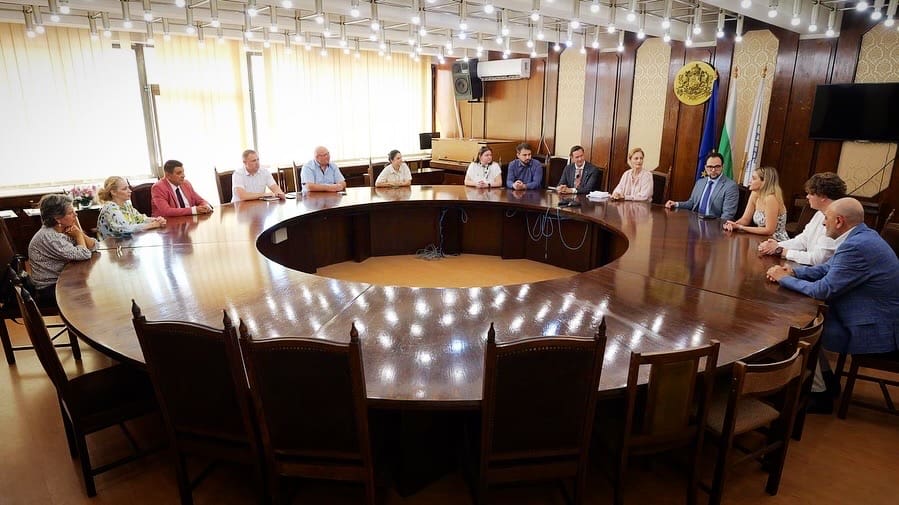
Under the stewardship of acting Mayor Nikola Lazarov and with the essential backing of the municipality, “Rivers of Peace 2025” became more than a camp: it became a vivid testament to what can emerge when international peace networks and local civic leadership coalesce around youth, dialogue and culture. At the opening of the camp, the presence of Nikola Lazarov, along with deputy Mayors Encho Enchev and Dimitar Nedev, as well as department heads and Senior expert Tanya Todorova, Miglena Voinova and Desislava Peeva, signaled that URI’s agenda for interfaith conversation and inclusive citizenship found not only a venue, but ardent support from Ruse’s civic sphere.
The camp presented a meticulously curated program of workshops and interactive activities exploring themes thoughtfully chosen for their resonance with both the global reach of URI and the cultural contours of Ruse: interreligious dialogue, social and ecological justice, youth leadership, and the arts as a medium for peace. Forty young participants, aged 15 to 17, guided and inspired by nine facilitators aged 18 to 25, engaged in simulations, debates, and creative collaboration—models of exchange that transcended linguistic, religious and national boundaries.

One of the most exciting moments of the program was the encounter and joint workshop with His Royal Highness Prince Boris Saxe-Coburg-Gotha, who presented the project “Green Energy in Motion.” Together with him, participants learned more about solar panels as a symbol of sustainable change, powered by youthful energy. His presence bridged the symbolic dimension of Bulgaria’s history with the practical urgency of ecological innovation, giving the young participants an inspiring model of how tradition and modern responsibility can converge.
The leadership at the helm of the URI organizations who joined the camp embodied the transnational flow of ideas and solidarity. Samira Fatma Baručija, URI’s Multiregion coordinator, and Daniel Error, chair of the board of URI Europe, contributed insights on how building communal leadership within and across communities serves as a foundation for a more peaceful future. Their involvement brought not just authority, but a sense of shared mission, merging local energy with global vision. Adding further prominence, Eric Roux from France—chair of the Global Council of URI—traveled expressly to Ruse, expressing that among all invitations received that summer, he selected Rivers of Peace as his destination—a gesture he described as “a bright example for the future of URI.”

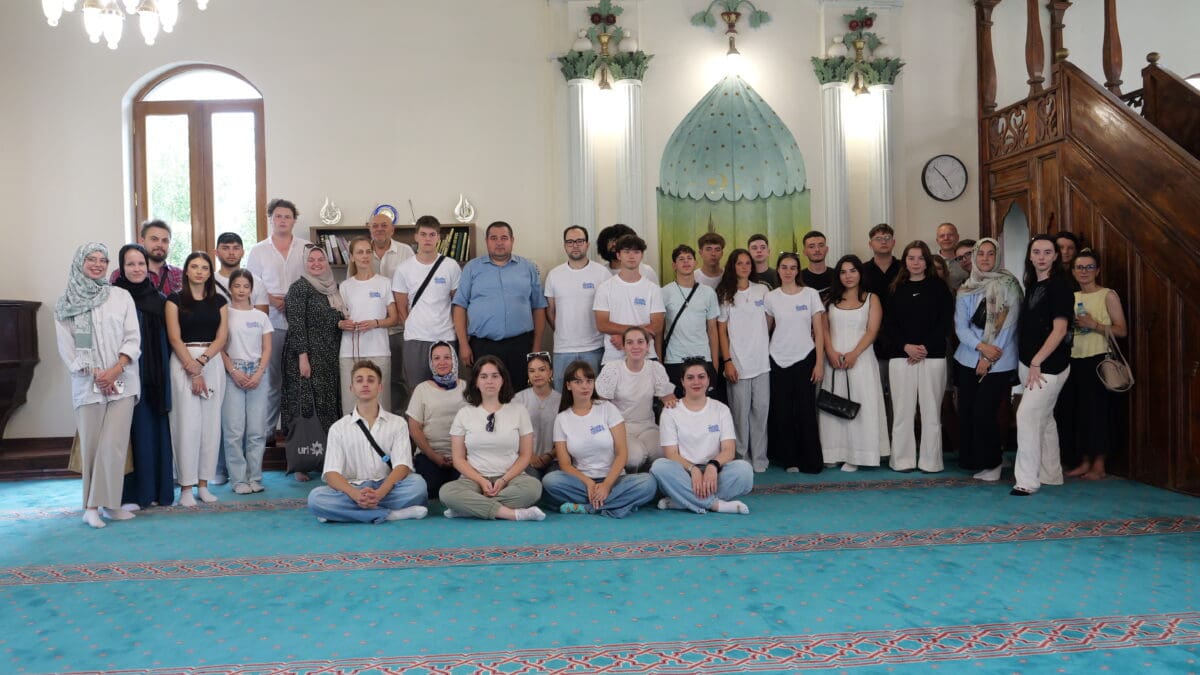
This gesture reflected both a narrative arc and a symbolic gesture: the Danube, coursing through Ruse, crossing ten countries before reaching the Black Sea, became the emblem for connection—geographic and human. That symbolism echoed through the weeks of the camp, and in the city’s historical and multi-faith fabric. Day two carried participants into the Regional History Museum and onward through three places of worship—St. Paul of the Cross Catholic Church, the Orthodox Church of St. Nicholas the Miracle-Worker, and the Said Pasha Mosque—where religious leaders Father Walter, Father Stefan, and Mufti Yücel Hayredin spoke on tradition, unity and tolerance. Together, their presence embodied interfaith friendship in action.
The collaborative spirit extended into ecological consciousness and creative self-expression. Bulgarian-Albanian facilitator duo Dimitar Borumov and Marvina Mansaku led environmental workshops, encouraging the creation of school-based green campaigns and interreligious art as a form of dialogue. Another Bulgarian-Dutch tandem—Steven Pires and Vladimir Stoychev—guided a “Leadership and Decision-Making” session, urging participants to consider how they could be “peace-builders” in their communities—a form of empowerment rooted in reflection, creativity and history.

Most remarkable, perhaps, was how the Municipality of Ruse wove natural, spiritual, and cultural threads into the camp’s fabric. Participants were taken for a symbolic boat ride along the Danube, guided by officials including Tanya Todorova and Tatyana Kyuranova of the local Municipal Commission for the Protection of Children, in a journey that connected them to the river’s role as both a physical and emotional bond among peoples. A visit to the rock-hewn St. Dimitar Basarbovski Monastery—an evocative spiritual sanctuary with roots in the Second Bulgarian Empire—offered a meditative pause in the relationship between nature and the sacred. Night-time observation of the stars, led by astronomer Ivo Dzhokin, unfolded as an intimate reminder of human wonder under the same sky. All of these experiences were captured in final performances and an art-infused concert at the Ruse Art Gallery, culminating poignantly with a rendition of John Lennon’s “Imagine.”
These immersive experiences were strategically reinforced by moments of institutional coordination. In a formal meeting, representatives of the Bridges association (“Мостове”), URI Europe, URI Global, and the deputy mayors Nikola Lazarov, Encho Enchev, and Dimitar Nedev convened to solidify a shared plan. They agreed on an enduring partnership focused on future educational, youth, and cultural initiatives, with the ambition to make Ruse a sustained platform for dialogue, tolerance, and peace.

In a city shaped by centuries of multicultural, architectural legacy and positioned at the crossroads of rivers, trade and faith, the “Rivers of Peace 2025” camp marks a turning point: here, local governance and international networks did not merely coexist—they constructed bridges of possibility. Mayor Pencho Milkov and his administration—embodied by deputy-mayors Nikola Lazarov, Encho Enchev, and Dimitar Nedev—provided not only logistical, but moral, support for URI’s goals. URI Europe, under the guidance of Daniel Error, URI Multiregion coordination through Samira Fatma Baruchia, and global continuity embodied by Global Council Chair Eric Roux, brought onward broader vision and legitimacy. Bridges (“Мостове”), with president Angelina Vladikova, rooted the initiative in regional dialogue traditions.

From the cobblestone streets and curving boulevards of Ruse to the contemplative skies over the Danube, “Rivers of Peace 2025” emerged not as a transient festival but as an invocation: global organizations and local government, standing side-by-side, can cultivate a generation shaped by dialogue, creativity, and civic courage.