David declared Solomon king, and not Adonijah, his son from Haggith, who was older than Solomon and who, without his father’s knowledge, was declared king by the priest Ebiathar and some of the military leaders and nobles (1 Kings 1:5–40). The Bible explains David’s choice of Solomon as his heir to the throne, despite the fact that he was one of the younger sons (1 Chronicles 3:1–10), not by Solomon’s outstanding qualities, but by the promise that David made to Bathsheba (1 Kings 1:13, 17, 30). Solomon was anointed king at the insistence of the prophet Nathan, who demanded that David fulfill his promise to Bathsheba while he was still alive. By David’s order, the ceremony took place near Gihon; Solomon was anointed by the priest Zadok in the presence of the prophet Nathan and other close associates of the king (1 Kings 1:32–40). Adonijah’s attempt to strengthen his position at court after David’s death provoked a sharp reaction from Solomon: Adonijah and Joab, who supported him, were executed, and the priest Ebiathar was removed to Anathoth (1 Kings 2:13–35). Apparently, Solomon ruled together with his father in 967–965 BC and only after his father’s death did he become the sole ruler. He inherited a kingdom that extended from the Egyptian border in the south to Hammath in central Syria, but did not include the territory of the Philistines (1 Kings 5:1; in the English tradition 1 Kings 4:21). Dominion over the Syrian kingdoms and over Transjordan ensured control over the trade routes between Egypt, Mesopotamia, and Anatolia, the caravan routes linking the oasis of Tadmor (see Palmyra) with Arabia (see Arabian Peninsula), and possibly the route to southern Arabia and the land routes between the Mediterranean and the Red Sea. The Bible reports that Solomon took an active part in (and possibly controlled) the exchange of goods between the northern and southern countries (1 Kings 10:28–29). Thus, horses purchased in Anatolia were sold to Egypt, and Egyptian chariots were sold to the Neo-Hittite and Aramaic kingdoms. Solomon’s participation in international trade is associated with the story of the arrival of the Queen of Sheba (see Sheba) in Jerusalem “with very great wealth: the camels were loaded with spices and a great abundance of gold and precious stones” (II Kings 10:2). Economic interests also explain the close connection between Solomon and the Tyrian king Hiram (see Tyre). “Hiram’s servants” — experienced sailors — together with “Solomon’s servants” participated in sea expeditions to Ophir, from where, as from other southern countries, apparently also from Africa, they brought gold and silver, sandalwood, ivory, monkeys and peacocks (I Kings 9:11,26–28; 10:11,22). These enterprises led to the development of Israelite maritime trade, the base of which was the port at Ezion-geber, from where the ships of both Solomon (I Kings 9:26) and Hiram (I Kings 10:11, 22) departed. In the exchange of goods between Solomon and Hiram, Tyre received grain and vegetable oil, and Israel received cedar and cypress wood and gold (I Kings 8:22–25; 9:11). Hiram’s builders, along with Solomon’s builders, participated in the construction of the Jerusalem Temple. Trade cooperation between Tyre and Israel found expression in the alliance treaty between them (I Kings 5:26; in the Russian tradition 5:12), and the Bible even tells of a personal friendship between the two rulers (I Kings 5:15–26; in the Russian tradition 5:1–12). Solomon’s relations with neighboring states were peaceful, and Solomon’s international political ties were cemented by marriages. Of particular importance was the marriage with an Egyptian princess – an exceptional case in the annals of the Egyptian pharaohs, testifying to the power of Solomon’s state. The king built a palace in Jerusalem for the Egyptian princess (I Kings 3:1; 7:8; 9:24; II Chronicles 8:11), having received Gezer from the pharaoh as a dowry. However, with the accession to the throne of the founder of the new (“Libyan”) dynasty, Sheshonk, Egypt’s attitude towards Solomon became hostile (I Kings 11:40). Although Solomon was generally successful in maintaining the integrity of the Davidic kingdom and in preventing wars, during his reign the conquered territories began to fall away. The Bible reports the rebellion of Hadad in Edom in the south, at the very beginning of Solomon’s reign (I Kings 11:14). In the north, Rezon and his people “settled” in Aram Dammesek and were “an adversary of Israel all the days of Solomon” (I Kings 11:23–25); his accession to the throne was the beginning of the process that later led to the fall of Aram from Israel. The period of Solomon’s reign was a time of economic prosperity for the country: “… silver was counted as nothing in the days of Solomon” (I Kings 10:21). Thanks to its extensive economic and political ties, Israel during Solomon’s reign for the first time became an independent factor in the material civilization of the ancient Near East, which found its expression primarily in construction. The biblical narrative, confirmed by archaeological finds, allows us to create a picture of construction work on a large scale: the majestic and richly decorated buildings of the Temple and the royal palace, the expansion of Jerusalem to the north, the construction of garrison towns where the chariot army was stationed and casemate towns throughout the kingdom and possibly in the border regions in Hammat (1 Kings 9:19; 2 Chronicles 8:2–6), public buildings such as those discovered during excavations at Beth-Shemesh and Tel Beth-Mirsim, strong city walls at Hazor, Megiddo, Beth-Shemesh and Tel Beth-Mirsim, four-columned gates at Hazor, Megiddo and Gezer, the characteristic structure of the four-room Israelite house built of hewn stone.
The creation of the administrative apparatus, which began during the reign of David, was continued by Solomon. Solomon’s list of officials includes scribes, a chronicler, a commander of the army, priests, a commander of the district governors, a commander of the palace, a royal friend, and a tax collector (1 Kings 4:1–7). The division of the kingdom into districts, which may have begun under David, was finally consolidated under Solomon: at the head of each district stood a governor, who for one month of the year had to provide the king and the royal court with everything necessary (1 Kings 4:7 ff.). The division into districts did not exactly coincide with the boundaries of the allotments of the tribes of Israel and reflected the transition to a territorial administration. Although a governor was also appointed over the tribe of Judah (1 Kings 4:19), this tribe was not included in the 12 districts on an equal basis: it formed a separate political unit along with Israel (1 Kings 4:20; 5:5, in the Russian tradition 4:25) and, apparently, was exempt from royal duties. Extensive construction and rapid economic development required a significant workforce, the mobilization of which was carried out through labor service: “And King Solomon imposed a tax on all Israel; and the tax was thirty thousand men. And he sent them to Lebanon, ten thousand a month, by turns; a month they were in Lebanon, and two months in their own house … Solomon also had seventy thousand bearers of burdens, and eighty thousand hewers of stone in the mountains”; Three thousand three hundred chiefs supervised the work (I Kings 5:27–29, in the Russian tradition 5:13–16). Heavy duties and taxes, the luxury of the royal court and the privileged position of the tribe of Judah, as well as, possibly, the concentration of the cult in Jerusalem to the detriment of traditional cult centers (in Bethel, Dan and other places) served as the cause of the rebellion of the northern tribes after the death of Solomon (see Jeruvant I). Researchers believe that already during the reign of Solomon, an economic and then a political crisis began in the country. One of the evidences of this is the fact that Solomon paid Hiram of Tyre not with gold or goods, but with cities in Galilee belonging to the Jews. The Bible explains the peace and prosperity of the country under the rule of Solomon by his extraordinary wisdom, in which he surpassed all other people (I Kings 2:6, 9; 3:11, 12; 5:9-14; in the Russian tradition 4:29-34; 10:1, 3). First of all, Solomon was considered a wise and fair judge (I Kings 3:16-28). Subsequent generations attributed to Solomon the authorship of the Song of Songs, the Book of Proverbs and Ecclesiastes. Along with wisdom, Solomon’s authority was based on his priestly function as a king-priest, who oversaw religious ceremonies, personally offered sacrifices, blessed the people, played a central role in the consecration of the Temple, etc. (I Kings 3:15; 8:1-5, 14, 22, 54-56, 62-66).
Unlike the single biographical narrative of David, the narrative of Solomon in the first book of Kings is a compilation of a number of disparate sources – state administrative lists, diplomatic archives, duty lists, fiscal and construction documents. The source of the biblical story of the construction of the Temple is most likely an original document from the time of Solomon. It should be noted that in the first book of Kings, the image of Solomon is not idealized; the Deuteronomistic editor even emphasizes his sins: Solomon not only married foreign women, but also built several pagan temples for them in Jerusalem. According to the biblical author, it was Solomon’s sins that caused the house of David to lose power over all of Israel. Unlike the First Book of Kings, in the Second Book of Chronicles Solomon is portrayed as an ideal personality – a wise king, following the precepts of faith, a true successor of David, who built the Temple and introduced regulations regarding the kohanim and Levites (see Levi). Nevertheless, despite the apologetic tendency of the author (II Chronicles), he makes extensive use of historical tradition. The latest biblical criticism is inclined to see in the biblical description of the era of Solomon elements of the idealization of this period by the Deuteronomistic editors, in whose eyes the period of Solomon’s reign was the time of the highest flowering of the Jewish kingdom under the rule of the house of David. In the Aggada, Solomon appears as the wisest of men, who understood the language of the beasts that obeyed him (Song of R. 1:1 and elsewhere); the Midrash contains numerous stories about the wisdom of Solomon’s judgment, which was so great that he did not even need witness testimony to make the right decision. Solomon’s most important deed was the building of the Temple, in which he was assisted by angels and demons (Ex. R. 54:2). At the same time, the motive of Solomon the proud is outlined, which ultimately led him to sins, because of which he gradually lost his throne, wealth and even wisdom (TI., Sanh. 2b, 20b, 21c). Legends about King Solomon were known in the Arabian Peninsula even before the emergence of Islam. In the Koran, Solomon (Suleiman) is not only the heir of David, but also a faithful servant of Allah; he was endowed with the greatest wisdom, understood the language of birds and commanded the winds and spirits. Following the Jewish Aggada and ancient legends, some of which developed in Persia (see Iran), Muslim commentators on the Koran paid considerable attention to the character of Solomon, emphasizing his wisdom and justice as a judge.
There are many works dedicated to Solomon in world literature. One of the oldest surviving works about Solomon is the Anglo-Saxon poetic legend “Dialogue of Solomon and Saturn”. In the 15th century, the anonymous German mystery “The Performance of King Solomon and the Two Fauns” and the Russian “The Tale of Kitavras”, based on the midrashic story of the construction of the Temple, were created. Among the Renaissance plays are the Spanish “Farce of Solomon” (c. 1530) by D. Sanchez, the German “Performance on the Night of Great Lent” (1550) by G. Sachs, the anonymous Italian “Performance of King Solomon” (1562), and others. Numerous dramas about Solomon were written in the 17th century, including P. Calderon’s play The Eastern Sibylla, or the Great Queen of Sheba (Madrid, 1682). Among the works of the 18th century are F. G. Klopstock’s tragedy Solomon (1764) and I. Bodmer’s religious drama The Madness of the Wise King (1776). In the 19th century, the image of Solomon inspired R. Browning (the poem Solomon and Balkis, 1833), G. Heine (the romantic poem Solomon as part of Romancero, 1851), H. Longfellow (the story Azrael – the story of a Spanish Jew in the third part of Tales from a Wayside Inn, 1872), V. Hugo (the poem Solomon, 1877) and others. Among the 20th century writers who dedicated their works to Solomon are the American poet W. Lindsay (“King Solomon and the Queen of Sheba”, 1917), the German playwright A. Paquet (“Markolf, or King Solomon and the Builder”, 1924), the Irish poet W. Yeats (“Solomon and the Witch”, 1924) and others. In Hebrew, H. N. Bialik wrote about Solomon (“And there was a day…”, 1938). In the visual arts, Solomon is one of the central biblical images. Scenes from his life are found in miniatures in Byzantine manuscripts, and in medieval cathedrals they are often found in sculptural groups and on stained glass windows. The image of Solomon was addressed by artists Van Eyck (the painting was destroyed), Mantegna, Giorgione, Rubens, Poussin, Tiepolo and others. Among the musical works about Solomon, the following are well-known: Josquin des Prez’s motet “Solomon stood” (1538) and Pietro Valentini’s 96-voice canon “Solomon’s Knot” (1631). Among the oratorios about Solomon are Carissimi’s “The Judgement of Solomon” (1669), Charpentier’s oratorio of the same name (1702), and Handel’s “Solomon” (1749), later revised by F. Mendelssohn. Handel’s hymn “Tzaddok the Priest” on the theme of Solomon’s coronation is one of four hymns written by the composer for the coronation of George III in 1727; it was performed at all English coronation ceremonies. Charles Gounod wrote the opera “The Queen of Sheba” (premiered in 1862); In 1915, E. Bloch composed a rhapsody for cello and orchestra, “Solomon” (first performed in 1917).
*Solomon (שְׁלֹמֹה, Shlomo), son of David and Bathsheba, king (c. 967 BCE – c. 928 BCE) of the Jewish state, builder of the Jerusalem Temple.
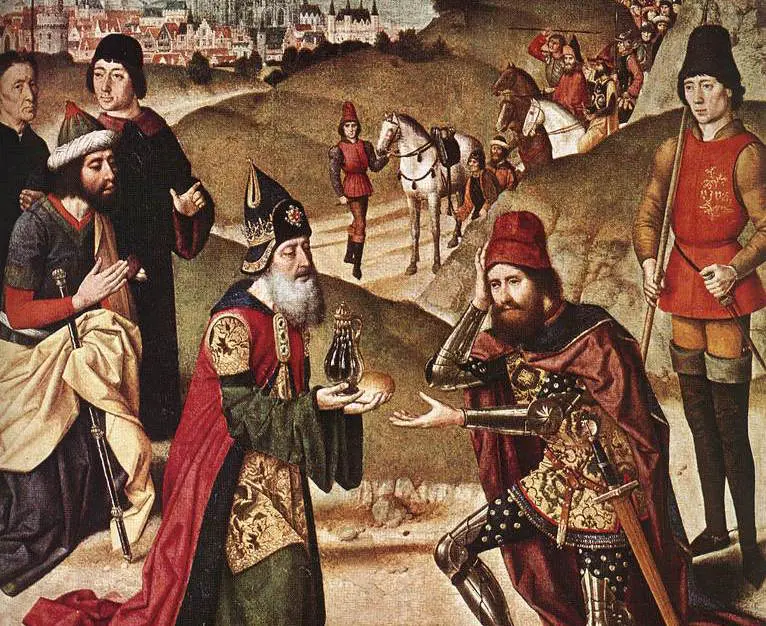
Illustrative photo: The Meeting of Abraham and Melchizedek 1464-67, Oil on panel, Sint-Pieterskerk, Leuven, by Dieric Bouts the Elder (b. ca. 1415, Haarlem, d. 1475, Leuven)
![[Press Release] The Church of Jesus Christ Feeds Families in All 50 States for America250](https://i0.wp.com/newsroom.churchofjesuschrist.org/media/640x480/20260613_1505_CSmith_0164.jpg?resize=1,1&ssl=1 "[Press Release] The Church of Jesus Christ Feeds Families in All 50 States for America250")