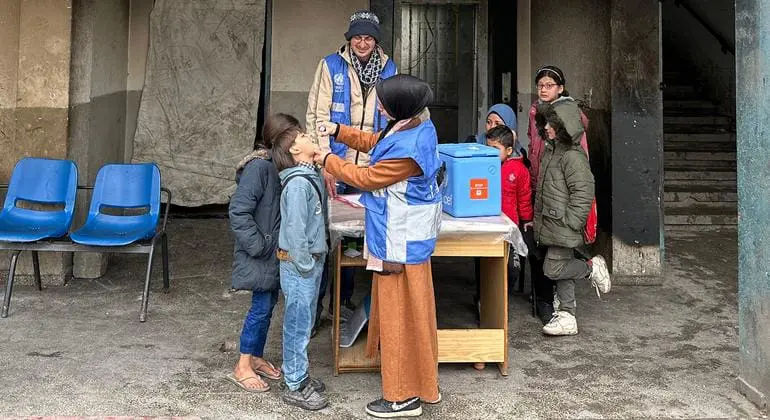
Joyce Msuya, the Assistant Secretary-General at the UN Office for the Coordination of Humanitarian Affairs (OCHA), along with Gilles Michaud, the head of the UN Department of Safety and Security (UNDSS), addressed a meeting focused on the safeguarding of civilians amidst armed conflicts.
The discussion centered around Council Resolution 2730 (2024), which emphasizes the need to protect UN and humanitarian personnel. “Let me be direct,” Ms. Msuya stated. “Attacks on humanitarian workers must cease. Those responsible must be held accountable.” She highlighted that 2024 has recorded the highest number of fatalities among aid workers, with 377 deaths across 20 nations, marking an increase of nearly 100 compared to 2023, which itself had already seen a 137 percent rise from 2022. Additionally, numerous aid workers have faced injuries, kidnappings, assaults, and arbitrary detentions.
Ms. Msuya noted that the last two years have been particularly violent, with at least 85 humanitarian workers killed in Sudan since the onset of hostilities in April 2023, all of whom were Sudanese nationals.
In Gaza, she reported that just three days prior, OCHA teams and the Palestinian Red Crescent Society unearthed the bodies of 15 emergency workers from a mass grave, who had been killed by Israeli forces while attempting to provide aid. This incident occurred shortly after another tragic event on March 19, when a UN colleague was killed and six others injured in Gaza. Since October 7, 2023, over 408 aid workers have lost their lives in Gaza, making it the most perilous region for humanitarian efforts.
Ms. Msuya challenged the ambassadors present: “As we discuss the protection of humanitarian workers today, I must ask this Council: what actions will you take to help us find solutions and ensure justice to prevent further fatalities?” She pointed out that while robust international legal frameworks exist to protect humanitarian and UN personnel, there is a significant lack of political will to enforce these measures.
She further emphasized that approximately 95 percent of those killed are local aid workers, who are vital to relief operations. “These individuals deserve our utmost respect, yet violence against our local staff seldom garners attention or media coverage,” she said.
Challenges such as the criminalization of their work also plague humanitarians, with many facing detention, questioning, and accusations of terrorism for simply providing aid. Organizations are increasingly targeted by disinformation campaigns in regions like Haiti, the Occupied Palestinian Territory, and Yemen. Moreover, funding shortfalls exacerbate these issues, forcing humanitarian groups into difficult decisions.
Ms. Msuya regarded the adoption of Resolution 2730 as a positive advancement and made three appeals to the Council and member states. “First, take action to ensure adherence to international law and the protection of humanitarian and UN staff,” she urged, suggesting measures such as Security Council visits, fact-finding missions, or the suspension of arms transfers. She called for vocal condemnation of violence against UN and humanitarian personnel, including local workers, stating that “silence, inconsistency, and selective outrage only serve to empower those who commit such acts.”
Her final request centered on accountability, stressing the importance of enhancing both domestic and international legal frameworks to prosecute international crimes. “The Security Council should play a crucial role in advocating for accountability by urging relevant governments to pursue justice and by following up on their efforts,” she proposed. “When national jurisdictions fall short, the Council may leverage international mechanisms, including referring cases to the International Criminal Court.”
Ms. Msuya highlighted that accountability encompasses more than just prosecution and must also focus on aiding survivors. She reiterated the UN Secretary-General’s call for a survivor-centered approach, ensuring that affected aid workers have a voice in global discussions.
In his remarks, Mr. Michaud pointed out that progress has been slow in encouraging more nations to join the Convention on the Safety of UN Personnel, while attacks on humanitarian workers persist.
“Impunity for attacks against humanitarian personnel has become an accepted norm,” he declared, “a norm that is propagated not only by non-State actors but also by governments and their affiliates.” He noted that due to widespread neglect of international humanitarian law, various UN agencies are now compelled to drastically reduce assistance because of budget cuts from several member states.
Mr. Michaud warned that if the UN and its partners are forced to provide less aid, the risks to UN and humanitarian staff will increase. “We are already witnessing signs of this in Gaza and elsewhere, where humanitarian personnel may become the initial targets of public despair,” he cautioned.
He reassured that the UN will adapt, acknowledging that budgetary constraints will also impact the level of security support available. “We will need to adjust our presence, and in some regions, we might have to withdraw completely due to resource limitations,” he explained. “However, the UN Security will remain committed throughout these challenging times, ensuring our presence wherever humanitarian partners require assistance.”
Mr. Michaud affirmed that the UN Security will continue its engagement with the Council and member states to safeguard investments in humanitarian, peace, security, and development efforts. He reiterated the necessity for attacks on UN and humanitarian personnel to come to an end.