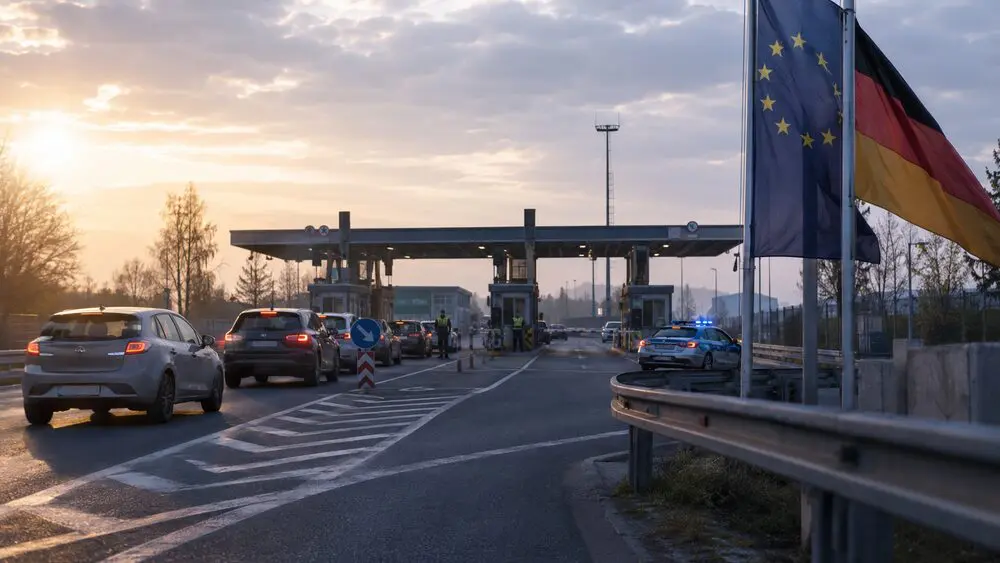
Germany is under renewed EU pressure to begin lifting internal border controls, as Brussels argues that migration reforms and alternative policing tools should now allow Schengen’s passport-free travel area to function with fewer disruptions for commuters, businesses and travellers.
The European Commission has urged Germany to work toward the gradual removal of checks at its internal land borders, setting up a politically sensitive test of how far member states are willing to trust common EU migration and security systems.
The dispute has sharpened just days before the EU’s new migration and asylum framework begins applying in June 2026. Brussels says the reforms, together with stronger external border systems and risk-based policing, should reduce the need for controls inside the Schengen area. Berlin argues that the checks remain necessary to combat irregular migration, smuggling and security threats.
A Schengen dispute with everyday consequences
Germany has notified controls at all nine of its land borders, including with Austria, France, Poland, Czechia, Switzerland, Denmark, Luxembourg, Belgium and the Netherlands. In its formal opinion on Germany’s border controls, the Commission said Berlin should move toward a “tailor-made” lifting of checks by border section and by threat, using police cooperation, mobile checks and technology instead of routine internal border control.
The issue is not only institutional. Internal border checks can affect cross-border workers, logistics companies, families and students in regions where daily life depends on fast movement between neighbouring countries. The Commission said it had received many complaints from citizens and businesses, pointing in particular to difficulties along the German-Luxembourgish, German-Polish and German-Dutch borders.
Schengen has long been one of the EU’s most tangible promises: the ability to move across much of Europe without routine passport checks. Yet temporary controls have become increasingly common, often justified by migration pressure, terrorism risks or organised crime. As European Times has previously reported on Schengen reform and free movement, EU lawmakers have sought to keep internal border controls as a measure of last resort.
Brussels says alternatives should come first
The Commission’s position is not that Germany has no security concerns. Its opinion acknowledges Berlin’s arguments about unauthorised movements, public service pressure, smuggling and wider security risks linked to conflicts beyond the EU. German authorities reported around 83,600 unauthorised entries in 2024 and around 63,000 in 2025, according to the Commission document.
But Brussels questions whether checks across all internal land borders for repeated six-month periods remain necessary and proportionate. It says Germany’s notifications did not provide enough detailed risk analysis to explain why the threat should be treated in the same way across every border, or why a full six-month prolongation was needed rather than a shorter or more targeted approach.
EU Migration Commissioner Magnus Brunner has made the same argument publicly. In remarks reported by Tagesschau on Saturday, he said a gradual reduction of border controls was possible and appropriate, pointing to a sharp fall in asylum figures and to EU measures such as external border protection and the common Entry/Exit System.
Berlin’s security case remains politically powerful
For Germany, the domestic politics of border controls are difficult to separate from the legal debate. The government presents the checks as evidence that it is acting against irregular migration and human smuggling, while local court rulings and EU scrutiny have kept questions of legality and proportionality alive.
The Commission also notes a practical strain: Germany’s own Federal Police Commissioner has warned that broad internal controls can draw resources away from ordinary policing duties and called for a more tailored approach based on regional conditions.
That point matters for rights as well as efficiency. When border measures become routine, people seeking protection may face faster refusals, less predictable access to asylum procedures and more uneven treatment depending on where they cross. Brussels has reminded Germany that EU asylum and return rules still apply at internal borders where controls have been reintroduced.
The coming weeks will show whether the migration pact gives the Commission enough political leverage to restore confidence in Schengen’s open-border model. If Berlin keeps resisting, the EU’s central dilemma will remain unresolved: how to reassure citizens on security while preserving one of Europe’s clearest daily freedoms.