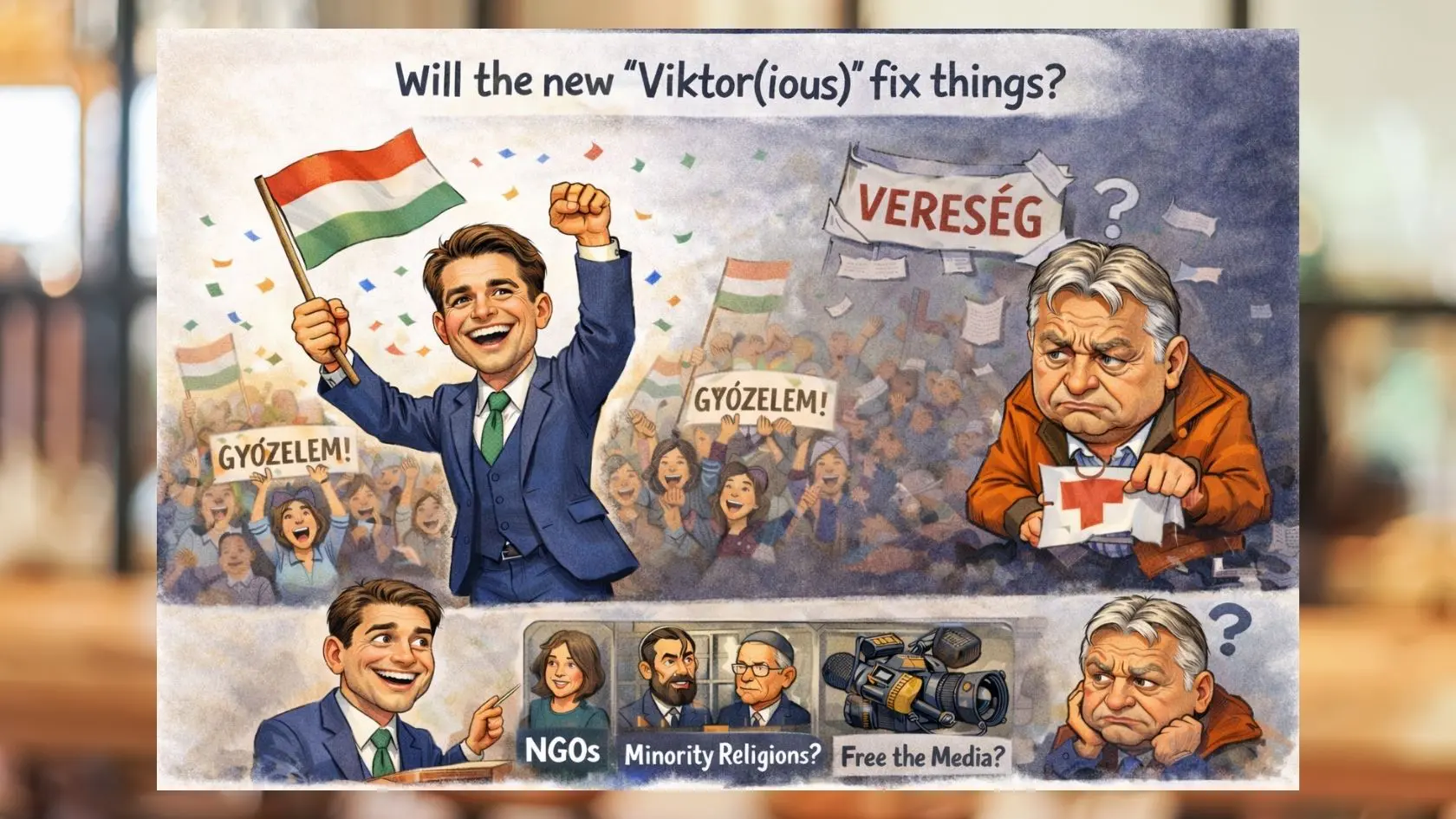
Hungary’s election on 12 April 2026 has already made history. Viktor Orbán has conceded defeat, and the fall of the long-dominant Fidesz-KDNP alliance now raises a harder question: will political change finally bring legal and administrative relief for religious minorities, independent NGOs and civic groups that spent years under pressure? If the incoming leadership wants to show that Hungary is turning a page, one of the clearest places to begin will be freedom of religion or belief, freedom of association and equal treatment under the law.
By Sunday night, Orbán had acknowledged defeat after 16 years in power, while Péter Magyar and the Tisza party emerged as the election’s clear winners. The political significance is obvious. But for many Hungarians, and for many in Brussels, Strasbourg and beyond, the deeper issue is whether this vote will now be followed by institutional repair. Elections can change governments in a day. Systems of discrimination usually take longer to dismantle.
More than an electoral upset
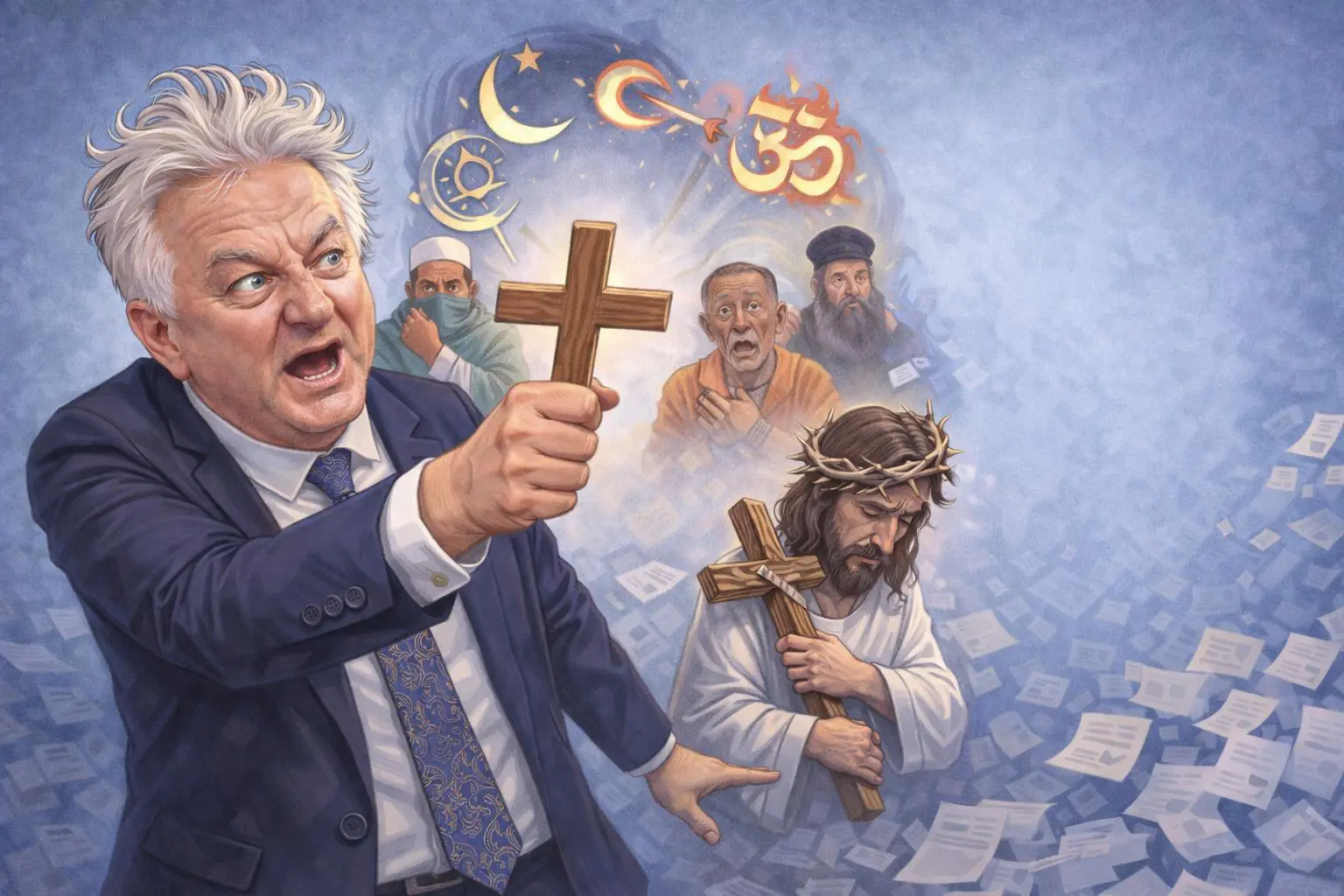
Orbán’s era will be remembered not only for constitutional change, media concentration and conflict with the European Union, but also for a governing style that divided civil society into “loyal” and “suspect” actors. That distinction affected migrant-support organisations, anti-corruption groups, independent media and also several religious communities that did not fit comfortably inside the government’s preferred narrative of “Christian Hungary.”
That concern has not come only from political opponents. In October 2024, UN Special Rapporteur Nazila Ghanea warned that Hungary still needed further reforms so that all religious and belief communities could operate without discrimination. The issue was not symbolic. It concerned legal personality, equal recognition, access to rights and the ability of communities to function without political favour. The European Times has also previously reported on those concerns.
The church law problem did not disappear
One of the clearest examples is Hungary’s long-running church-status regime. The 2011 Church Law stripped official recognition from nearly 350 religious communities, leaving many smaller groups in a weaker legal position. In 2014, the European Court of Human Rights held that the loss of full church status breached rights protected by the European Convention, warning in substance against a system in which religious communities had to seek political approval from Parliament in order to regain recognition.
The legal story did not end there. Even after later amendments, the UN’s assessment in 2024 was that the framework still produced unequal treatment among communities. In practice, that meant some groups could still feel tolerated rather than treated equally, when not (for at least a number of them) persecuted. In a democratic Europe, that is not a minor distinction. It goes to the heart of state neutrality.
The consequences have also been concrete. According to Human Rights Watch, Hungarian authorities in August 2024 revoked the operating licences of three schools run by the Methodist Evangelical Church, a community associated with long-running disputes over church recognition and state treatment. When legal discrimination reaches schools and social services, it is no longer an abstract constitutional question. It becomes a matter of daily life for families, children and vulnerable communities.
NGOs were treated as targets, not partners
The same political logic shaped Hungary’s treatment of NGOs. In 2020, the Court of Justice of the European Union ruled against Hungary’s so-called foreign-funded NGO transparency law, finding that the restrictions were discriminatory and unjustified. The law forced affected organisations to register publicly as foreign-supported and disclose donor information, reinforcing the message that independent civic activity was somehow suspect.
Then came the “Stop Soros” package. In 2021, the same court found that Hungary had breached EU law by criminalising certain forms of assistance to asylum seekers. That mattered far beyond migration politics. Once a government starts turning legal aid, humanitarian advice or solidarity work into grounds for suspicion, it weakens the basic democratic space in which civil society operates.
More recently, that pressure was updated rather than abandoned. The 2023 sovereignty law and the creation of the Sovereignty Protection Office added a new mechanism that critics said could chill public debate and stigmatise organisations receiving outside support. The European Commission referred Hungary to the Court of Justice over the law, while Freedom House reported that anti-corruption organisations and investigative media were subjected to arbitrary and frivolous investigations. The Venice Commission was blunt: the framework created a chilling effect and should be repealed.
If Peter Magyar is serious about renewal, these are the tests
The new majority will now have a rare opportunity. It can treat rights repair as secondary to economics and anti-corruption, or it can understand that the two are connected. A democratic state cannot credibly promise clean government while leaving intact the legal tools used to pressure minority faiths, stigmatise NGOs or intimidate watchdog journalism.
A serious first phase of reform would be both practical and visible. It would mean restoring a genuinely equal legal framework for religious communities, ending politically conditioned recognition systems, protecting faith-based schools and charities from retaliatory treatment, and bringing Hungarian law fully into line with European court rulings already delivered years ago.
It would also mean revisiting the laws and institutions built to frame civic organisations as agents of foreign influence. That includes ending arbitrary investigations, rolling back sovereignty-based intimidation and making clear that independent NGOs are part of a democratic society, not enemies of it. Hungary does not need a new rhetoric of tolerance. It needs equal citizenship under neutral laws.
The message for Hungary’s winners
If Péter Magyar and the incoming leadership want to demonstrate that this election was not only a change of faces but a change of direction, they should move early on freedom of religion or belief and civic space. Those issues are sometimes treated as secondary, yet they are among the clearest indicators of whether a democracy is confident enough to protect people and groups it does not control.
Hungary’s next chapter should not be written only in terms of markets, Brussels funding or geopolitical repositioning. It should also be written in the everyday reality of whether a minority church can keep its status without political bargaining, or keep its religiously sacred documents and practices, it is whether a faith-based school can operate without retaliation, and whether an NGO can defend rights without being branded disloyal.
Orbán’s defeat, if followed by real reforms, could become more than a dramatic electoral event. It could become the moment when Hungary finally begins to heal the civic and religious freedoms that were wounded under Orban and Semjen’s rule. That is the democratic test now facing the winners. Europe will be watching.