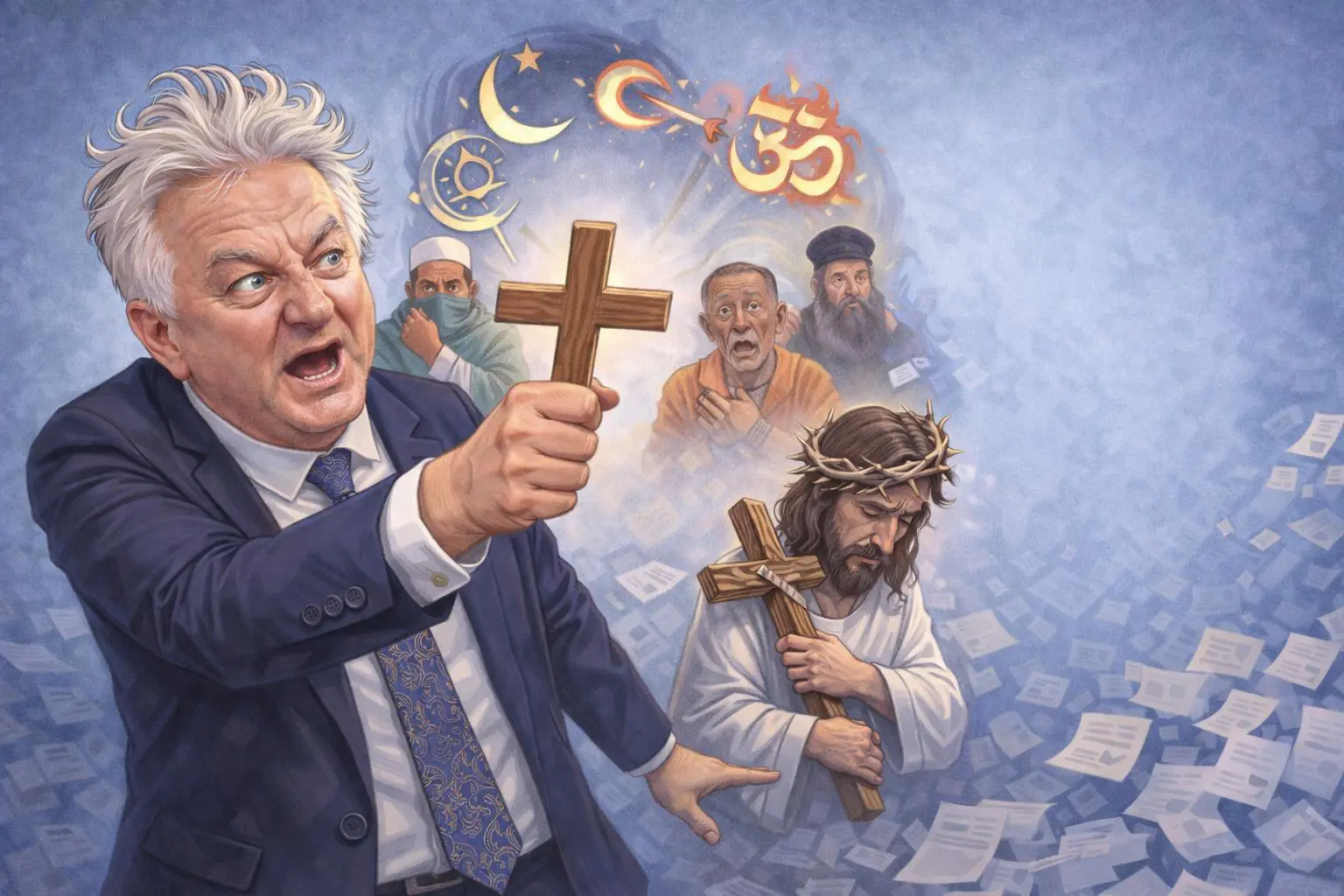
As Hungary heads toward its parliamentary election on 12 April 2026, Viktor Orbán is again campaigning as the defender of Christian Hungary. But a closer look suggests that the deeper driver of the country’s exclusionary church policy has long been Deputy Prime Minister Zsolt Semjén. Critics argue that the model he helped build has not protected Christianity so much as politicised it — harming minority faiths first, but ultimately weakening the freedom, independence and moral credibility of religious communities across the board.
In campaign messaging, it is usually Orbán who is presented as the face of Hungary’s Christian nationalism. Yet the architecture behind that politics points repeatedly to Zsolt Semjén, the KDNP (Christian Democratic People’s Party (Hungarian: Kereszténydemokrata Néppárt) leader and deputy prime minister whose official portfolio includes church policy and church diplomacy. Orbán may sell the message. Semjén has helped design the system.
That distinction matters in the final days before the election. The 12 April vote is widely seen as the toughest electoral test of Orbán’s long rule, with Reuters describing it as a pivotal contest for Hungary’s political direction and the OSCE’s Office for Democratic Institutions and Human Rights deploying an observation mission. But the stakes are not only political. They are also constitutional, civic and religious: what kind of public role faith should have in Hungary, and who gets to decide which believers count as legitimate.
Semjén’s vision was never neutral
The public record leaves little doubt that Semjén’s approach to religion has long been explicitly selective. On his official CV, he highlights a proposal he made while still in opposition: that state recognition as a church should depend on at least 100 years of presence in Hungary or 10,000 members. This was not a technical adjustment. It expressed a governing philosophy: religion should be filtered through history, scale and state approval.
That approach may be presented as a defence of Christian values, but it replaces freedom with hierarchy. It favours large, historically embedded institutions and places smaller, newer or less politically useful communities at a structural disadvantage. In practice, it turns religion from a right into a status conferred more generously on some than on others.
From Semjén’s criteria to Hungary’s church law
After Orbán returned to power in 2010, Semjén was in a position to turn that philosophy into law. The Venice Commission recorded that Semjén was the minister responsible for church-related issues when it reviewed Hungary’s 2011 church law. That law stripped many religious communities of their previous status and shifted recognition into a parliamentary process vulnerable to political discretion.
The Venice Commission warned that recognition by Parliament could politicise the issue and was not in line with normal European standards. The European Court of Human Rights later ruled in Magyar Keresztény Mennonita Egyház and Others v. Hungary that the system violated the applicants’ rights, including because communities had to seek parliamentary approval to regain church status.
This is where the election-year rhetoric about protecting Christianity begins to look less like spiritual conviction and more like state engineering. Semjén did not merely defend Christian identity in the abstract. He helped create a model in which the state sorts religions into preferred and less-preferred categories.
The Iványi case shows who pays the price
Today’s most visible example is the case of pastor Gábor Iványi, the Methodist minister who once officiated Orbán’s wedding and baptised two of his children. As Politico reported, Iványi now rejects Orbán’s brand of Christian nationalism as something that “has nothing to do with the Bible.” He is also facing prosecution in a case that critics say is politically motivated.
Iványi’s Hungarian Evangelical Fellowship was among the communities damaged by the post-2011 recognition regime. The loss of status had practical consequences: reduced resources, legal vulnerability, and pressure on its schools, shelters and social work. That matters because Iványi is not a fringe provocateur. He is a pastor from Hungary’s own Protestant tradition, one whose organisation has worked with homeless people, Roma communities and refugees.
Human Rights Watch says the prosecution of Iványi and the interference with his church’s work form part of a wider pattern of targeting people and organisations supporting migrants, refugees, people in poverty, children with disabilities and LGBT people. In other words, the issue is not simply administrative control. It is the use of legal and financial pressure against religiously rooted humanitarian work when that work falls outside the government’s preferred ideological frame.
Why exclusiveness harms more than minority faiths
The first victims of an exclusionary church policy are usually smaller communities. Hungary’s UN Special Rapporteur on freedom of religion or belief said in 2024 that the 2011 law had stripped legal status from almost 350 religion or belief groups, and that later amendments still failed to resolve broader discrimination. That is the clearest, most measurable damage.
But the harm does not stop there. A state that claims to protect Christianity by selectively rewarding compliant churches also changes the meaning of religion for majority denominations. Once churches become too closely associated with state power, funding streams and political patronage, they risk losing part of what gives them public credibility in the first place: moral independence.
That is the paradox at the heart of Semjén’s project. In the name of defending Christian values, it risks reducing Christianity to a political identity marker — something national, majoritarian and administratively managed — rather than a faith that can challenge power as well as cooperate with society. Such a model may strengthen the state’s control over religion, but it can weaken religion’s own spiritual authority.
A protection model that narrows Christianity itself
Even for communities that benefit materially from state recognition, this bargain comes with a cost. If religion is publicly framed through exclusiveness, state preference and suspicion of the outsider, then Christian witness itself is narrowed. The social message becomes less about conscience, compassion and universal dignity, and more about boundary-drawing: who belongs, who is traditional enough, who is loyal enough, who deserves recognition.
That helps explain why the dispute is not just between government and minority faiths. It is also an internal argument about Christianity. Iványi’s break with Orbán is important precisely because it comes from within Hungary’s Christian world. His criticism suggests that what is being defended by the government under the label of Christian values may, in fact, be an exclusivist political ideology that instrumentalises religion rather than serving it.
The election is also a verdict on Semjén’s model
Seen in that light, the 2026 election is not only a referendum on Orbán’s power. It is also a verdict on Semjén’s long stewardship of church policy. Orbán remains the dominant political figure, and the one publicly selling the nationalist-Christian message. But Semjén has been the specialist, the institutional custodian, and the policymaker who helped convert that message into a legal order.
If the governing alliance wins again, it will be able to claim renewed legitimacy not only for Orbán’s electoral machine but also for the church-state model Semjén has spent years advancing. If it loses, one of the most important questions for Hungary’s democratic future will be whether the next government dismantles that hierarchy and restores a more equal framework for religion and belief.
That is why Semjén deserves closer scrutiny in this campaign. His policies did not simply disadvantage minority religious communities. They helped create a public culture in which religion is ranked, rewarded and politicised. In the long run, that does not protect faith. It places it under state management — and harms believers of every denomination.