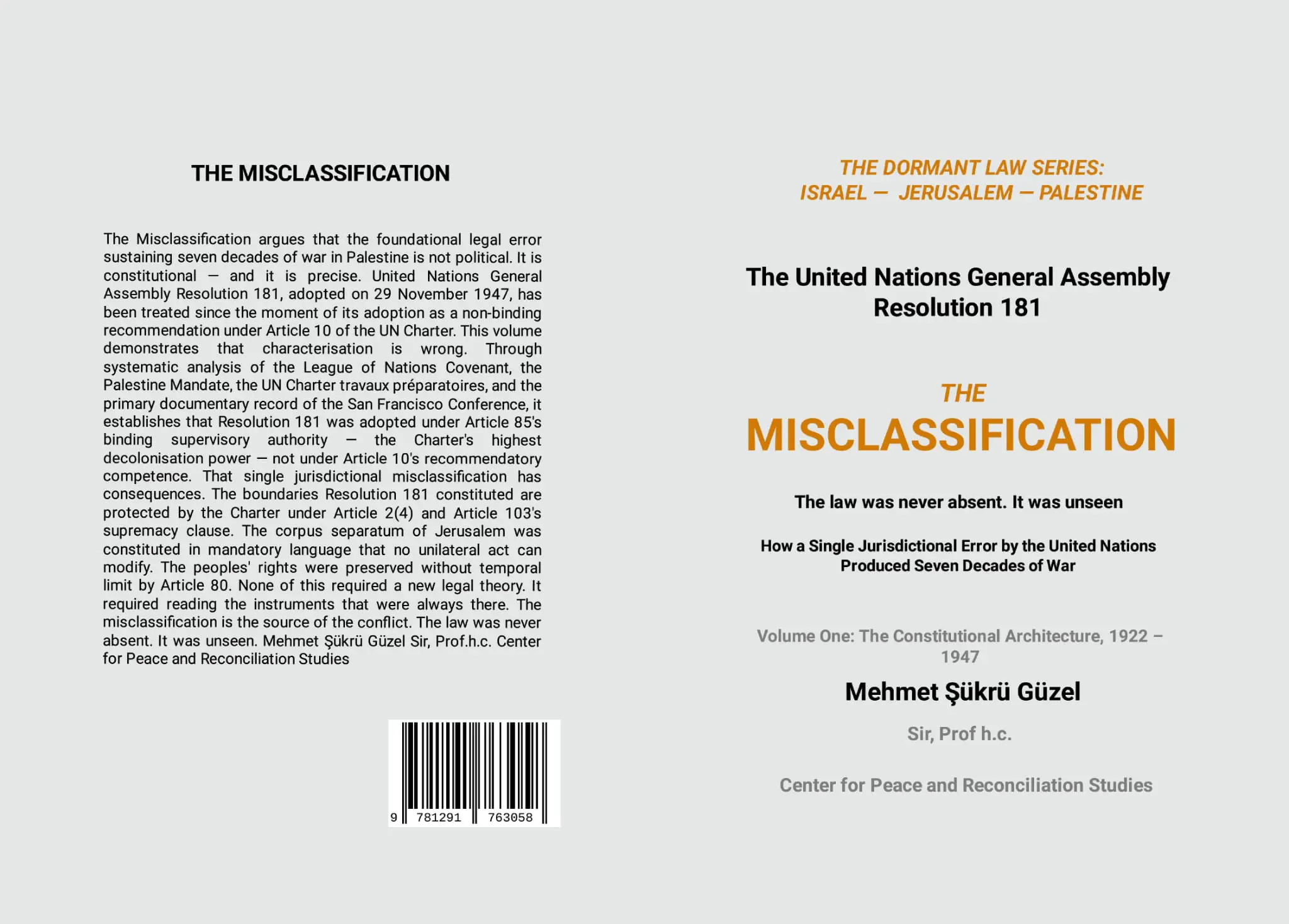
In the quiet archives of international law, where dust settles on treaties and resolutions, a persistent silence has surrounded the origins of one of the modern world’s most intractable conflicts. We are accustomed to viewing the strife in the Middle East through the lens of political failure, diplomatic deadlock, or ancestral hatred. However, a new volume by Mehmet Şükrü Güzel, titled The Misclassification, suggests that the root of the problem may be far more technical—and far more bureaucratic—than previously imagined.
Güzel’s work is not a political manifesto. It is a forensic examination of the legal instruments that governed the end of the British Mandate for Palestine. The central thesis is deceptively simple: for nearly eight decades, the international community has misread the legal character of United Nations General Assembly Resolution 181. According to the author, this single jurisdictional error—treating a binding constitutional order as a non-binding recommendation—created a vacuum of authority that seven decades of war have failed to fill.
The book invites the reader to look beyond the visceral reality of conflict and examine the dry text of the UN Charter. Güzel argues that Resolution 181, adopted on November 29, 1947, was not issued under the General Assembly’s standard recommendatory powers (Article 10). Instead, he posits it was an exercise of the Assembly’s exclusive “terminal disposition” authority under Article 85, acting as the Successor Trustee for the “Sacred Trust of Civilization” originally established by the League of Nations.
This distinction is not merely semantic. If Resolution 181 was a recommendation, the parties were free to accept, reject, or negotiate its terms. This interpretation implies that the territory became a terra nullius—a land without a sovereign—open to acquisition by force. However, if Güzel’s legal analysis holds water, the Resolution was a binding fiduciary determination. The boundaries it established, and the international regime it created for Jerusalem, were not bargaining chips; they were protected obligations under the Charter’s supremacy clause (Article 103).
There is a profound “Arendtian” quality to this argument. Hannah Arendt famously observed that the greatest evils are often committed not by monsters, but by functionaries following flawed logic within bureaucratic systems. Güzel applies a similar lens to international law. He does not accuse the actors of 1947 of malice, but rather of a collective cognitive slip—a reflex to categorize a complex constitutional act as a simple diplomatic suggestion.
The consequences of this misclassification are outlined with surgical precision. The author traces how the failure to recognize the binding nature of the UN’s fiduciary duty allowed the mandatory power to withdraw without ensuring a lawful transition. This abandonment, Güzel argues, left the territory in a legal void, substituting military capacity for legal authority. The “peace processes” that followed, from Oslo to the various Roadmaps, are presented in the book as attempts to negotiate rights that were already legally determined, or to trade away territories that were already under a specific international regime.
Of particular interest is the book’s treatment of Jerusalem. Güzel maintains that the corpus separatum—the international status for the city—was not a proposal waiting for approval, but a legal reality that came into force upon adoption. The decades of recognizing exclusive sovereignty over the city by any party are, therefore, framed as a persistent breach of this erga omnes obligation owed to the international community.
The Misclassification is a dense text, grounded in the minutiae of the Covenant of the League of Nations, the UN Charter, and the Vienna Convention on the Law of Treaties. Yet, its value lies in its accessibility to the underlying logic. It strips away the political rhetoric to reveal a structural failure in the application of international law.
For the reader seeking to understand why the conflict remains unresolved, Güzel offers a provocative answer: we have been trying to solve a political problem when we should have been enforcing a legal trust. The book serves as a sobering reminder that in the realm of nations, the absence of law is not freedom; it is merely the prelude to chaos. Whether one agrees with his conclusions or not, Güzel demands that we look at the documents of 1947 not as historical artifacts, but as the active, unseen constitution of a region that has forgotten its own rules.