Having in mind that sustainability might be a very tricky word, especially when we dissect its meaning – sustain what and for what reasons – we are once again left with the question – then what? What sustainability sustains often depends on the bigger picture – what system it functions within and for. Therefore, within the dominant economic system nowadays, sustainability tries to sustain the natural environment and by doing this, sustain the economy itself. Therefore, the ultimate goal is the economy and every environmental action is done simply in favour of economic sustainment – the economy before the environment. In other words, mainstream sustainability’s key principle is to make sure that the realm the economy depends on is sustained enough, so that the economy could function and follow its logic of constant expansion.
Again, the logic requires the economy to grow so that it could expand and include (exploit) and commodify more and more. This growth imperative is, however, the problematic part of the equation – as long as our sustainability approach remains within the logic of constant expansion, it would always favour the sustainment of the economy and not the environment per se. A critical look beyond the growth imperative, however, with a focus on the environment, allows us to discover a number of other approaches to the environment-economy nexus.
What makes the growth imperative even more problematic is that together with being a necessary condition for the sustainment of the dominant economic system, growth has also turned into an end-goal. This, then, makes it even more difficult to focus on solving environmental issues within the growth imperative. Why? Let us put it that way:
- the system needs to grow in order to continue being;
- the system’s goal is to grow (growth for growth’s own sake);
- (1) and (2) both negatively influence the natural environment; in other words – constant expansion requires the exploitation of previously unexploited realms;
- (3) leads to environmental degradation and crisis;
- environmental degradation and crisis negatively influence the economy, as the economy needs the natural environment in order to continue growing; recall (3) – the natural environment serves as a realm for exploitation and commodification;
- (5) necessitates seeking solutions to the economically-caused environmental crisis for the sustainment of the economy itself through addressing environmental issues;
- even with environmental issues at hand, the growth of the system needs to be sustained;
- all of the above shows that within a system that serves the growth imperative, sustainability would always position in the centre the economic system it functions within, and not the environment it undoubtedly depends on.
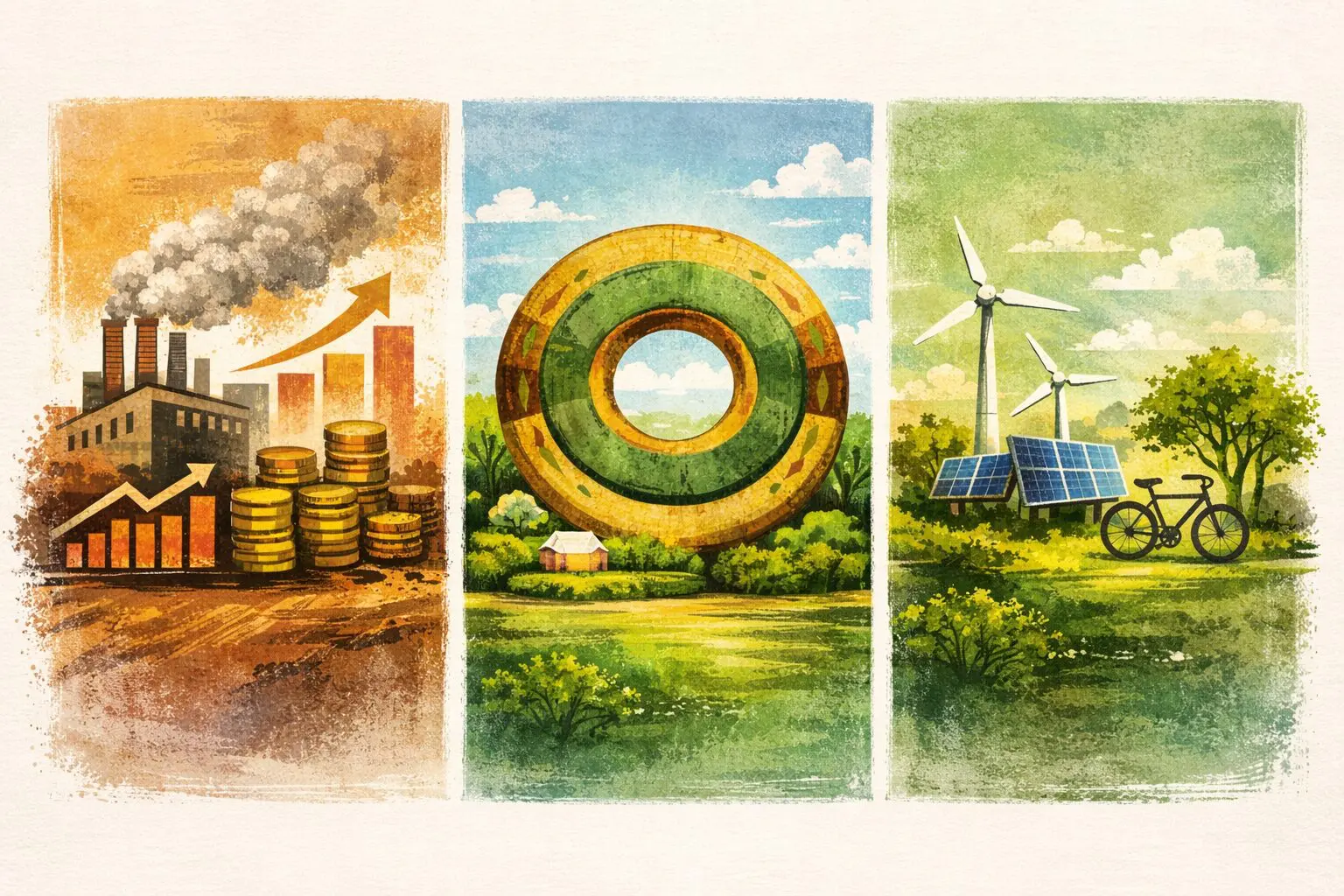
With all this in mind, the solution should be simple – forget about growth! If growth is the problem, as it seems, then we should perhaps eliminate it? Or at least care less about it? This is what proponents of shifting the focus away from conventional sustainability suggest. If conventional sustainability could also be presented as sustainable economic development (with a focus on the development of the economy) or sustainable growth (with a focus on growth), then unconventional sustainability would shift the focus onto the natural environment, or societal development and welfare. In fact, despite being the most present practically, growth- and economy-centred solutions to environmental issues are just a part of a broad spectrum of practical and theoretical approaches to economically-caused climate problems:
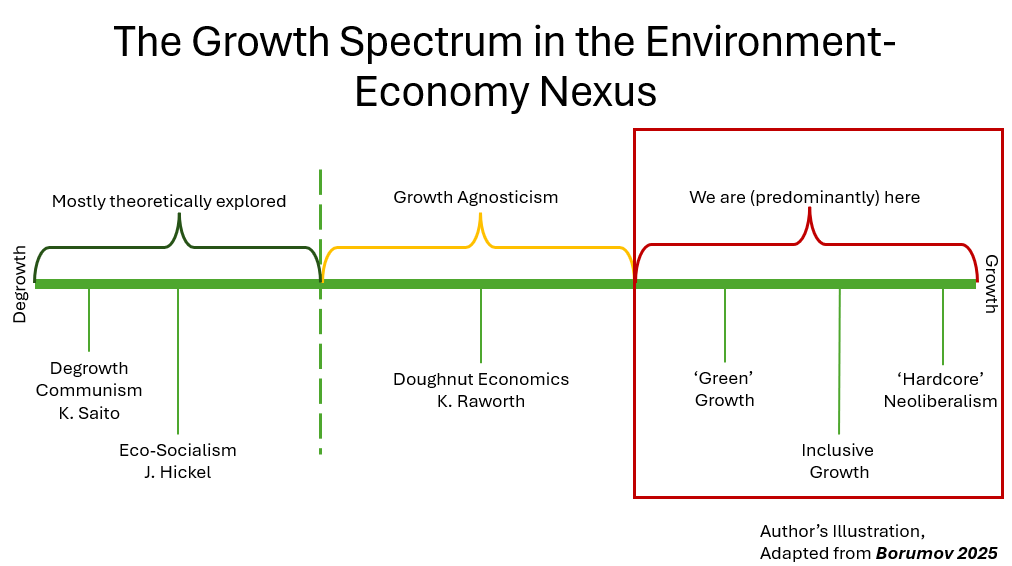
The right-hand side of the spectrum shows the dominant approaches we see every day – growth-focused economies with some alternations that focus on making this growth inclusive so that everyone can benefit from it, or green so that it is not harmful to the environment. Yet, if we were to ‘not care’ about growth for a moment, we get what is known as growth agnosticism. Growth agnosticism then is this approach to the environmental crisis which acknowledges the wrongdoings of growth outlined above. This approach suggests that we should not actively focus on growing the economy. Instead, societies should focus on their own sustainment and wellbeing at peace with the environment.
The most prominent proponent of the growth agnosticism approach is British economist Kate Raworth’s Doughnut Economics. Raworth (2017) suggests that the core purpose of our economic activities should be to create a humanity- and environment-centred system, in which growth might or might not happen. The point here is not to dissociate from growth, or to actively alter our relationship with it, but to fundamentally change the system we live in and focus on our own sustainment, without stepping out of planetary boundaries. Our economy should function within the boundaries of an imaginary doughnut, the inner hole of which represents a state of critical human deprivation, and the space beyond the outer layer of the doughnut – critical planetary degradation. Hence, instead of the economy being in the centre of attention when ‘addressing’ ecological issues, Raworth’s approach positions human- and ecological-wellbeing there, moving growth outside of the centre of attention together with other not-necessary conditions for the development of such an economy. Whether growth happens or not, we should not actively care.
Of course, other approaches, which lie on the left side of the spectrum above, have more radical opinions when it comes to growth. Following the same logic – that growth is essentially the precondition for ecological crises, proponents of what is known as degrowth argue that it is not possible to achieve ecological sustainability within the boundaries of growth-bound economic systems. Not only is it impossible to help the environment, but it is also too late to try doing it in a growth-centred or an agnostic manner. The only solution, these proponents argue, is the active reduction of economic output, energy use and overproduction in an attempt to bring the natural environment back within planetary boundaries. Active reduction of economic growth, hence – degrowth. By doing so, societies could redistribute already existing wealth without the need for producing more, thus slowing down the economy and actively reducing environmental damage. With a focus on the environment, then, humanity would be able to get ever closer to it in an attempt to rebuild its initial connection to nature. This, of course, would require an even greater reconceptualisation and alternation of the socio-economic system on a world scale.
We are, then, left with three approaches to the environment-economy nexus with regard to growth. And yet another question to answer – To grow or not to grow? Theoretically speaking, all of these approaches are logical within their own paradigmatic logic. Then, it could be said that it is a matter of subjective opinion (and to some extent empirical evidence) whether to be loyal to one or another. Yes, there are alternatives to what we know as sustainability today. In other words, there are various ‘sustainabilities’ which consider different things important – growth, human wellbeing, nature’s health. The question in the centre of discussion should be What do we want to be the reason why our economy functions? And the answers may vary depending on whom we ask. Whatever the answers, however, we should be aware that human wellbeing and nature’s health are no less important than economic growth and the sustainment of the economic system we live in. And to acknowledge that, it is worth discussing the theoretical reasonings and practical promises of the non-growth alternatives to problems in the environment-economy nexus. This is what I do in the article to follow.