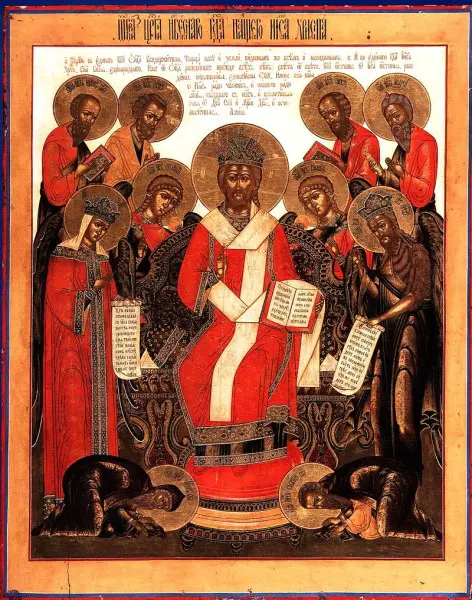
King of Kings, The Queen Stands at Your Right Hand – a special variant of the Deesis composition, where Christ is depicted as “King of kings and Lord of lords” (1 Tim. 6:15). It originally appeared as an illustration of one of the verses of Psalm 44 – “The queen stood at Your right hand, clothed in gold…” (Psalm 45:10–11), where, according to exgetical tradition, Christ is represented as the king, and the Mother of God-Church as the queen. It developed in Serbian art in the 14th–15th centuries, then spread to Rus’. In the original versions of the “King of Kings” composition (“The Queen Stands Before Me”), the image of John the Baptist was absent; instead, King David and other prophets were depicted (Fresco in Zaum, near Ohrid, 1361; Markov Monastery, 1370). John the Baptist was later included in this composition as a witness to the mystical union (John 3:29). The depiction of Christ in royal guise is usually combined with another type—the Great Bishop.
Jesus Christ is depicted seated on a throne, which is not only a symbol of royal power but also of the universe—the visible and invisible world. He is dressed in a dalmatic—the robe of Byzantine emperors; on his head is a tiara, sometimes an archbishop’s kamilavkion, as this iconography echoes the “Great Hierarch” type. For this reason, an omophorion is often depicted over the dalmatic. In one hand, Christ holds a scepter or the Gospel (sometimes both), and the other he raises in a blessing gesture. The Gospel is sometimes replaced by a sphere. In some variations, a sword is depicted to the left of his lips, in keeping with the text of Revelation.
The image can be a single image or part of the composition “The Queen stands at your right hand,” with Christ standing before the Mother of God (on the right) and John the Baptist (on the left). There are also multi-component compositions where Christ is accompanied by archangels, evangelists, and chosen saints, sometimes depicted on the margins of the icon or in medallions.
The Great Hierarch (Saviour Great Hierarch) is one of the symbolic titles for Christ, revealing him as the New Testament High Priest sacrificing himself (see Eucharist). This term is based on the Old Testament prophecy, “You are a priest forever according to the order of Melchizedek” (Psalm 110:4), commented on by the Apostle Paul (Hebrews 5:6). It served as the source for a special type of depiction of Christ in bishop’s vestments, which appears both independently and in combination with other symbolic images representing Christ as the Heavenly King.
Another interesting symbolic title for Christ, borrowed from the Old Testament (Isaiah 9:6), is the Angel of the Great Council. This served as the source for a special type of depiction of Christ as a winged archangel, which appears both independently and in various symbolic and dogmatic compositions (“The Creation of the World” – “And God rested on the seventh day…” and others).
Source in Russian: Dictionary and index of names and concepts in Old Russian art / E. V. Gladysheva, L. V. Nersesyan. – M.: “Almanac “Strange World”, 1991. – 79 p. (Library of the almanac “Strange World”; Issue 1).