They Use Special Organs
Deep-sea fish usually have very large eyes, with very developed lenses and pupils
It has already been proven that fish see in color and even distinguish a much wider range of colors than humans. These animals need to see up close more than from afar. Seawater is almost always cloudy with plankton and other particles that limit the field of view. To see at great distances, fish use special organs called lateral lines or pressure receptors. Located along the length of their bodies, they capture the vibrations of the waves caused by the movement of other fish.
Using this natural radar, the fish can identify the predator/ or its own prey/ and even recognize its health: when swimming, an injured fish causes waves with different pressure than those caused by a healthy fish.
Deep-sea fish usually have very large eyes, with very developed lenses and pupils. In this way, they distinguish even the faintest flashes of light. These fish are probably sensitive to the blue-green lines of the spectrum, i.e., to the wavelengths that penetrate the deepest parts of the ocean. During the courtship period, organs called photophores light up on the heads of some deep-sea fish. The purpose is clear: to recognize each other as male and female of the same species. The depths of the sea are filled with such lights, as if they were fireflies at night. Other deep-sea fish use light to attract their victims. Recently, photophores were even found in the mouth of a shark, which most likely play the role of bait to attract prey.
Do sharks see? Scientists have decisively refuted the belief that sharks are blind. In fact, all studies on fish vision have been carried out in laboratories on freshwater species. It is impossible to create suitable conditions for studying large marine fish. Therefore, the shark will keep the secret of its eyes somewhere deep in the sea abysses for a long time.
Winter fishing
Winter life in water bodies does not die down, but of course it is not so stormy. Still, wintering is a difficult season for the fish world. Feeding is almost interrupted, metabolism is significantly reduced, and in general the activity of the fish is very weak. Adaptation to the low water temperature is necessary. With a sharp cooling, shock can also occur in the fish. Of course, if the water temperature begins to rise, the fish becomes more active.
And yet, the lack of food is much easier to tolerate than the lack of oxygen /sometimes even this is fatal/. In principle, for the normal life of fish, fresh, oxygen-rich water is necessary. The most sensitive in this regard are river perch, whitefish, and perch. And therefore, in winter, the fish’s greatest enemy is dirty sewage.
After the formation of ice and the creation of a more or less uniform temperature regime in the water, a number of fish species begin to migrate. The bream rises up and leads an active lifestyle directly under the ice. The river perch is around the springs. In general, the behavior of fish developed in the struggle for life at every moment of their life corresponds to the specific ecological conditions. In general, in winter, fish avoid rapids / strength is needed, and it must be saved /. When the cold season passes, then everything alive is carried towards them. When talking about winter fishing, of course, one does not mean days with strong dry frosts, freezing winds, snowdrifts. A walk among the quiet and white nature is an encounter with a fairy-tale world. And fishing success increases self-confidence even more.
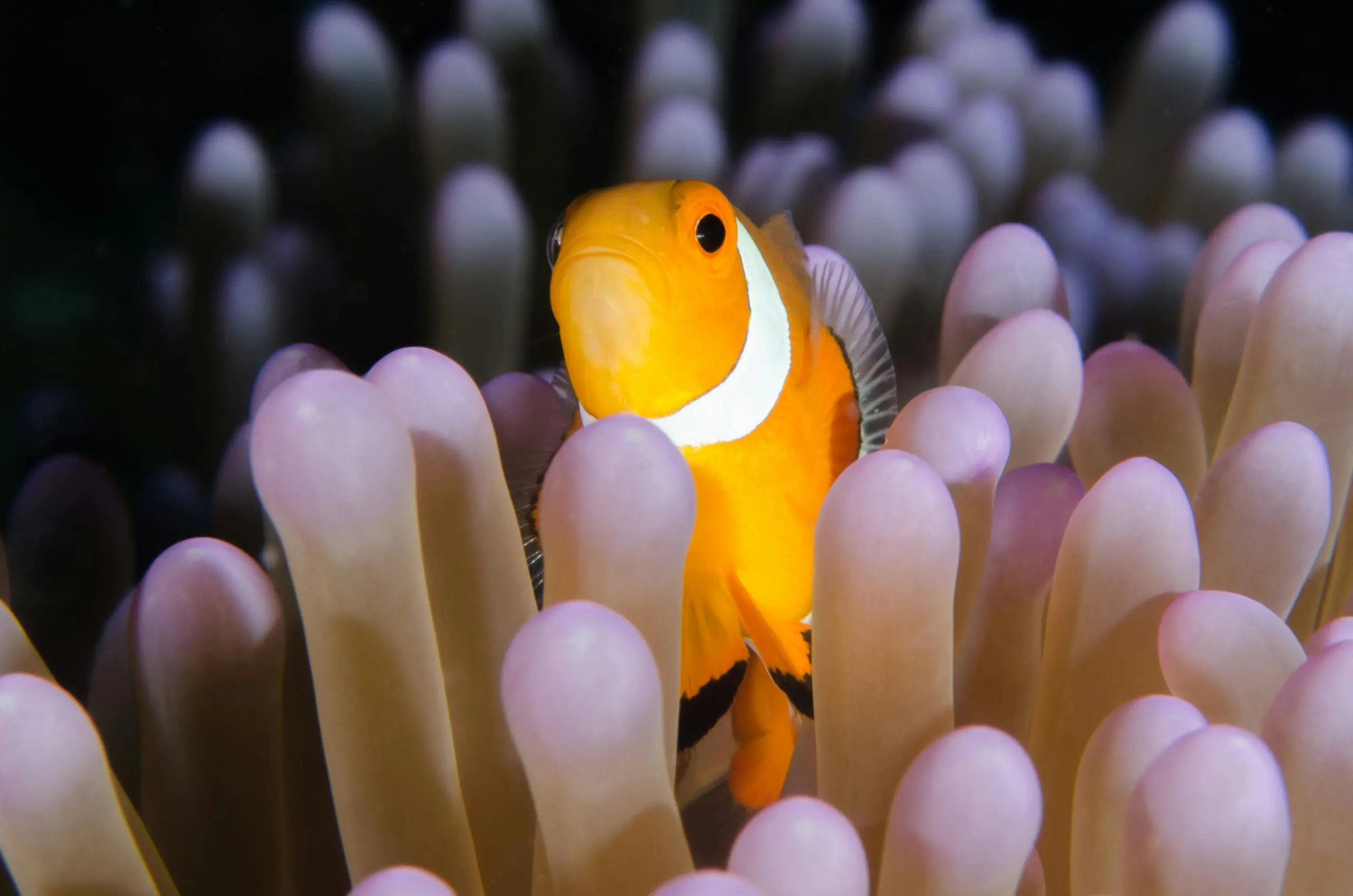
Illustrative Photo by Ben Phillips: https://www.pexels.com/photo/clown-fish-on-white-corals-4781926/