For researchers at the Jožef Stefan Institute (JSI) in Slovenia, the realisation that gender-balanced research is better research hit home in 2024.
That year, scientists at JSI’s space medicine laboratory, working with the European Space Agency, were testing ways to improve astronauts’ health – but only on men. Around that time, US astronaut Sunita Williams had to stay longer than planned on the International Space Station.
“The lead researcher came to me and said ‘next time we’re going to include women, we need data for women too’,” said Dr Romana Jordan, assistant director for EU affairs at the JSI. “Research is more valuable if it covers everybody.”
Exposing a hidden gender gap
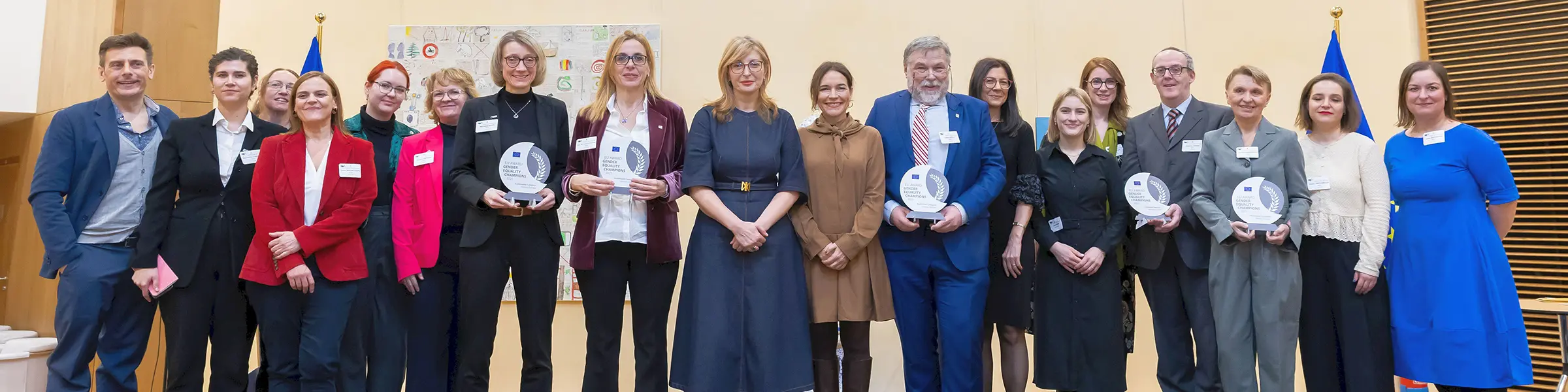
The JSI is one of five winners of the latest EU Award for Gender Equality Champions, which honours institutions successful in creating more inclusive and gender-equal research environments.
Staff at the JSI had initially believed that, thanks to Slovenia’s socialist past, the research and academic environment was meritocratic, Jordan said. But a detailed analysis showed a different picture.
“The most alarming finding was when we looked at who led departments and who sat on key decision-making committees: there was a clear gender gap,” said Jordan.
The JSI responded by setting up a human resources department, modernising promotion rules and introducing more flexible mobility requirements. It also improved communication about systems for reporting harassment and violence.
Now, through a new diversity and inclusion committee, it is looking at ways to improve opportunities for researchers and staff from different countries and age groups, and for those with disabilities.
“Gender equality is not about promoting women because they are women. It is about creating a working environment where excellence can truly flourish,” Jordan said.
Awards that reward better research
The EU Award for Gender Equality is structured around three categories: newcomer, sustainable, and inclusive champions. Each comes with a €100 000 prize.
It aims to reinforce and complement the eligibility requirement for public bodies, higher education institutions and research organisations applying to Horizon Europe to have a Gender Equality Plan (GEP) in place.
All the winners – this year from Czechia, Germany, Ireland, Slovenia and Spain – show how equality efforts improve fairness, strengthen research and support key European values.
“Implementing different perspectives on the same topic area improves the quality of the research because it becomes multifaceted,” said Professor Michaela Vogt, vice-rector for international affairs, diversity and society at Bielefeld University in Germany.
The university won the sustainability award for its long commitment to equality. It published its first GEP in 2000, long before EU funding rules linked research grants to gender equality.
“
Implementing different perspectives on the same topic area improves the quality of the research because it becomes multifaceted.
Bielefeld updates its GEP every three years, constantly asking what can be improved and what needs to change. Around 80 people across the university – from central administration to individual faculties – are involved in keeping the momentum going.
That work ranges from gender-aware hiring procedures and training that helps women scientists strengthen their professional visibility, to a publicly available “toolbox” with more than 120 practical measures that departments can draw on.
The results are visible. The proportion of women professors has grown from 16% in 2003 to 38% in 2023. Many academics are drawn to Bielefeld precisely because of this forward-thinking culture. The university also takes an intersectional approach, recognising that gender often overlaps with other forms of discrimination such as race, disability or social background, and needs to be addressed in that wider context.
“Bielefeld University really tries to look at the bigger picture,” Vogt said. “We recognise that discrimination isn’t one-size-fits-all. People experience it in different ways, and gender is often intertwined with other factors.”
Looking at equality from all angles
This approach fits wider European efforts to help people thrive regardless of gender, racial or ethnic origin, religion, disability, age or sexual orientation.
Intersectionality – looking at different aspects of a person’s identity – is also a priority for the Open University of Catalonia (UOC), Spain, which shared the sustainability award with Bielefeld.
Dr Maria Olivella, director of the equality, diversity and inclusion unit at UOC, said the university’s online model needs a different approach to inequality, or it can backfire.
Online learning supports work–life balance and can help staff and students with caregiving responsibilities. However, the digital environment needs careful management.
“Online work can reinforce inequalities if not supported properly,” Olivella said. “Not everyone has adequate home conditions, migrant staff may experience isolation, or there may be class- or race-based disadvantages.”
The university provides home office equipment to help redress the balance. Recent efforts also include updating its sexual harassment protocol so that online abuse is taken as seriously as in-person incidents, adding specific rules on LGBTQ+ phobia and carrying out annual gender pay gap analyses.
Changing attitudes online and offline
The Catalan university’s work is also about changing attitudes. Along with encouraging women to go for leadership roles, the university is probing why vital tasks such as administration or mentoring are as invisible as they are essential, Olivella said.
“This invisible academic administrative work needs to be officially recognised.”
The UOC is also trying to end the tendency for senior academics to benefit disproportionately from junior researchers’ work. It trains research leaders to prevent harassment and unconscious bias in how people are treated or evaluated, and promotes more equitable ways of running departments.
The institution reports that some professors choose to work there specifically because of its commitment to valuing women’s achievements, which it says leads to better academic results.
“If you don’t take gender into account, your research is not good. Society is gendered. If your research ignores that, it is unscientific,” Olivella said.
Newcomers raising their game
Charles University in Czechia won the newcomer award for its first GEP. It was introduced in 2022, coinciding with the arrival of the nearly 700-year-old university’s first female rector, Milena Králíčková.
She made equal opportunities a strategic priority and ensured that the university had the necessary capacity to drive change.
This included appointing a staff member dedicated to gender equality, establishing a university-wide ombudswoman, and creating a new advisory body on gender equality – all of it entirely unprecedented in the Czech context, said Iveta Bayerová, equal opportunities agenda coordinator.
The first phase of the university’s plan was a gender audit, which helped it assess the state of equality and set up a framework to measure progress.
Now on its second GEP, Charles University is introducing steps, such as childcare and child-friendly co-working spaces.
“
Society is gendered. If your research ignores that, it is unscientific.
“Universities have always been the nests of democracy,” Bayerová said. “We have a social responsibility to influence society in a way that is not political, but defends basic human rights and democratic values.”
Dr Avril Hutch, director of equality, diversity and inclusion at fellow award winner University College Cork in Ireland, agreed. “Universities are spaces where identity is formed and debated, and it is critical that they reflect the societies they serve.”
In Ireland, research institutes work under the Athena SWAN framework, a national charter to promote gender equality in higher education and research.
Hutch believes that linking research funding to the requirement for a GEP, in Ireland and across Europe under the Horizon Europe programme, is “transformative”.
Putting equality into practice
The university won its award for its 2019–2024 GEP, which introduced leave for fertility treatment, foster carers, surrogacy and pregnancy loss.
As part of that policy, managers get access to a toolkit with guidance and scripted conversations to help them support staff at a difficult time.
Under its 2025–2030 plan, the university will launch race equality and LGBTQ+ action plans and age-friendly initiatives.
Hutch stressed that the award also helps promote core European values.
“I can’t overstate the prestige of getting an award like this, which is a stamp of approval at European level, and which also says that Europe is not reneging on this,” she said.
“The European Union values are human rights, equality and the rule of law. To be able to say that we are part of this is really important.”
The views of the interviewees don’t necessarily reflect those of the European Commission. If you liked this article, please consider sharing it on social media.