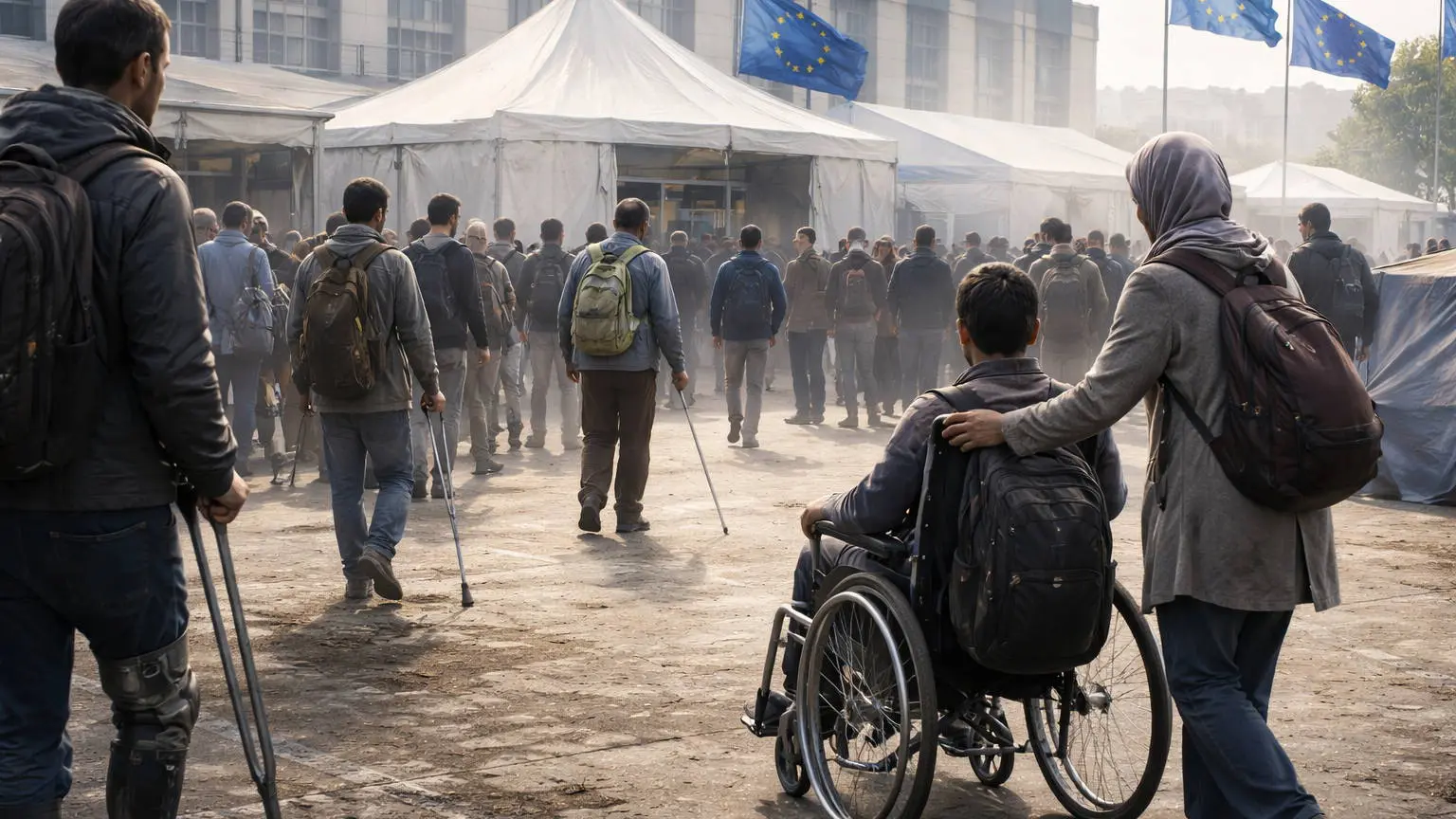
As the European Union moves toward full application of its Pact on Migration and Asylum in June 2026, disability-rights advocates are warning that one group remains too often overlooked: migrants and asylum seekers with disabilities. A new policy brief by the European Disability Forum and the International Refugee Assistance Project argues that, despite Europe’s legal commitments, many people still face inaccessible procedures, weak safeguards and barriers to basic support at the very point where protection should begin.
The warning comes in a joint statement published by the European Disability Forum (EDF) and in a longer policy brief prepared with the International Refugee Assistance Project (IRAP). Their argument is direct: Europe’s migration and asylum systems remain too often designed without disabled people in mind, even though the EU and its member states are bound by the UN Convention on the Rights of Persons with Disabilities and by the EU Charter of Fundamental Rights.
The timing matters. The Pact on Migration and Asylum, adopted in 2024, entered into force in June that year and is due to start applying after a two-year transition period. The European Commission has presented the framework as a system that is both firm and fair, and in January it published its first European Asylum and Migration Management Strategy to guide implementation over the next five years. But EDF and IRAP say that if disability is not built into that implementation, legal promises will remain largely theoretical for many of those seeking safety in Europe.
That concern fits into a broader debate about the direction of European migration policy. As The European Times recently noted in its wider analysis of Europe’s migration turn, the EU is under increasing pressure to show control at its borders while also preserving its commitment to rights and asylum. The EDF-IRAP brief suggests that disabled migrants and asylum seekers are where that tension becomes especially visible.
Five gaps at the centre of the dispute
The policy brief identifies five main problem areas. The first is invisibility. According to the authors, people with disabilities are still not properly recognised in EU migration frameworks, and disability-disaggregated data are not collected in any systematic way. Without that visibility, support often depends on chance, local practice or whether a person’s needs are immediately obvious.
The second is accessibility. Reception centres, screening systems and border procedures may exist on paper, but they are not always physically accessible or adapted for communication, cognitive needs or mental-health related disabilities. The brief argues that the expanded use of faster border procedures could make these failures worse if identification and reasonable accommodation are not built in from the start.
The third issue is exclusion from social protection. Migrants and asylum seekers with disabilities may face major obstacles in accessing healthcare, disability-related support, income assistance and community-based services. In practice, the gap between reception systems and mainstream welfare structures can leave people without meaningful support during crucial stages of the asylum process.
The fourth problem concerns family reunification and legal migration rules. EDF and IRAP argue that disability-related income and support arrangements are too often ignored when authorities assess whether a person meets financial or maintenance requirements. The result, they say, is indirect discrimination that can shut disabled people out of legal pathways that are open to others.
The fifth and most sensitive area is detention and return. The brief says disabled people face heightened risks when placed in detention-like settings or processed for return without proper safeguards, accessible information or adequate assessment of their needs. For rights advocates, this is not only an administrative issue but a test of whether Europe is willing to apply basic dignity and equality standards in its migration system.
What EU law already says
This is not a legal vacuum. Article 18 of the EU Charter guarantees the right to asylum. Article 21 prohibits discrimination, including on grounds of disability, and Article 26 recognises the right of persons with disabilities to measures supporting independence and participation in community life. The CRPD, which binds both the EU and all its member states, adds further duties on accessibility, equality, liberty, social protection and protection in situations of risk.
In other words, the dispute is not about whether disability rights are relevant to migration law. They clearly are. The real argument is whether the EU’s new migration architecture, as it is being implemented, gives those rights practical effect.
A test of implementation, not only intention
There is no doubt that migration systems are under strain across Europe, and EU institutions have spent years trying to build a more coherent framework after repeated crises. The Commission insists that the pact is meant to combine border management with safeguards for people in need of protection. Yet the EDF-IRAP intervention shows how easily a rights-based promise can weaken when policy is designed around speed, control and administrative efficiency.
For disability-rights organisations, the answer is not abstract. They are asking EU institutions and national governments to make accessibility and reasonable accommodation part of every stage of asylum and reception systems, ensure equal access to healthcare and support regardless of status, remove discriminatory migration conditions, and prevent detention or return procedures from placing disabled people at further risk.
The political question for Europe is now simple enough to state, even if harder to answer in practice: when the new pact begins to apply, will migrants and asylum seekers with disabilities finally be treated as rights-holders within the system, or remain an afterthought at its margins?