How anti-Islam politics moved from the fringe to the centre of political campaign?
Bashy Quraishy
Secretary General – European Muslim Initiative for Social Cohesion – Strasbourg
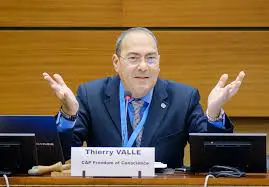
Thierry Valle
Coordination des Associations et des Particuliers pour la Liberté de Conscience
The recent parliamentary elections in Denmark, held on March 24. 2026 have marked a significant shift in the country’s political landscape. Called by Prime Minister Mette Frederiksen against the backdrop of heightened geopolitical tension, particularly surrounding Greenland and relations with the United States, the election was expected to consolidate her leadership in uncertain times. Instead, it delivered a decisive setback to the governing coalition and revealed a deeper, more troubling undercurrent within politics.
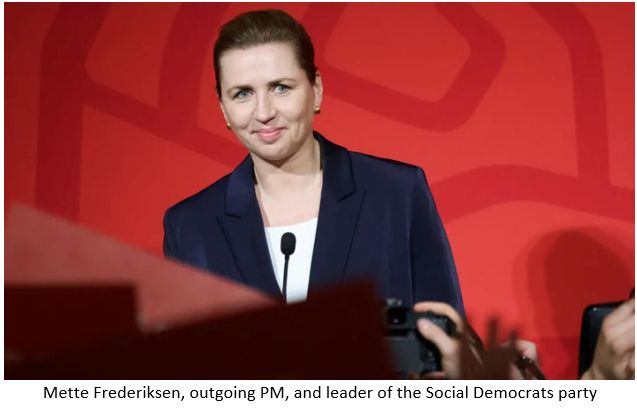
The Social Democrats, along with their coalition partners in the SVM government, suffered substantial losses. Yet beyond the immediate political implications of government instability, a more consequential development emerged: the strong performance of parties campaigning on explicitly anti-Islam and anti-immigration platforms. The Danish People’s Party and other right-wing actors capitalized on rhetoric that framed Islam not merely as a cultural difference, but as a threat to national identity and social cohesion.
Denmark’s March 24 parliamentary election was not simply a defeat for Prime Minister Mette Frederiksen’s SVM coalition, it was the culmination of a political shift years in the making. What unfolded during the campaign was not an isolated surge of right-wing populism, but the normalization of a narrative that increasingly defines Islam itself as incompatible with Danish society.
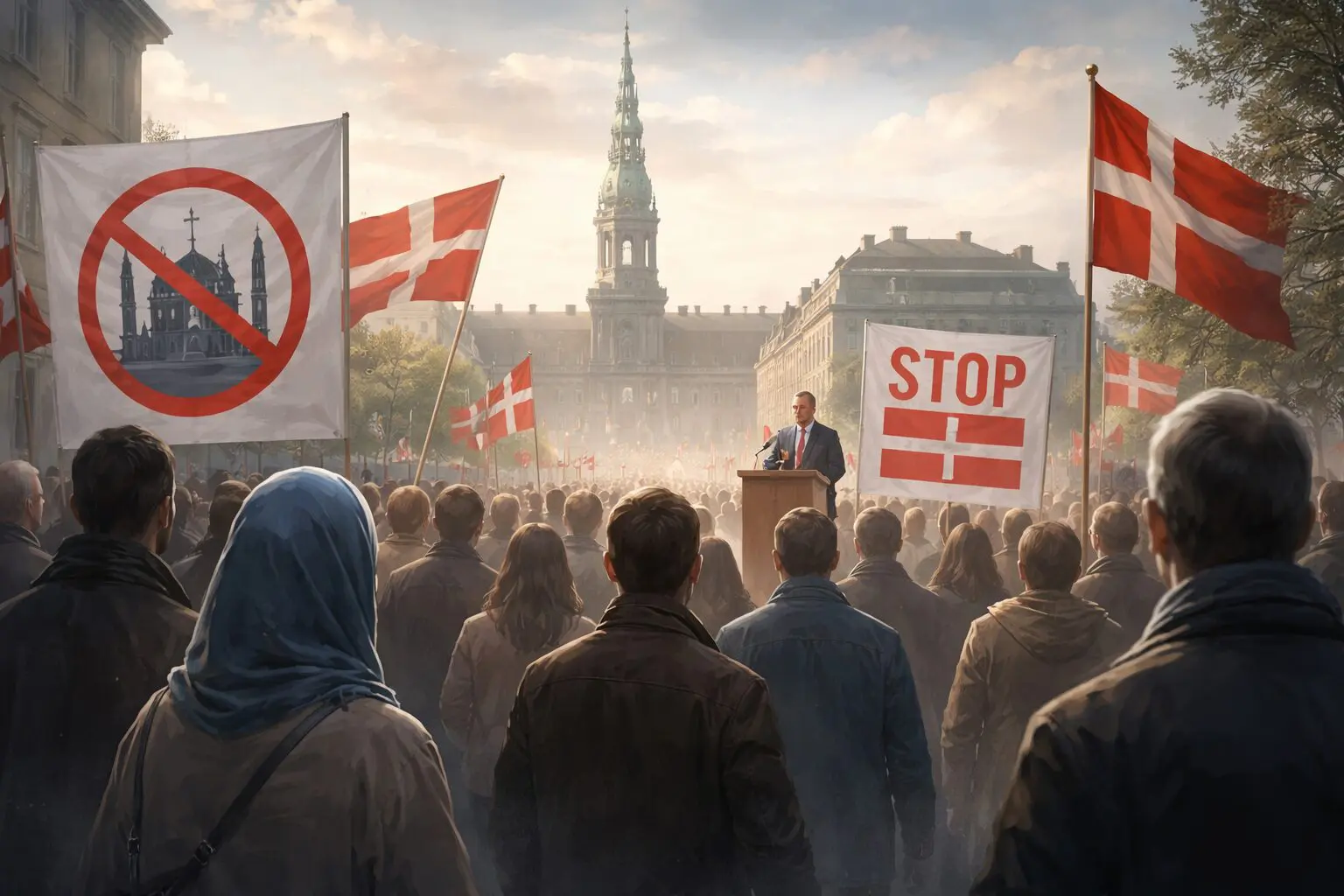
Throughout the campaign, Islam was framed not simply as a religion, but as a civilizational challenge. Political messaging emphasized “cultural incompatibility,” often linking Muslim communities to crime, welfare dependency, and social fragmentation. Immigration and integration ranked among the top voter concerns, underscoring how effectively these narratives resonated.
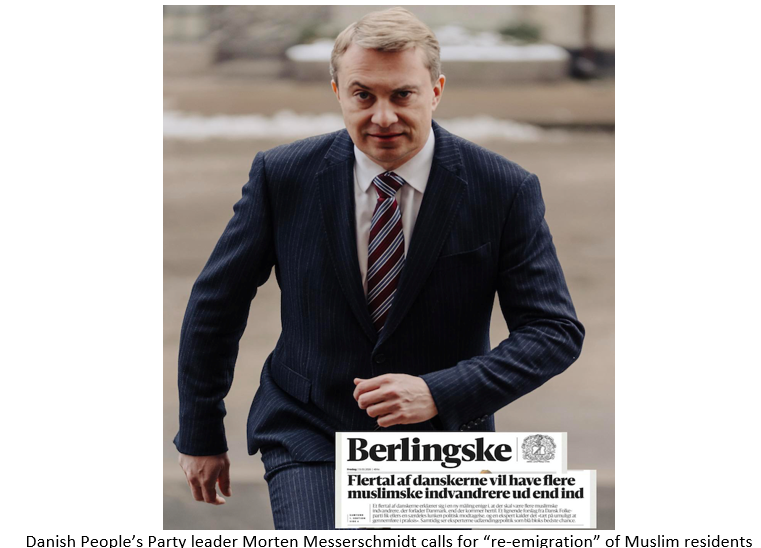
At the centre of this shift was the strategic use of identity politics, directed at minorities. Danish People’s Party leader, Morten Messerschmidt’s call for “net emigration of Muslim residents” marked a clear escalation, placing religion at the core of political belonging. Crucially, such proposals were not dismissed as fringe; they entered mainstream debate as negotiable positions.
Framing of Islam as a societal threat
In the months leading up to the election, anti-Islam discourse increasingly dominated political messaging. Issues of integration, security, and cultural values were framed in ways that disproportionately targeted Muslim communities. While some mainstream actors attempted to navigate these debates cautiously, few forcefully challenged the underlying assumptions or the divisive framing. This reluctance created a vacuum, one that was readily filled by parties willing to push the boundaries of acceptable political discourse.
This development did not emerge in isolation. It builds on years of political framing in which Islam has been treated as a societal problem. PM Frederiksen herself has described Islam as “a barrier to integration,” while more extreme politicians such as Rasmus Paludan and Lars Bøje Mathiesen have openly called for all Muslims to leave Denmark. While widely condemned, such statements expand the boundaries of acceptable discourse, making more moderate exclusionary positions appear reasonable. This is how normalization operates: not only through electoral success, but through repetition and insufficient resistance.
The consequences of this silence are now evident. The normalization of exclusionary rhetoric has shifted the political centre of gravity. Positions that were once considered fringe have gained legitimacy, not only through electoral success but through repetition and lack of resistance. These risks embedding a narrative that undermines democratic principles of equality, pluralism, and mutual respect.
Silence as strategy by the mainstream parties
A defining feature of the election was not just the presence of anti-Islam rhetoric, but the absence of sustained opposition to it. Mainstream parties largely avoided direct confrontation. Instead, they adopted softer variations of the same framing, speaking of “integration challenges,” “parallel societies,” and “cultural cohesion.”
This convergence reflects a strategic calculation: challenging such narratives risks alienating voters who have already internalized them. Yet the consequence is clear. By failing to contest the premise, mainstream actors legitimize it. The debate shifts from whether exclusionary ideas are valid to how they should be implemented.
As a result, exclusionary rhetoric no longer needs to win arguments, it only needs to be repeated.
A representation gap is widening
Denmark’s population includes a significant and growing number of citizens with immigrant roots. Yet their presence in national politics remains marginal. The explanation lies not primarily with voters, but with political parties themselves.
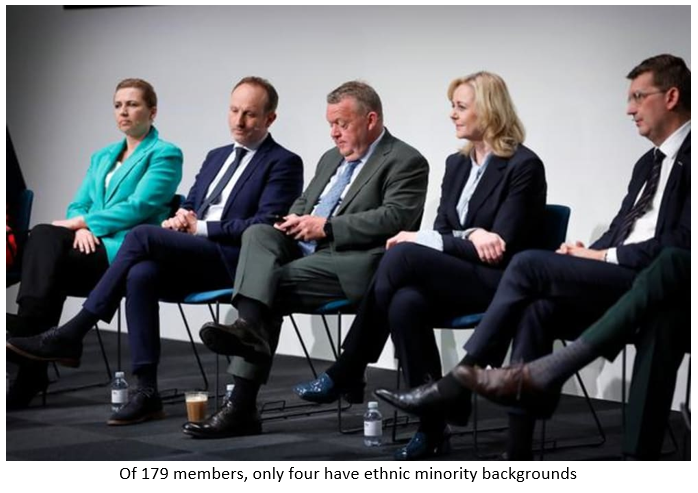
While identity dominated the campaign, the composition of parliament reveals a stark imbalance. Of 179 members, only four have ethnic minority backgrounds, despite roughly one in ten residents having immigrant roots.
This disparity is driven less by voter behaviour than by party structures. Minority candidates remain underrepresented and are often placed in unwinnable list positions. Political recruitment continues to rely on established networks that many minorities struggle to access, while concerns about “electability” persist.
The contradiction is striking: a political system preoccupied with minority communities, yet resistant to their participation. The result is a parliament that debates issues such as integration, religion, and identity with minimal direct representation from the communities most affected by those policies.
Rhetoric and representation reinforce each other. When minorities are absent from parliament, debates about them become abstract and detached from lived experience. This makes simplified narratives easier to sustain and harder to challenge. In turn, these narratives can discourage political participation among minority communities, deepening underrepresentation. The result is a self-reinforcing cycle that benefits actors who rely on polarization.
Breaking the pattern and changing the picture, from margins to representation
Reversing this trajectory requires structural change.This means that the political parties must first confront their role in shaping the current discourse. Rejecting overt discrimination is not enough; they must also challenge the underlying assumptions that frame Islam as a societal threat.
Second, candidate selection must change. This means actively recruiting minority candidates, supporting them, and placing them in winnable positions. Diversity must move beyond symbolism toward measurable inclusion.
Third, the risks of inaction must be recognized. A parliament that does not reflect its population is not only unbalanced, it is vulnerable. Democratic legitimacy depends on meaningful representation.
Fourth, minority participation must be understood as a form of political agency, not assimilation. Engagement, through voting, organizing, and candidacy, is essential to reshaping the system from within. But responsibility cannot rest solely with those excluded; it must also be assumed by those who control access.
Finally, representation must be framed not as identity politics, but as democratic legitimacy. A parliament that does not reflect its population, risks losing trust and failing to fully address the complexities of modern society. This means that civic participation within minority communities is crucial. Higher voter turnout and stronger engagement can influence party strategies, particularly in urban constituencies where minority voters represent a significant share of the electorate.
Minorities should utilize their rights and responsibilities in the political spectrum
The very low percentage of ethnic voters in the elections calls for a renewed engagement from Denmark’s ethnic and religious minorities. Political participation is not merely a right but a crucial avenue for representation and influence. Voting, civic engagement, and active involvement in political parties are essential steps toward ensuring that minority voices are present where decisions are made.
Encouragingly, there is growing awareness among younger generations from diverse backgrounds about the importance of political representation. Supporting and empowering these individuals to enter public life, whether at the local or national level, can help rebalance the discourse and bring lived experiences into the heart of policymaking.
The future of Danish democracy will depend not only on who forms the next government, but on how the country chooses to define itself in the face of rising polarization. Will it reaffirm its commitment to inclusivity and democratic integrity, or will it allow exclusionary narratives to take deeper root?
The answer lies in the actions taken now by political leaders, civil society, and all citizens – particularly of ethnic origins.
A defining moment for Denmark and Europe
Denmark’s election reflects a broader European pattern in which anti-immigration and anti-Islam narratives are reshaping political competition. The question is no longer whether these narratives exist, but whether they will continue to define the political centre.
If left unchallenged, they risk becoming embedded not just in campaigns, but in governance. Reversing such a shift becomes far more difficult once it is institutionalized.
The coming weeks will focus on coalition negotiations, but the more consequential question lies beyond government formation: whether Denmark’s political class is willing to confront the narratives that now shape its politics.
For minority communities, the message is equally clear. Participation is essential. Representation, engagement, and civic involvement are critical to ensuring that democratic institutions reflect the society they serve.
As Europe watches, Denmark faces a choice, one that will shape not only its own democratic future, but also broader debates across the continent.