By Boris Ilyich Gladkov
Conversation Two
1. Last time, I began our conversation about the transmigration of souls with the words: “Man has never been able to reconcile himself to the idea that death is the end of his existence.” Indeed, the desire to know where the human soul goes after death, where and how it lives, has always occupied those who desire a conscious relationship with themselves and the world around them. This desire has given rise to a wide variety of theories: of a dark underworld where the souls of the dead wander like shadows, of islands of bliss located somewhere in the west, of the painful and seemingly endless reincarnations of souls into various bodies of people and animals, plants, and even inorganic objects. But all these theories remained just that, theories, providing no positive knowledge.
Therefore, since ancient times, there has been a desire to establish contact with the afterlife, to summon the souls of the dead from that world, and to learn from them what is hidden from us by an impenetrable veil. And where there is a demand for something, there is immediately a supply of what is needed. This is the law of human society. When there was a desire to summon the soul of the deceased and converse with it, soul-seekers arose. But since souls are incorporeal and therefore cannot be seen by human eyes, nor can they assume any visible form, soul-seekers, even in ancient times, were forced to pose as intermediaries between the summoned souls and those who wished to converse with them. But souls, of course, could not speak; therefore, the intermediaries themselves answered questions, as if paraphrasing the summoned soul’s answers, which, supposedly, were understandable only to them, the soul-seekers. It should be noted that these soul-seekers, or sorcerers, were generally reputed to be evil people, having dealings with evil spirits, with the devil. In many countries and throughout the ages, they were persecuted, expelled, and even burned at the stake. Their lives were far from those of holy people close to God, to whom God could reveal the secrets that interested them. Holy people did not engage in such matters and did not reveal any secrets of the afterlife to their worshipers.
2. The Bible contains the story of the witch of Endor. And since many cite this story as proof of the possibility of communication with the afterlife, I will dwell on it first.
This story is found in the 28th chapter of the First Book of Kings. Here is what it says: 4. Then the Philistines gathered themselves together, and came and encamped at Shunem. And Saul gathered together all the people of Israel, and they encamped at Gilboa. 5. And Saul saw the host of the Philistines, and was afraid, and his heart trembled greatly. 6. And Saul inquired of the Lord; but the Lord answered him not, neither by dreams, nor by Urim, nor by prophets. 7. Then Saul said to his servants, “Find me a woman who has a medium, and I will go to her and inquire of her.” And his servants answered him, “There is a woman who has a medium here at Endor.” 8. So Saul took off his clothes and put on other clothes, and went, he and two men with him. And they came to the woman by night. And Saul said to her, “I pray thee, use a sorceress for me, and bring out for me whom I shall tell thee.” 9. But the woman answered him, “Thou knowest what Saul has done, how he has driven the mediums and the sorcerers out of the land: why then have thou laid a snare for my life to destroy me?” 10. Then Saul sware to her by the LORD, “As the LORD liveth, no harm shall come upon thee for this thing.” 11. Then the woman asked, “Whom shall I bring out for thee then?” And he answered, “Bring out Samuel for me.” 12. And when the woman saw Samuel, she cried out with a loud voice, and said, “I am Samuel.” And the woman spake unto Saul, saying, Why have you deceived me? art thou Saul? 13. And the king said unto her, Fear not; tell me, what seest thou? And the woman answered, I see one as it were a god coming up out of the earth. 14. What form is he? Saul asked her. And she said, An old man, clothed in a robe, cometh up out of the earth. Then Saul knew that it was Samuel; and he fell with his face to the ground, and worshipped. 15. Then Samuel said unto Saul, Why dost thou trouble me to come forth? And Saul answered, I am greatly distressed: the Philistines fight against me, and God is departed from me, and answereth me no more, either by prophets, or by dreams, or by visions: therefore have I called upon thee, that thou mayest teach me what I should do. 16. And Samuel said, Why dost thou ask of me, seeing the LORD is departed from thee, and is become thine enemy? 17. The Lord will do what he has spoken through me: He will tear the kingdom out of your hand and give it to your neighbor, to David. 18. Because you did not obey the voice of the Lord and did not execute His fierce anger against Amalek, therefore the Lord has done this to you this day. 19. And the Lord will deliver Israel with you into the hand of the Philistines: tomorrow you and your sons will be with me; and the Lord will deliver the host of Israel into the hand of the Philistines. 20. Then Saul fell suddenly with his whole body to the ground, for he was greatly afraid at the words of Samuel; and there was no strength left in him, because he had eaten no food all that day or all that night. (1 Samuel 28:4-20)
Before explaining this story, I must make a disclaimer. Following the teachings of the Holy Orthodox Church, I believe that everything recorded in the Old Testament books of the Bible actually happened as recorded. Following the teachings of the Father and Teacher of the Church, St. John Chrysostom, I want to grasp the true meaning of the biblical narratives without stopping at a literal understanding of them. St. John Chrysostom, in his homilies on the book of Genesis, said: If we wish to accept the words of Scripture in their literal meaning, will not much seem strange? (Discourse XVII, 1). And the Saint pointed out several passages in the book of Genesis that may indeed seem very strange and may lead the reader into complete bewilderment if he decides to understand them literally (Discourse IV, 4; VII, 3; XII, 4-5; XIII, 2-3; XV, 2; XVII, 1, etc.). One thousand five hundred years have passed since then, but even today many demand that Bible readers understand all biblical passages literally, and thus, albeit unintentionally, spread atheism, especially among young students, as I discuss in greater detail in my brochure, “The Root Cause of Our Atheism.”
If St. John Chrysostom says that Moses was forced to clothe the thoughts inspired by God in crude expressions in order to be understood by the underdeveloped listeners of his time; if the Saint advises that even the words of a divinely inspired writer be understood not literally, but rather to seek out the divinely appropriate meaning hidden beneath the crude expressions, then we must be even more wary of the words of unknown authors of biblical passages or the ordinary chroniclers of the Jewish kings. So, recognizing the authenticity of the story of the witch of Endor, let us strive, in the light of Christ’s truth, to understand it in a godly manner—that is, so that nothing in it seems strange to us, so that by revealing the story’s true meaning, the Bible’s lofty authority will be upheld, and not undermined.
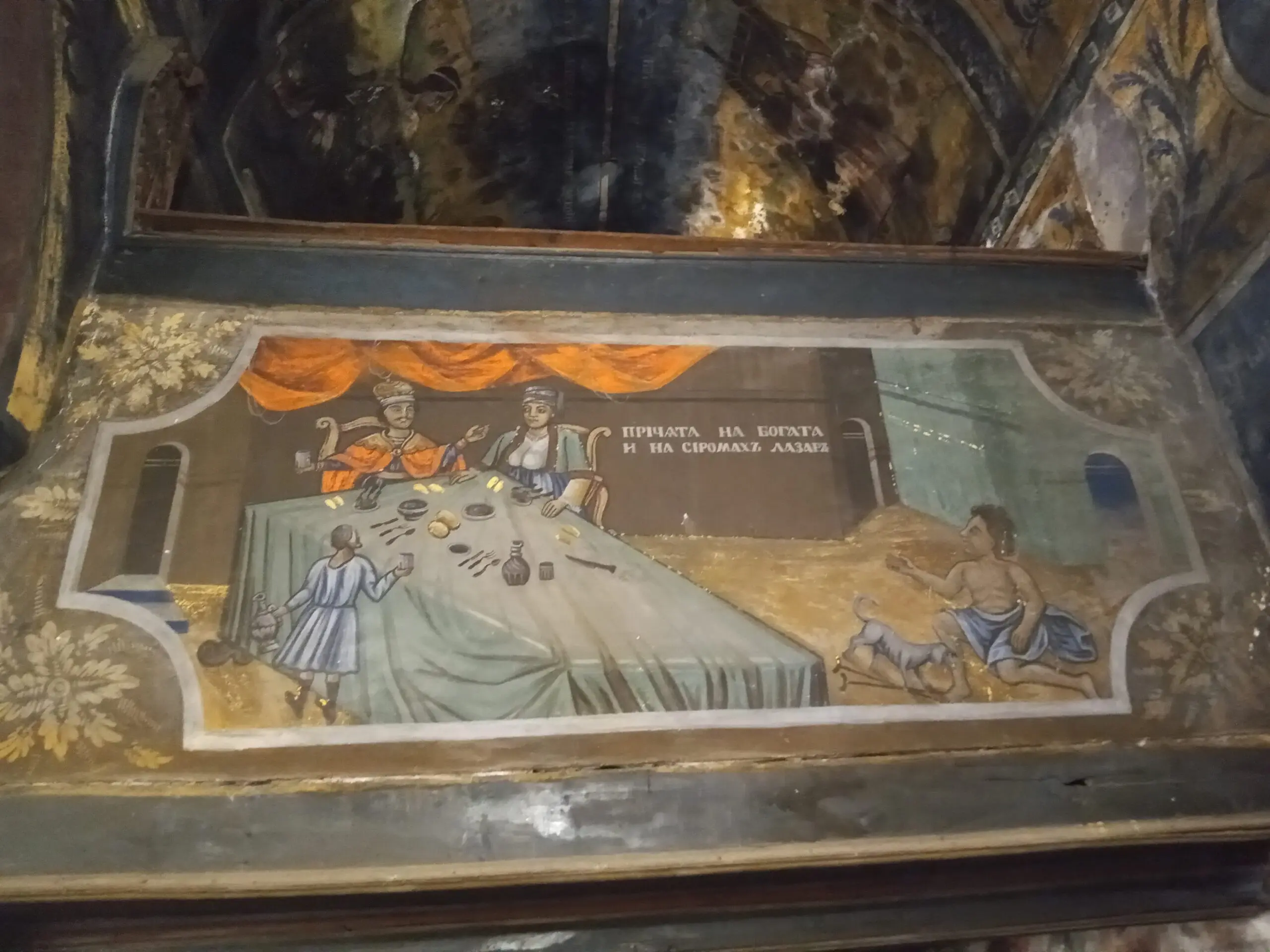
Illuminating this story with the light of Christ’s truth, we must recall the Lord’s parable of the rich man and the beggar Lazarus (Luke 16:19–31). The rich man in the parable, after his death, understood the full sinfulness of his dissolute life and felt its terrible consequences. He longed to warn his brothers who remained on earth, lest they fall into the same place of torment where he suffered unspeakably. However, despite his passionate desire, he could not appear to them, but prayed to Abraham to send his beggar Lazarus to his brothers. This parable convinces us that between our earthly world and the afterlife lies an impassable chasm—that no one of the dead can cross it, and that, therefore, summoning the souls of the dead constitutes a daring attempt to lift the veil lowered before us by God Himself, a daring rebellion against God. Therefore, the summoning of spirits was condemned by God in ancient times through the inspired prophets. (Exodus 22:18; Leviticus 19:31, 20:6, 27; Deut. 18:2; 1 Samuel 15:23).
So, in the light of divine truth, we will not have difficulty comprehending the true meaning of the story of the Witch of Endor. And I advise illuminating with this light all biblical stories in general, even those that, in their literal meaning, may seem strange. Before discussing this account, we must first determine who wrote it. In the Hebrew Bible, the First and Second Books of Samuel are called the Books of Samuel the Prophet; however, since Chapter 25 of the First Book speaks of Samuel’s death, and then of the events that followed his death, it is clear that the entire Second Book of Samuel, as well as Chapters 25 and later of the First Book, could not have been written by the Prophet Samuel. Chapter 29 of the First Book of Chronicles (1 Chronicles 29:29–30) states: Now the acts of King David, first and last, are they not written in the book of Samuel the seer, and in the book of Nathan the prophet, and in the book of Gad the seer? Also all his reign, and his might, and the things that befell him, and Israel, and all the kingdoms of the earth. These words of the chronicler prove that the reign of David is described by the prophets Nathan and Gad; but by whom the last days of Saul’s reign are described remains unknown.
From the very account of Saul’s visit to the witch of Endor, it is evident that, in addition to the witch herself, King Saul and two of his servants witnessed the evocation of Samuel’s spirit. Consequently, whoever recorded what transpired at the witch’s could only have done so from the words of these witnesses, or with their words; and their words must have reflected the involuntary agitation they experienced upon crossing the witch’s threshold. If, upon seeing the numerous Philistine camp, Saul was frightened, and his heart trembled violently; if, desiring to know the outcome of the impending battle, he resorted to the Lord with prayer to reveal the future, whether in a dream or by throwing sticks, Urim and Purim, and received no answer; if, finally, he recalled the prophecies of the now-dead Samuel concerning his impending doom—then it is understandable with what fear he entered the witch’s presence, desiring, at least through her, to learn what would become of him. And those servants he had decided to confide in were undoubtedly experiencing the same sense of fear that had overwhelmed their master. In short, all three were then in that nervous state when people are prone to see not what is actually happening before them, but what their disordered imaginations conjure up, and to hear the words they themselves instill in themselves. Therefore, the accounts of such witnesses must be treated with great caution.
Let us consider what exactly happened here. The sorceress, who had certainly seen Saul more than once, must have recognized him even without his royal garb; and undoubtedly she did. But since it would have been unwise to hide now from the king, a persecutor of all sorcerers and fortune-tellers, who had come to avail himself of her services, she had to pretend not to recognize him. Saul directly asked her to cast a spell on him and bring forth the one he named. Having extracted an oath from Saul that no harm would come to her for this matter, and learning that Saul desired to see Samuel, the sorceress began her spell and cried out. To Saul’s question, “What do you see?” she replied, “I see something like a god coming up out of the earth.” “What is his appearance?” Saul asked. And the sorceress said, “There comes up out of the earth an old man, dressed in a long robe.” From this description of the appearance of the one coming out of the earth, Saul guessed that it must be Samuel, whom he desired to see. And Saul fell face down on the ground and remained in such a position that he could not see anything. Undoubtedly, his servants also fell on their faces, according to the Jewish custom, and as a result, they too could not see anything. And indeed, there was nothing to see. Saul’s conversation with the sorceress leaves no doubt that neither Saul nor his servants saw Samuel; Of course, the sorceress didn’t see him either, but she at least said she saw him, although her words shouldn’t be given any credence.
This story reflects, as in a mirror, the worldview of the Jews of Saul’s time. Knowing nothing of the afterlife or the Kingdom of Heaven, they imagined the souls of all the dead, sinners and righteous alike, to be located in Sheol, the mysterious underworld. Therefore, the sorceress, who knew nothing of the afterlife beyond Sheol, says she sees Samuel emerging from the earth. A modern sorceress would have brought Samuel down from heaven, from the abodes of the Heavenly Father; but the sorceress of Endor could only have brought Samuel out of the dark underworld, for she had no idea of any other abode of souls. Modern geology gives us information about the layering of the earth’s crust and about the fiery-liquid state of the interior of the globe, which does not allow the existence of any Sheol, any underground kingdom.
All this proves that the witch of Endor was shamelessly lying when she assured Saul that she saw Samuel emerging from the earth.
Next follows the conversation between Saul and Samuel. Whether this was a direct conversation, or whether Saul spoke to Samuel through the witch, is unclear from the Bible. But since, based on the above, we must admit that Samuel, at the witch’s request, did not emerge from the dungeon, we must also admit that he did not speak to either Saul or the witch. The witch conveyed to Saul, on behalf of Samuel, the usual question always asked by imaginary spirits summoned by someone: “Why do you disturb me to come out?” Sorcerers always ask this question so that the answer to it will inform them how to proceed with the conversation on behalf of the imaginary spirit. Saul fell for this bait and immediately began to tell in detail what had brought him there. And that was all the cunning sorceress needed. Falling on his face in fear and, as a result, blinded by everything, Saul said, “I am in great distress. The Philistines are fighting against me, and God has departed from me and no longer answers me either by prophets or in dreams. Therefore, I have called upon you to teach me what I should do.” Having thus learned why Saul wanted to summon Samuel, the sorceress could now easily answer Saul in Samuel’s name. But what could she say? If Samuel could appear to Saul, then, of course, he would only repeat what he had told him in life, which was known to everyone, including the sorceress. And what Samuel said in his lifetime is evident from the same First Book of Samuel, chapter 15. Before the war between the Jews and the Amalekites began, Samuel reminded Saul of how this people had harmed the Jews coming out of Egypt. And Samuel said to him, “Go and smite Amalek, and destroy all that they have. And show them no mercy, but put to death both man and woman, child and suckling, ox and sheep, camel and donkey!” (1 Samuel 15:3). Saul, having gained victory over the Amalekites, destroyed them all with the sword, but spared their king Agag and the best of the sheep and oxen and fattened lambs and all the good things of the property taken from the vanquished. Then Samuel came to him and, reminding him of God’s previously given commandment about the destruction of the Amalekites, said, “Why did you not obey the voice of the Lord, but rushed upon the spoil and did evil in the sight of the Lord? Because you have rejected the word of the Lord, He has also rejected you from being king over Israel. This day the Lord has torn the kingdom of Israel from you and given it to your neighbor, a better man than you (1 Samuel 15:19, 23, 26, 28).
The witch of Endor, of course, knew all this, for Samuel spoke these words to Saul not in secret, but publicly. And so, in these words of Samuel, the witch found the most fitting answer to Saul’s question. She conveyed to Saul the answer of Samuel, whom she had supposedly summoned, in this form: “Why do you ask me, seeing the Lord has departed from you and become your enemy? The Lord will do what He has spoken through me: the Lord will tear the kingdom out of your hand and give it to your neighbor, to David.” Because you did not obey the voice of the Lord and did not execute His fierce anger against Amalek, therefore the Lord has done this to you this day. And the Lord will deliver Israel and you into the hand of the Philistines: tomorrow you and your sons will be with me. And the Lord will deliver the host of Israel into the hand of the Philistines (1 Samuel 28:16–19).
This is the answer of the witch of Endor to Saul, who lay face down before her. The cunning witch first secured Saul’s oath that no harm would come to her. Then, knowing that a decisive battle with the Philistines was to follow the next day and fully understanding the fate that awaited the king in this battle, trembling with fear and therefore unable to galvanize his army, she repeated to him Samuel’s earlier words and foretold the death of him and his sons.
How loudly the sorceress’s words struck Saul, and he fell with his whole body to the ground. Until then, he had remained in the position he had assumed immediately after the sorceress uttered the words: “An aged man comes forth from the earth, clothed in a long robe.” After these words, he assumed the position of a man prostrated, according to the Hebrew custom, on his face. To fall on one’s face is not the same as lying face down on the ground with one’s chest down; to fall face down means to kneel and, bending forward, place one’s head on the ground, face downwards; it is something like our prostration, only with a more extended position of the body. To fall with one’s whole body on the ground, however, means to assume the position of a man either dead, fainting, or completely exhausted. I draw particular attention to this difference in Saul’s position before and after hearing his sentence, in view of the objection raised to me. It has been pointed out to me that if the Bible describes Saul falling flat on his face, this proves that before his fall he was standing and could have seen Samuel summoned by the sorceress. But such an objection clearly contradicts the biblical narrative. The Bible describes Saul falling face down on the ground after hearing from the sorceress that an elderly man in a long robe was emerging from the earth, but the subsequent narrative does not indicate that Saul then rose to his feet and spoke standing up. The suggestion that Saul supposedly rose to his feet is unacceptable, as an arbitrary addition to the biblical narrative. Moreover, the chronicler’s silence on this point rather suggests that Saul, having fallen face down, remained that way until he, upon hearing the sentence, collapsed flat on his face. Saul was so terrified of the Philistines that he decided to resort to the mediation of a sorceress, thereby violating both the Law of Moses and his own decree banishing sorcerers and fortune-tellers. In this depressed state of mind, he suddenly heard from the sorceress that the one he desired to see was emerging from the earth—that is, the formidable and implacable denouncer of his iniquities. Having bowed his face to the ground even before Samuel’s imaginary emergence, Saul, of course, did not dare raise his head once the conversation with this denouncer had already begun through the sorceress. Trembling with fear, not daring to raise his eyes, Saul remained in the same position and, of course, saw nothing of what was happening.
To all this, I consider it necessary to add that even if the conjuration of spirits and their appearance at the summons of the conjurers were possible, Samuel would not have appeared to Saul at the summons of the sorceress. After all, he himself, in the name of God, condemned witchcraft as a grave sin. Reproaching Saul for not destroying all the property of the Amalekites and their king himself, he said, among other things: “Rebellion against God is as the sin of witchcraft” (1 Samuel 15:23). He could not have gone against God and become an accomplice to such grave sin, even if he had been able and willing to again foretell to Saul the tragic end he had prophesied in his lifetime.
Some theologians agree that the witch of Endor herself could not have summoned Samuel; but, wishing to adhere to the literal meaning of the biblical account, they suggest that God permitted the witch to summon Samuel—that is, it was not the witch who summoned him, but God. Of course, the Almighty God could have performed a miracle, could have commanded the dead Samuel to take on a visible form, appear to Saul, and even converse with him. Those who believe in God cannot doubt this. But there is also no doubt that if God had wished to announce the outcome of the battle with the Philistines to Saul on the eve of the battle, He would have done so in another way, for example through a prophet, and certainly not through a deceitful sorceress. God Himself condemned sorcery as one of the most grievous sins, so is it even conceivable that He would choose a sorceress as the instrument of His will, thereby tempting people, giving them an excuse to circumvent His laws and violate His holy will? If the Bible says that Saul prayed to God to reveal the outcome of the upcoming battle, but God abandoned him and did not answer him, whether through a dream, the Urim, the prophets, or a vision, this means that God was unwilling to reveal Saul’s future. And if God did not want Saul to know the outcome of this battle, then it is impossible to even imagine that God would allow a sorceress to violate His will.
Therefore, the biblical story of the Witch of Endor gives spiritualists no basis for citing it as proof of the possibility of summoning spirits or, in general, the possibility of communicating with the afterlife. This story confirms only one thing: that among the Jews, too, there were many people who desired to know what happens to a person’s soul after death, and that there were also many who sought to profit from this desire. No other conclusion can be drawn from this story.
This is how I understand the biblical story of Saul and the Witch of Endor. I believe that in my interpretation I fully follow the instructions of St. John Chrysostom, and that my explanation, in the words of the Saint, is entirely pleasing to God.
3. In other times and probably among all peoples, there have been spiritists, sorcerers, magicians, and sorcerers. But since I am referring only to our modern desire to establish contact with the spirit world, I will limit myself to a brief reference to the Bible.
Moses, after leading the Jewish people out of Egypt and composing laws for them, instituted the death penalty for spirit-conjurers. “If a man or a woman practice a medium, whether they be a medium of the dead or a sorcerer, they shall surely be put to death; they shall be stoned; their blood shall be upon them” (Lev. 20:27). In his farewell address, Moses implored the Jews not to engage in either incantations or any form of sorcery. “When you enter the land which the Lord your God gives you, you shall not learn to do the abominations that these nations have committed. There shall not be found among you anyone who makes his son or his daughter pass through the fire, or one who practices divination, or a soothsayer, or a practitioner of witchcraft, or a sorcerer, or a charmer, or a medium, or a wizard, or one who calls up the dead. For everyone who does these things is an abomination to the Lord; and because of these abominations the Lord your God will drive them out from before you. You shall be blameless before the Lord your God. These nations listen to soothsayers and diviners, but the Lord your God has not given you that. The Lord your God will raise up for you a Prophet like me from among you, from your brethren; him you shall hearken to him” (Deut. 18:9-15). By the name of the Prophet spoken of by Moses, the Jews always understood the promised Messiah, Christ. Thus, it turns out that Moses implored the Jews not to listen to fortune-tellers, spiritists, and sorcerers, but to listen only to the Messiah-Christ. It was common for pagans to turn to them, but the Lord has not given you this; He reveals His will to you through divinely inspired prophets; but to you the Messiah will come; listen to Him!
And the divinely inspired prophet Isaiah warned the Jews not to turn to spiritists and urged them to turn to God. When they say to you (he said), “Turn to mediums and to sorcerers, to whisperers and ventriloquists,” then answer ye: “Should not a people turn to their God? Should men inquire of the dead for the living? Turn ye to the law and to the testimony” (Isaiah 8:19-20).
If so spoke the Jews their prophets; If they foretold the coming of the Messiah and commanded them to listen to Him and not to spiritists, then we Christians are ashamed to listen to sorcerers and whisperers: the Messiah-Christ came long ago, long ago revealed to people everything accessible to their understanding, everything necessary for their salvation; but, unfortunately, those who are carried away by spirit invocations neither listen to Him nor believe Him.
4. In the last century, many were fascinated by turning tables, and this activity initially constituted amusement, amusement. But soon the tables went beyond mere movement; they began to tap. Both the turning of the tables and their tapping occurred, for the most part, with the direct participation of special individuals possessing the exceptional ability to reproduce these phenomena. These individuals became known as mediums, intermediaries between our world and the afterlife. The mediums explained that the tapping of the tables was a special way for spirits to communicate with people. They devised an alphabet for these taps, similar to the Morse code of the telegraph machine; and immediately, all the spirits unquestioningly accepted this alphabet and began to engage in conversations with people at spiritualistic séances. But conversations by tapping, which took place only with the participation of a medium, took too much time and soon became tiresome to the spirits. Therefore, they, that is, the spirits, advised the mediums to take a pencil, tie it to a box, place the box on a piece of paper, and place their fingers on the box itself. And as soon as this was done, the pencil immediately began to write the spirits’ answers to the questions posed to them under the medium’s fingers. But soon the spirits grew tired of this too, and they advised the mediums to drop the box and, without any ceremony, take the pencil in their own hands and hold it as one normally holds it when writing. And when everything that constrained the spirits was discarded, the pencil in the hands of mediums began to quickly write not only the spirits’ answers to the questions asked of them, but even entire lectures.
Having collected and systematized the responses and communications of spirits, Allan Kardec composed a kind of catechism for the spiritists and elevated spiritism to the status of a new revealed religion, rejecting the teachings of our Lord Jesus Christ. Allan Kardec’s books, “Spirits,” “Genesis,” “Heaven and Hell,” and “The Gospel Explained by Spiritism,” were intended to replace the Bible for spiritists.
Let us examine this teaching in its most basic features to enable us to properly evaluate it.
First, let us examine the conditions under which so-called conversations with spirits occur.
I consider it necessary to clarify that I will be referring primarily to the works of the father of spiritism, Allan Kardec, and to “Unknown Forces of Nature,” a work by the renowned astronomer and philosopher Flamarion, who meticulously studied the spiritualistic séances of all the leading mediums. Allan Kardec says that communication with spirits can only occur through mediums, gifted with a special ability. And Flamarion confirms that a medium is needed for this. But why, one wonders, are spirits reluctant to communicate with others? Is it not because mediums are among God’s chosen ones, granted this gift of communication with the afterlife? After all, from Allan Kardec’s books, it is clear that mediums summoned the apostles, St. Louis, St. Augustine, and other righteous men, who, even if they could communicate with us, would likely have chosen from among us individuals worthy of universal trust by their holy lives. Indeed, one would have to assume that mediums can only be sinless people, whose souls are receptive both to God’s revelations and to the communications of souls in the afterlife. In fact, as Flamarion asserts, there has never been a single prominent medium who hasn’t been caught faking spiritualist phenomena—that is, deceiving others. Flamarion, himself a keen spiritualist, tries to justify the mediums he himself exposed for deception; he argues that these were perhaps involuntary deceptions. But, as we will soon see, these deceptions can hardly be considered involuntary.
Thus, conversations with spirits can only occur through mediums, who often resort to deception. This, I believe, is sufficient reason to approach the teachings of spiritualists with great caution.
Another requirement for spiritualist séances is darkness. Spirits, according to spiritualists, dislike light and manifest their activity only in darkness. Here, too, Flamarion defends the spiritists, arguing that the unknown force of nature that operates at séances may not operate in the light; perhaps the light destroys its effect. It should be noted that Flamarion, while denying the possibility of spirits participating in spiritualistic séances, attributes all spiritualistic phenomena to the action of unknown forces of nature, as well as to self-deception, the self-hypnosis of mediums and those participating with them in séances, and the deception of the mediums themselves.
Let us assume that the unknown forces of nature that produce the movements and displacements of various objects truly cannot operate in the light; although, this assumption is made by Flamarion as a condescending concession to spiritualism. But even this assumption in no way justifies the spirits’ fear of light. In the material world, light truly produces remarkable phenomena. Take, for example, a white glass bottle containing equal parts hydrogen and chlorine; if you want to preserve this mixture, you must keep it in the dark; But if you expose it to sunlight, an explosion will occur, and the hydrogen and chlorine will transform into hydrochloric acid. But light exhibits these and other effects only in the material world. The spiritual world is completely opposed to the material world; they are two different worlds. As long as the spirit is embodied, that is, united with a material body, their interaction is certain: sometimes the spirit dominates its body, sometimes it slavishly submits to it. But when the spirit is freed from bodily bonds, it severs all connection with the material world; and then no forces of this world act upon it; and therefore it should not fear light. And if mediums fear light, their fear is entirely understandable. In the light, one cannot commit the deceptions of which they have often been caught when working in the dark. Moreover, darkness affects the nerves of the participants in the séance and thus contributes to the success of mediums. Anyone who has ever had to spend sleepless nights and remain in the dark for several hours knows how darkness and silence affect the nerves. If you spend a sleepless night in the dark, but with your eyes open, then your optic nerve, not perceiving any of the usual light sensations, becomes especially sensitive to the weakest light rays; the tension of the optic nerve, your desire to see something in the darkness, creates, with the help of a disordered imagination, false sensations, visions of something that is not really there. And the tension of the auditory nerve in complete silence creates, in turn, false sensations of non-existent sounds: you hear something crackling, knocking; and with some disorder of the nerves you might even hear the footsteps of people walking, even though no one is actually walking. Anyone who has spent sleepless nights in the dark with their eyes open understands that darkness is essential at spiritualistic séances; it aids self-hypnosis and self-deception among the participants, who are already nervous in anticipation of mysterious phenomena. One acquaintance of mine, who was into spiritualism, became so nervous that he saw spirits everywhere and in everything; in his apartment, the spirits tormented him with their constant knocking, sometimes on the furniture, sometimes on the walls; but only he heard these knocks; his sister, who did not believe in spiritualism, heard no knocks.
The third condition necessary for communication with spirits is the séance participants’ belief in the possibility of such communication. It would seem that the results should be quite the opposite: if the séance participants are unbelievers or merely doubters, then the spirits should convince them of the possibility of communicating with them. After all, spirits, judging by the books of Allan Kardec, are especially concerned with people living earthly lives; spirits teach them, reveal the unknown, correct and expand upon the teachings of Jesus Christ. Whom, then, should they instruct and save from error, if not those who do not believe in spiritualism or doubt the possibility of communicating with spirits? If our Lord Jesus Christ came to save sinners, not the righteous, then the spirits claiming to correct His teachings should not abandon the unbelievers or doubters. However, they do abandon them and, in the presence of sinners (sinners from the perspective of spiritualists), do not engage in conversations with mediums. Doesn’t the presence of doubters have the same effect on them as light?
5. The renowned medium Hume visited St. Petersburg in 1870. A commission of scientists assembled to investigate the phenomena occurring in his presence. Hume gave three séances, but all were unsuccessful. In 1875, at the instigation of Professor Mendeleev, the Physical Society at St. Petersburg University recognized the need to study spiritualist phenomena. Spiritualist Aksakov offered his services to the Society and invited three English mediums from abroad: the Petty brothers and Mrs. Clayer. The séances began in the presence of a scientific commission chaired by Mendeleev. The commission complied with all the mediums’ requirements, thereby providing them with full opportunity to demonstrate their powers and communicate with spirits. However, the séances were unsuccessful, and the commission recognized the spiritualist phenomena as the result of unconscious muscular movements of the participants, partly due to the conscious deception of the mediums, and labeled spiritualism itself superstition. Yes, strange as it may seem, when a committee assembled of those doubting the spirits’ involvement in spiritualistic séances, the spirits treated them with disdain and refused to speak. Strange spirits! They should have opened their mouths, they should have proved to all the doubters that communication with them was possible. But they became embarrassed and left. I think that if spirits really could communicate with us through mediums, they wouldn’t have been embarrassed by the presence of learned people, who are difficult to deceive, at the séances. Were the mediums themselves embarrassed?
So, according to spiritualist teaching, spirits can communicate with us only through special, favored intermediaries, who are often, however, caught in deception. This first condition is a disservice to spirits. But even these intermediaries can only converse with spirits in the dark. There is no doubt that if spirits could converse with us, they would not be afraid of the light. Aren’t the intermediaries, the mediums, afraid of the light themselves? Even in the dark, mediums are reluctant to communicate with spirits, and spirits withdraw from them if those present are distrustful of everything happening before them. You must agree that these are highly suspicious conditions, undermining confidence in spiritualism.
But let’s see what happens at spiritualist séances under these conditions.
6. The existence of deception on the part of mediums has been proven. Therefore, it would be desirable to know where phenomena explained by unknown natural forces end, and where deception begins.
Many mysterious phenomena at séances with mediums have been reproduced by ordinary magicians. For example, in 1882, the renowned magician Marius Cazeneuve offered his services to spiritualists to reproduce the same phenomena that spirits allegedly exhibit at séances. Under the same conditions required by mediums, Cazeneuve replicated many of the same phenomena that only occurred at séances with distinguished mediums. Cazeneuve was seated in a chair in a dark room, his hands bound, and he was tied to a post. A drum, tambourines, and a bell were placed on his knees. One of the spectators sat next to him and placed one hand on Cazeneuve’s forehead and the other on his chest. After this, the room was filled with the sounds of drums, tambourines, and bells. Sitting in the same position, Cazeneuve invited someone to enter this room from another, and the newcomer felt hands touching them, pinching them, and hitting them. Then his coat was removed and he was thrown to the floor. When the room was illuminated, it turned out that Cazeneuve was still sitting in the chair, his hands bound, tied to a post.
A similar challenge to spiritualists was made in 1884 by a certain Rudolf Gebhardt, who had purchased the magician’s secrets from a certain magician. Our writer Vseev Soloviev was present at his séance and wrote the following about these tricks: “A bell flew and rang above our heads; a guitar played itself; invisible hands touched us. Rudolf was bound and the ends of the twine were sealed, and a minute later he was freed from these bonds.” Both Cazeneuve and Rudolf Gebhardt assured those present at their performances that all the phenomena occurring were produced not by spirits, with whom they had no contact, but by themselves, through their dexterity and skill in deceiving those present.
Thus, many phenomena at spiritualist séances are explained by simple dexterity and conjuring—that is, deception, or, in common parlance, distraction.
But what actually happens at spiritualist séances? First, the same things that Cazeneuve and Rudolf performed, under the same circumstances, occur: musical instruments played without anyone touching them, a bell rang, a drum beat, invisible hands touched the participants, even beating them and stripping them. We will leave all such phenomena, as those produced by magicians, without discussion. Let us focus on others.
The astronomer Flamarion, who observed the actions of the most prominent mediums, testifies that he saw the table move when the hands of the séance participants were placed on it; he saw the table continue to move when the hands of the séance participants were raised above the table rather than resting on it; he saw the table lift not only by one leg, but by two, and even by all of them; he saw a chair and a small table approach the table at which the medium sat, and in general, various objects move; he heard the fluttering of a heavy curtain.
Flamarion explains the rotation of the table upon which the hands of the séance participants are placed by the unconscious pushes of the participants; he says that it is sufficient for everyone to push the table in the same direction, and the table’s movement will inevitably occur; the participants think they are following the moving table, but in reality, they are leading the table. Here, only muscular force is at work.
The table’s rise, according to Flamarion, usually occurs from the side opposite to that to which the medium’s hands are pressed. If the table has three legs, then the slightest effort on the part of the medium is enough for one leg to lift the table and tap out whatever the medium desires. A four-legged table requires more effort on the part of the medium.
The lifting of a table off the floor by all four legs cannot be explained by the unconscious pushing of the table by the séance participants. But, firstly, the table cannot rise without a medium, and secondly, the heavier the table, the more séance participants are required.
I will not dwell on other types of object movement. It is enough to know that, in the presence of a medium and the required number of séance participants, objects of considerable weight rise off the floor and generally move in a manner that cannot be explained by the unconscious muscular movements of the medium and the séance participants. Flamarion attributes these movements to the action of unknown natural forces. But such an explanation is unlikely to satisfy the inquisitive mind. If we explain spiritualistic phenomena by the action of unknown natural forces, then with equal justification, spiritualists will explain them by the actions of the spirits they summon.
7. If we explain spiritualistic phenomena by the action of natural forces, and if some phenomena require the participation of a significant number of other spiritualists in addition to the medium, then this force undoubtedly emanates from those participating in the séance themselves. But what kind of force is this? Is it known to us or unknown?
Strictly speaking, every force of nature is unknown to us, because we don’t even know the essence of any of those forces we use every day. We light our apartments with electricity and travel in electric railway cars; we communicate over considerable distances by telegraph and telephone, again using electricity; we utilize this force in laboratories and technical industries; but we don’t know what electricity is. Children amuse themselves with toys: metal fish that swim in a bowl filled with water and are caught with a magnetic rod. But why iron is attracted to a magnet, we don’t know. The explanation that in the former cases a natural force called electricity is at work, and in the latter another natural force called magnetism, cannot satisfy us. Call the forces what you will; the issue is not the name, but the essence of the forces, which remains unknown to us, no matter what the name. Tell me, why does an apple fall from a tree to the ground, instead of swirling around it and being carried away into space? You explain it by the gravity of the earth; but you don’t know what gravity is. And the same can be said of all the forces of nature. We observe their manifestations, study their actions, use them for our practical purposes, but still they remain unknown forces to us. Therefore, if Flamarion says that spiritualistic phenomena can be explained by the action of natural forces that are as yet unknown to us, there is nothing strange in this, for, I repeat, all the forces of nature are unknown forces to us.
But for Flamarion’s explanation to have scientific value, we must determine whether the human body can generate a force capable of moving fairly heavy objects. Does the current state of physics allow for the human body to generate a force, even if unknown to us, capable of influencing the objects around it?
Until the last decade, physicists understood matter—that is, the substance of which the entire material world is composed—and the forces inherent in this matter. Moreover, the indestructibility of matter, or its preservation under all transformations, and the conservation of forces or energy, were elevated to the level of a law of nature. The entire doctrine of materialism is built on the indestructibility of matter, as on a foundation stone. “What cannot be destroyed,” say materialists, “could not have been created; therefore, matter is eternal; it always was, is, and always will be.”
But in the last decade, the discovery of radium and other radioactive substances has led physicists to different conclusions. Radium, maintaining a constant temperature above its surroundings, gradually decreases in weight, not dissipating itself, but emitting a kind of radiant energy—that is, the radium substance is transformed into energy, a force. We don’t know what this force is, but its effects are being observed, and it has been noted that its effect on surrounding objects is extremely strong and destructive.
So, radium, not absorbing any force from anywhere, emits it from itself and in doing so decreases in weight, gradually dissipating. Another substance similar to radium, uranium, also emits an unknown force and is also gradually destroyed, but not as quickly as radium.
This circumstance led Gustave Le Bon to the idea that not only radium and uranium, but other bodies, and all bodies in general, emit force and are gradually, but at varying rates, destroyed. The human body should be no exception in this regard; it radiates energy, and the intensity of this energy emission varies among individuals. Having hypothesized the formation of matter from etheric vortices, Le Bon argues that every atom of matter—that is, every tiny, infinitesimal particle of it—formed as a result of the vortex-like, extremely rapid rotation of the ether, can, upon loss of equilibrium, revert to ether, developing extraordinary, destructive force. Yet, even without losing their equilibrium, all atoms constantly radiate energy at varying speeds, gradually aging. A simultaneous loss of equilibrium among a significant number of atoms could result in such a prodigious release of intra-atomic energy that the entire globe would explode, leaving nothing but the primordial ether. Astronomers observed a similar explosion in the constellation Perseus. A bright star suddenly appeared in this constellation, outshining all other stars in a matter of days. However, it dominated the sky for only a day; then it began to fade and soon completely extinguished itself. Such a rapid outburst and equally rapid extinction of this star can only be explained by the explosion of this unknown planet, which had no light of its own and therefore had not been noticed before. And if this explanation is correct, then astronomers have witnessed the destruction of one of the worlds.
I won’t develop Gustave Le Bon’s hypothesis further, but will simply note that the human body, like all other objects, constantly radiates energy, the intensity of which varies from person to person but can reach a significant level.
Numerous examples from everyday life can be cited to support this. Try staring at someone in a large group, but without them noticing. After a while, they will turn and look at you. Why? Because the energy emanating from your eyes affected the one at whom you directed it; and they, sensing the effect of this energy, involuntarily, completely unconsciously, turned. In other words, the energy emitted from your eyes turned the head of the one at whom you directed it, at whom, so to speak, you took aim.
The energy emitted by the human body also acts over great distances. Read Flamarion’s book, “The Unknown,” in which he collected numerous indisputable facts about the transmission of thoughts from one person to another over considerable distances. Previously, such thought transmission was a mystery; now, with the discovery of wireless telegraphy and the help of Le Bon’s hypothesis, there is nothing mysterious about it.
Of course, we cannot say about thought the same thing we say about energy or force in the material world. Thought is not material; it has no spatial extension and cannot be transmitted in the same way as, for example, light, heat, and electricity. But since the spirit can dominate the body, thought, as a manifestation of spiritual activity, acts on the human organism, on the energy emitted from it, and imparts to this energy not only a direction but also a certain tone. And if this energy or force, like all other forces, is nothing other than a wave-like oscillation of the ether, pervasive throughout the universe, then it is not surprising that this wave-like oscillation of the ether, spreading in all directions, reaches the person of whom they are thinking, to whom all thoughts are directed. Of the many similar cases described by Flamarion in his book “The Unknown,” I will cite two, noted by him as numbers 47 and 91:
General Bertrand’s daughter, Madame Thayer, fell ill and, on the advice of doctors, left for the island of Madeira. While there, on January 29, she conversed peacefully with her husband and relatives, experiencing not the slightest concern for her loved ones who remained in France. But suddenly she turned pale, cried out, and burst into tears, uttering: “My father is dead!” Those around her tried to calm her, but she persisted in her conviction and asked that the hour and day be noted. Some time later, a letter was received from France announcing General Bertrand’s death, which occurred on January 29th at the very hour his daughter had said, “My father is dead!”
And here’s another incident. A certain Emile Steffan informed Flamarion that among his wife’s grandfather’s workers was a drunkard and a scoundrel. When dismissing him, the grandfather said, “Well, you’ll surely end up hanging!” Later, this grandfather was sitting with the family at breakfast when he suddenly turned around and asked, “Who’s there? What do you want?” The family, surprised by the question and unable to understand its origin, asked for an explanation. He replied, “Someone just said loudly to me, ‘Farewell, master!'” However, no one present heard these words. That same day, it became known that the worker the grandfather had dismissed had hanged himself from a tree in the forest near the city. It must be assumed that at the moment the worker put his head in the noose, he remembered his master’s prophecy and said, “Farewell, master!” And these words were heard by the one to whom they were addressed.
When thoughts are transmitted over a considerable distance in this manner, not everyone who receives these wave-like oscillations of the ether perceives the transmitted thought, but only the one or those to whom the thought is directed, to whom the soul strives with all its strength. And there is nothing strange or surprising in this. You can observe these phenomena in your everyday life. For example, if you have two pianos, go up to one of them and strike a key. When you strike the key, the hammer attached to it will strike three strings of the same tone stretched above it; these three strings will begin to vibrate, tremble, and transmit their vibrations in all directions; the air and the ether contained within will vibrate in a wave-like manner, and these vibrations will reach all the strings of the other piano. But of all the strings of the other piano, only three strings will begin to vibrate, those that correspond in tone to the strings of the first piano that you struck; the remaining strings will remain deaf, unresponsive to this vibration. This occurs because each musical tone produces a sound wave of varying length and pitch; and not every sound wave can set a stretched string into vibration, but only that wave whose length and pitch are identical to the wave produced by this string. The same is true of wireless telegraph. It sends electric waves of a known number of oscillations in all directions, along all radii emanating from it; but not every wireless receiving apparatus can respond to these waves, but only one that is tuned identically with the apparatus sending these waves; all other apparatus that encounter them along the path of these waves will remain, as it were, deaf, not hearing what their fellow is saying. The same applies to the transmission of thoughts without the aid of wireless telegraph. A person sending waves of his energy to a friend involuntarily imparts to these waves a tone that is understandable, accessible only to his friend; and only he will understand such an aerial telegram, while others around him at that moment will understand nothing. Even if we don’t know what kind of energy it is that a person radiates, we nevertheless notice a complete analogy between the sound waves produced by musical instruments and the electrical waves of wireless telegraphy, on the one hand, and the transmission of thoughts over a distance, on the other. This is sufficient to explain the transmission of thoughts precisely by waves of energy radiated by a person. In all likelihood, this energy is not so powerful that thoughts sent through it always reach their destination; from the cases noted by Flamarion, it is clear that thoughts reach their destination over great distances only at critical moments in the life of the person sending them; and this, again, will be quite understandable if we recall Le Bon’s hypothesis. In moments of extraordinary calamity or sudden death, the equilibrium of atoms, their stability, is partially disrupted, and as a result, the radiation of energy increases significantly.
So, I hope it’s now clear even to those unfamiliar with physics that the movement of various objects at spiritualistic séances can be produced by energy emitted by the participants, and that the participation of spirits in this process is entirely unnecessary. This is proven by the observations of spiritualists themselves. For example, lifting or moving a heavy table requires the participation of more people than the same movement of a light table. Clearly, the sum of the energies emitted by those participating in the séance is at work here. But since the most active person at a séance is always the medium themselves, they must radiate a particularly large amount of energy. To achieve this, mediums, through self-hypnosis or otherwise, induce a special state of nervous excitation, which they call a trance, but which Le Bon would call an intensified disruption of the stability of the medium’s atoms. And since the emission of energy is nothing more than the transformation of particles of matter into energy—in this case, particles of the medium’s own body—it’s understandable that the medium, after a séance, should feel a particular fatigue and a weakness of the entire organism. This is indeed always the case. Here, for example, is what Flamarion says about the outstanding, remarkable medium, Eusapia Poladino: “The experiments involve such a strong expenditure of nervous and muscular strength that even such an extraordinary medium as Eusapia is unable to achieve anything for 6, 12, or even 24 hours after a séance, which involved intense tension.”
Thus, all movements of inanimate objects at spiritualistic séances are explained partly by the deceptive actions of the mediums, and partly by the emission of energy from the bodies of the séance participants. Spirits, as incorporeal, immaterial beings, cannot possess the power of movement. If spirits were to lift the table from the floor, there would be no need for the medium and the séance participants to touch it; it would be necessary to summon so many spirits that their combined efforts would lift the table without human assistance. However, no matter how many spirits the mediums gather at their performances, the spirits alone, without humans, prove powerless to lift even the lightest table. This proves that it is not the spirits who lift it, but humans, through a force emanating from within themselves, the properties of which have not yet been sufficiently studied.
8. Now we must consider the writings of mediums, which they claim to be spirit communications.
The following account by Allan Kardec of how the spirits gradually simplified the method of communication with them provokes involuntary laughter.
“The first intelligent manifestations were expressed by blows struck on the leg of a rising table, with a certain number of blows answering the questions posed. Then more extended answers were received using the letters of the alphabet: the moving object struck a number of blows corresponding to the place occupied in the alphabet by each letter in order, thus producing words and phrases that answered the question posed. The mysterious being, responding in this way, declared itself a spirit. But this method of communication was time-consuming and inconvenient, and the spirit indicated another method. He advised attaching a pencil to a box or some other object. The advice was given by the spirit on July 10, 1853, in the following terms: “Go and get a small box from the next room, attach a pencil to it, place it on the paper and place your fingers on its edge.” A few minutes later, the box began to move and the pencil very clearly wrote the following phrase: “What I have told you, I strictly forbid you to tell anyone; the first time I will write, and I will write better.” – It was subsequently established that the box was essentially an extension of the medium’s hand; therefore, the medium, taking the pencil directly in his hand, began to write, feeling an involuntary and almost convulsive movement of the hand. Thanks to this method, communications began to be made more quickly, easily and completely” (see “The Book of Spirits”, Introduction, IV and V).
So, according to Allan Kardec and other spiritualists, it’s not the medium who writes with a pencil on paper, but spirits. This assertion, of course, cannot be accepted. If we don’t accept the possibility of immaterial beings moving tables and other material objects, then we cannot accept that spirits could write with a pencil or guide the hand of a medium. The medium writes, sometimes unconsciously, but always writes what is accessible to them according to their knowledge and development.
Flammarion says that Victorien Sardou, who was interested in spiritualism, himself wrote as a medium in the presence of Allan Kardec. This was at the end of 1861. It should be noted that astronomers at the time were fascinated by the idea of Jupiter’s habitability; this idea has now been abandoned, as recent observations have proven that Jupiter is still in a period of its development where life on it is impossible. But back then, people believed in its human inhabitation. And so, Victorien Sardou, acting as a medium, wrote a message about the inhabitants of Jupiter and even drew the houses of Mozart, Zoroaster, and some unknown spirit located there, as well as scenes from the lives of the inhabitants of Jupiter. Clearly, a modern medium familiar with astronomy would never have written anything like this.
In telling this story, Flamarion also speaks of himself, as he, also as a medium, wrote at séances under Allan Kardec.
“I personally also tried writing, abstracting myself from everything earthly and allowing my hand to move passively and submissively. And each time I noticed that, after drawing a few dashes, circles, and intersecting lines, as a four-year-old might do when beginning to write, my hand ended up writing the beginnings of individual words and phrases. You have to constantly think about what you’re doing, otherwise your hand will stop.” I tried, for example, writing the word “ocean” differently than usual, simply letting my hand rest with the pencil on the notebook, thinking about the word and carefully observing how my hand wrote. And so, my hand wrote first “o,” then “k,” and so on. After two years of practice, the final conclusion I reached, without any preconceived thoughts for or against and with the most lively desire to elucidate the causes of the phenomenon, was that not only were the signatures of our notes inauthentic, but there was no proof of any outside influence, and that, as a result of the process occurring in the minds of the researchers, we ourselves were more or less conscious authors of them: literary language is ours, and if we don’t know the spelling, what we write will contain errors. Our minds are so closely tied to what we write about that if we begin to think about something else, our hand will stop or begin to scribble inconsistencies. This is the state of a writer (medium); at least, this is the state I observed in myself. This is a form of autosuggestion. At meetings of the “Paris Society for Spiritualist Research,” I wrote several pages on astronomy, signed by Galileo. Allan Kardec published these notes in 1867 under the title “General Uranography” in his book entitled “Genesis.” I do not hesitate to affirm that these notes were a response to what I knew, and that Galileo had nothing to do with it. It was like a waking dream. Spiritualist séances have not yet taught us anything; and such results in no way prove the intervention of spirits.” (Unknown Forces of Nature. pp. 30-32)
I’ll tell you an interesting story from my own experience. I had a friend, an inveterate spiritualist. He blindly believed that spirits dictated their messages to mediums; and he himself, having become a medium, conversed freely not only with the Holy Fathers of the Church but also with the apostles. He read these messages to me, but they weren’t particularly coherent, which, however, I attributed to the medium’s mental instability. Then, one evening, he brought me a message, written down from the dictation of the Apostle John by a certain renowned medium. It turned out that this medium, having summoned the spirit of the Apostle John, invited him to recount what he, John, had experienced when he stood on Golgotha at the Cross of the Lord. And the spirit of the apostle beloved by the Lord, satisfying the medium’s idle curiosity, began his message. This rather lengthy message was written in beautiful literary language and with great inspiration. But I had to disappoint my acquaintance, who read me this message with genuine delight. It contained two serious errors: the writer, in the name of the Apostle and Evangelist John, was poorly acquainted with his Gospel and, in two instances, clearly contradicted the Evangelist’s account. The spiritualist who read this message to me was forced to agree with me; and it made such a strong impression on him that he promised me not to engage in spiritualism any longer.
The renowned physiologist Carpenter, in his work “Mesmerism, Odilism, Table-Turning, and Spiritualism” (pp. 210-211), relates that at one spiritualistic seance, the spirit of the Apostle was summoned, and he reported the following about Jesus’s last journey to Jerusalem: “We were then very poor and sold small pamphlets on the road about the life and deeds of Jesus to raise money. We were in a great hurry to reach Jerusalem, for fear that the newspapers would get wind of our arrival and trumpet it throughout the city.”
In this brief conversation, I could not, of course, present to you all the objections to spiritualism; but I believe that what I have said is sufficient to recognize the impossibility of communication with the afterlife, the impossibility of lifting the veil that conceals from us the soul’s afterlife—a veil that has been lowered before us by God’s will. Let us not, then, boldly stretch out our hands to lift this veil, but content ourselves with the truth about our future life revealed to us by our Lord Jesus Christ.
Spiritualism is not a pastime; it is a new religion, daring to rise above the Christian religion. And therein lies the danger for those who regard it as an innocent amusement. Unable to critically approach the teachings of spiritualists, many begin to engage in table-turning, first as a pastime, and then as mediumship. They become so engrossed that, without realizing it, they become zealous servants of the spirits they imagine and blind executors of their commands. It is precisely this danger that I wish to warn you against.”
Source in Russian: Conversations on the Transmigration of Souls and Communication with the Afterlife (Buddhism and Spiritualism) / B.I. Gladkov. St. Petersburg: Printing House “Public Benefit”, 1911. – 114 p.