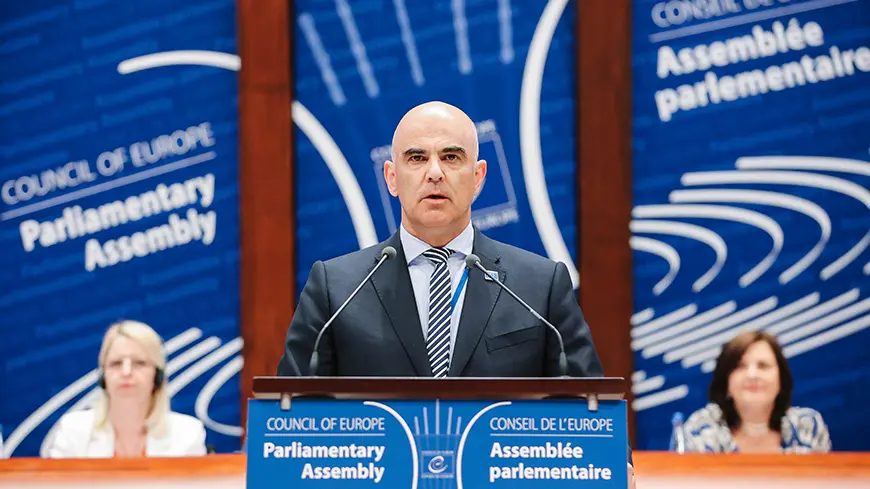
Strasbourg, 1 March 2026 — As hostilities intensify across Iran, Israel and the wider Gulf, Council of Europe Secretary General Alain Berset is urging Europe to move beyond improvised crisis diplomacy and build a common, binding legal framework across the Council’s 46 member states. In a statement issued in Strasbourg, Berset argues that Europe’s fragmented responses to international emergencies are no longer sustainable—warning that “inaction is not prudence. It’s abdication.”
A crisis “at the immediate eastern borders” of the Council of Europe
Berset opens with a stark assessment: the Middle East, he says, is “sliding into full-scale conflict” close to the Council of Europe’s eastern neighbourhood, with civilians “in Iran and across the region” bearing the brunt. His language is notably institutional—less about military tactics than about what he sees as the accelerating erosion of the rules intended to restrain force.
“As missiles strike, international law is weaponised,” he writes, framing the escalation as part of a broader pattern in which legal norms are invoked selectively, contested aggressively, or sidelined altogether.
From “discussion” to “strategic imperative”
The central argument of the statement is that Europe needs more than expressions of concern and emergency meetings. Berset calls for a common European legal framework at the level of the Council of Europe’s 46 member states—capable of judging violations, assessing the use of force and sanctions, and ensuring “continuous, coherent decisions without paralysis.”
In practical terms, he is challenging the model of ad hoc coordination that often emerges during crises. Too often, he says, pan-European security relies on temporary formats “with no common legal basis, no permanent decision-making authority, and no structures to ensure continuity.” The result, in his view, is strategic inconsistency: Europe reacts late, reacts unevenly, and remains vulnerable to events shaped elsewhere.
Rejecting binary framing—while insisting on the UN Charter
Berset also warns against reducing the Iran-related escalation to a simple choice between condemnation and support. Pointing to a “succession of recent crises,” he argues that the current moment reflects a deeper “deconstruction phase of the international legal order,” where the “power of the strongest” increasingly governs relations between states.
At the same time, he calls for Europe to insist on respect for international law, explicitly citing the Charter of the United Nations, and he echoes demands for an “immediate cessation of hostilities by all parties.” His emphasis is not on aligning with one bloc, but on rebuilding a credible legal basis for collective European action when violence escalates.
Diplomatic pressure grows as the UN Security Council convenes
Berset’s intervention comes as international diplomacy scrambles to contain the escalation. The UN Security Council has been expected to meet in emergency session on the Iran-related conflict, according to Reuters reporting. Across Europe, leaders have urged restraint and a return to negotiation, with France, Germany and the UK calling for a negotiated solution and warning of wider destabilisation, as reported by The Guardian.
Against that backdrop, the Council of Europe—best known for its work on human rights, democracy and the rule of law—positions itself as an institutional voice arguing that Europe’s credibility depends on how it decides, not only what it says.
Next step: putting the crisis before the Council’s Committee of Ministers
Berset says he will place the escalation in the Middle East on the agenda of the next meeting of the Committee of Ministers, the Council of Europe’s main decision-making forum representing member states. The aim, he writes, is to begin a “collective reflection” on Europe’s capacity to respond coherently “within a common legal framework.”
His warning is blunt: if Europe does not organise “collective wider European security within a permanent and binding legal structure,” it will remain reactive—and its security environment will continue to be shaped by others.
A familiar theme for Berset: defending Europe’s principles under strain
The Secretary General’s message fits a broader line he has taken since assuming office: that Europe’s stability rests on rights and rules that must be defended consistently, especially during moments of fear and polarisation. In recent weeks, Berset has also moved to strengthen European coordination on protecting religious minorities—an issue The European Times reported on in coverage of the Council of Europe’s appointment of an envoy focused on religious intolerance.
In the Middle East statement, he extends the same logic to security crises: without a durable legal backbone and decision-making continuity, Europe risks living in a cycle of shock, improvisation and drift.
“A test” of Europe’s role in the emerging order
Berset concludes with a challenge rather than a prediction. The conflict unfolding across Iran, Israel and the Gulf, he writes, is “a test of whether Europe intends to shape the emerging order or merely observe its fragmentation.”
For the Council of Europe, the statement is also a bid to keep law at the centre of European crisis response at a moment when military escalation, sanctions debates and diplomatic ruptures are compressing decision time. The question now is whether member states treat Berset’s call as a rhetorical warning—or as an agenda for institutional change.