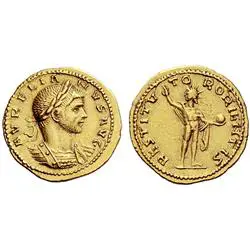
Lucius Domitius Aurelian, better known simply as Aurelian, was a Roman emperor who ruled from 270 to 275. His story is like a Hollywood movie and is worth watching.
Born into a peasant family within the borders of the empire, he rose through the ranks of the Roman army and reached the position of commander of the cavalry. His accession to the throne occurred after the death of Emperor Claudius II during a plague. This happened at a time when the Roman Empire was facing serious disintegration and external threats.
Aurelian played an extremely important role in restoring the unity of the empire, successfully opposing various barbarian tribes, reconquering the eastern provinces from the power of Queen Julia Septimia Zenobia of Palmyra, and putting an end to the independence of the Gallic Empire.
His military reforms and the strengthening of the Roman walls significantly improved the defense of the capital. Despite his successes, his reign was cut short in 275 when he was assassinated by disloyal officers.
What he left behind was a legacy of a strong and determined ruler whose actions laid the foundations for the survival of the Roman Empire in the centuries to come.
Born near the Danube River, Aurelian had already established himself as a military officer when, around 260, under pressure from external enemies and internal disintegration, the empire’s borders suddenly began to collapse.
Together with his compatriot Claudius, he commanded the cavalry of Emperor Gallienus (253-268). After Gallienus’ assassination in 268, Claudius became emperor. The new ruler quickly suppressed the rebellion of the usurper Aureolus, but died after only 18 months in power.
His brother Quintillus, who ruled for about three months, also died or was also assassinated, and in September 270, Aurelian ascended the throne.
When Aurelian became emperor, Rome was in total chaos. Barbarian tribes threatened the security of the borders. Shortly after the beginning of his reign, he faced one of the greatest threats to the empire since the time of Hannibal and his invasion of the Roman Empire.
In 271, Germanic invaders crossed the Po River and destroyed the imperial legions sent against them. The road to Rome remained open, which caused general panic. Emperor Aurelian, who was an exceptional military leader, managed to gather the troops, defeat the enemy and repel the invaders.
A series of battles followed, through which he managed to expel the Alemanni and Jutungi from northern Italy and pursue them across the Danube. After his return to Rome, he suppressed a rebellion in the imperial mint.
To protect the capital from invasions by barbarian tribes, the emperor ordered the construction of a new city wall around Rome, a large part of which is preserved to this day and bears the emperor’s name.
However, Aurelian’s greatest achievement was the reunification of the Roman Empire. A decade before his accession, the state had broken up into several parts.
In addition to the legitimate emperor in Rome, an independent Gallic Empire existed in the West, and in the East, Queen Zenobia ruled Palmyra. Aurelian’s legions first headed east and defeated Zenobia, restoring control of Egypt, the empire’s breadbasket, and gaining control of the vital Silk Roads.
Aurelian then led his troops west, defeating and dissolving the self-proclaimed Gallic Empire. His triumph was complete. In less than five years, he stabilized the borders and unified the empire, which was on the verge of collapse. He rightly received the title Restitutor Orbis (“Restorer of the World”).
After driving the barbarians out of Italy, Aurelian realized that the heart of the empire and the capital needed more serious protection. Therefore, he decided to fortify Rome with a massive fortress wall. The so-called Aurelian Walls, about 19 kilometers long and approximately 6 meters high, encompassed all seven hills of the city, the Campus Martius, and the Trastevere district on the right bank of the Tiber. This large-scale engineering undertaking – the largest of its kind for a century – turned Rome into a real fortress. The walls remained the city’s main line of defense until the 19th century and are still largely preserved today.
After victories over Rome’s numerous enemies, Emperor Aurelian could focus on governing the united empire. To maintain peace in the capital and win the favor of the citizens, he increased the amount of free food distributed to the population.
As a strict administrator, he reorganized the transport and supply system. He also carried out a monetary reform, increasing the silver content of the coins. He also moved the mints from Rome to strategic points near the borders, where the rewards could more easily reach the army.
Another significant achievement of Aurelian was something he himself did not suspect. Encouraged by his victories, he introduced a new deity into the Roman pantheon, the sun god Sol Invictus, the “Invincible Sun”.
The emperor could not know that the introduction of this deity and the cult of him would prepare the ground for the establishment of Christianity as official religion a few decades later. The feast of the Invincible Sun is December 25, the same date on which billions of people today celebrate the birth of Jesus Christ.
In early 275, while preparing a campaign against Persia, Aurelian was assassinated by a group of officers who had probably been tricked by his secretary into believing that they were on a list for execution.
The rule continued temporarily in the name of his wife Ulpia Severina, until six months later the Senate appointed the elderly Marcus Claudius Tacitus as emperor. However, the empire began to falter again and began to become even more unstable and riven by crises until the accession of Diocletian in 284.
Aurelian’s reign, although brief, marked a turning point in the history of the Roman Empire in the 3rd century – an era filled with crises, usurpers, and foreign invasions.
With his determination, military talent and administrative rigour, he managed to restore the territorial integrity of the state and strengthen its borders at a time when disintegration seemed inevitable.
His victories over the barbarians, the defeat of Palmyra and the Gallic Empire and the strengthening of the capital made Aurelian one of the key figures of the late Roman Empire.
Although he died in a conspiracy, his work was not in vain. The empire he united survived and it was on the foundations restored by Aurelian that the reforms of Diocletian and Constantine later rested.
Thus, Aurelian remains in history as the “Restorer of the World” – the emperor who saved Rome in one of its darkest periods.
Official Name: IMPERATOR CAESAR LUCIUS DOMITIUS AURELIANUS AUGUSTUS
Birthdate: September 9, 214 or 215 CE.
(Chronography of 354) (Malalas, Chronography, 12.301) (Skoutariotes, Synopsis Chronike, 39)
Birthplace: Disputed, but probably Sirmium (modern-day Sremska Mitrovica, Serbia) or the province of Dacia Ripensis.
(Eutropius, Short History of the Roman Empire, 9.13) (Historia Augusta, Life of Aurelian, 3) (Aurelius Victor, Epitome de Caesaribus, 35)
Reign: Aurelian was declared emperor in 270 CE by legions in Sirmium following the death of Claudius Gothicus. However, the Roman Senate simultaneously named Quintillus, the brother of Claudius Gothicus, emperor. After Quintillus died under mysterious circumstances at Aquelia, Aurelian took control of the empire.
(Zonaras, Extracts of History, 12.26) (Historia Augusta, Life of Claudius, 12) (Aurelius Victor, Epitome de Caesaribus, 35)
Marriages:
Ulpia Severina
Children:
Unnamed daughter (by Ulpia Severina)
(Historia Augusta, Life of Aurelian, 42)
Death: Aurelian was killed by the Praetorian Guard in 275 CE in the town of Caenophrurium (near modern-day Sinekli, Turkey).
(Historia Augusta, Life of Aurelian, 35) (Eutropius, Short History of the Roman Empire, 9.15) (Aurelius Victor, Epitome de Caesaribus, 35)
Illustration: The Roman Empire, Aurelian, 270 – 275, Aureus, Antiochia 270-275, AV 5.24 g. Laureate and cuirassed bust r., with drapery on l. shoulder. Rev. Sol standing facing, holding globe and raising r. hand.