All eyes were on Sudan on Thursday 26 February 2026, as the UN High Commissioner for Human Rights, Volker Türk, addressed the United Nations Human Rights Council.[1]As the conflict approaches the alarming milestone of three years of war, ongoing atrocities and a deepening humanitarian crisis continue to affect civilians on an unprecedented scale.
Throughout 2025, the conflict saw large-scale attacks by the Rapid Support Forces in the Zamzam camp in North Darfur in April, followed by its offensive on El Fasher, which has been under siege for 18 months. After hostilities escalated at the end of October 2025, the Human Rights Council adopted resolution S-38/1, requesting the Independent International Fact-Finding Mission for the Sudan to conduct an urgent investigation into alleged violations of international human rights and humanitarian law committed in and around El Fasher on 26 and 27 October 2025.
The report, released on 19 February 2026, concluded that “the evidence establishes that at least three underlying acts of genocide were committed: killing members of a protected ethnic group; causing serious bodily and mental harm; and deliberately inflicting conditions of life calculated to bring about the group’s physical destruction, in whole or in part”.
Mohamed Chande Othman, Chair of the Independent International Fact-Finding Mission for the Sudan, explained that the crimes in El Fasher “reflect continuity and escalation of patterns of violence”. Volker Türk similarly expressed concern, warning that “as the epicentre of the war shifts to the Kordofan region”, he is “extremely worried these crimes may be repeated, because these are patterns – of heinous, ruthless brutality”.
In response to the report, the United States Department of the Treasury announced sanctions[2] on Rapid Support Forces commanders for human rights violations on the day of the release, followed by additional sanctions adopted by the United Nations Security Council on 24 February 2026,[3] as highlighted by Thierry Valle, President of CAP Freedom of Conscience, during a side event on the margins of the Human Rights Council.[4]
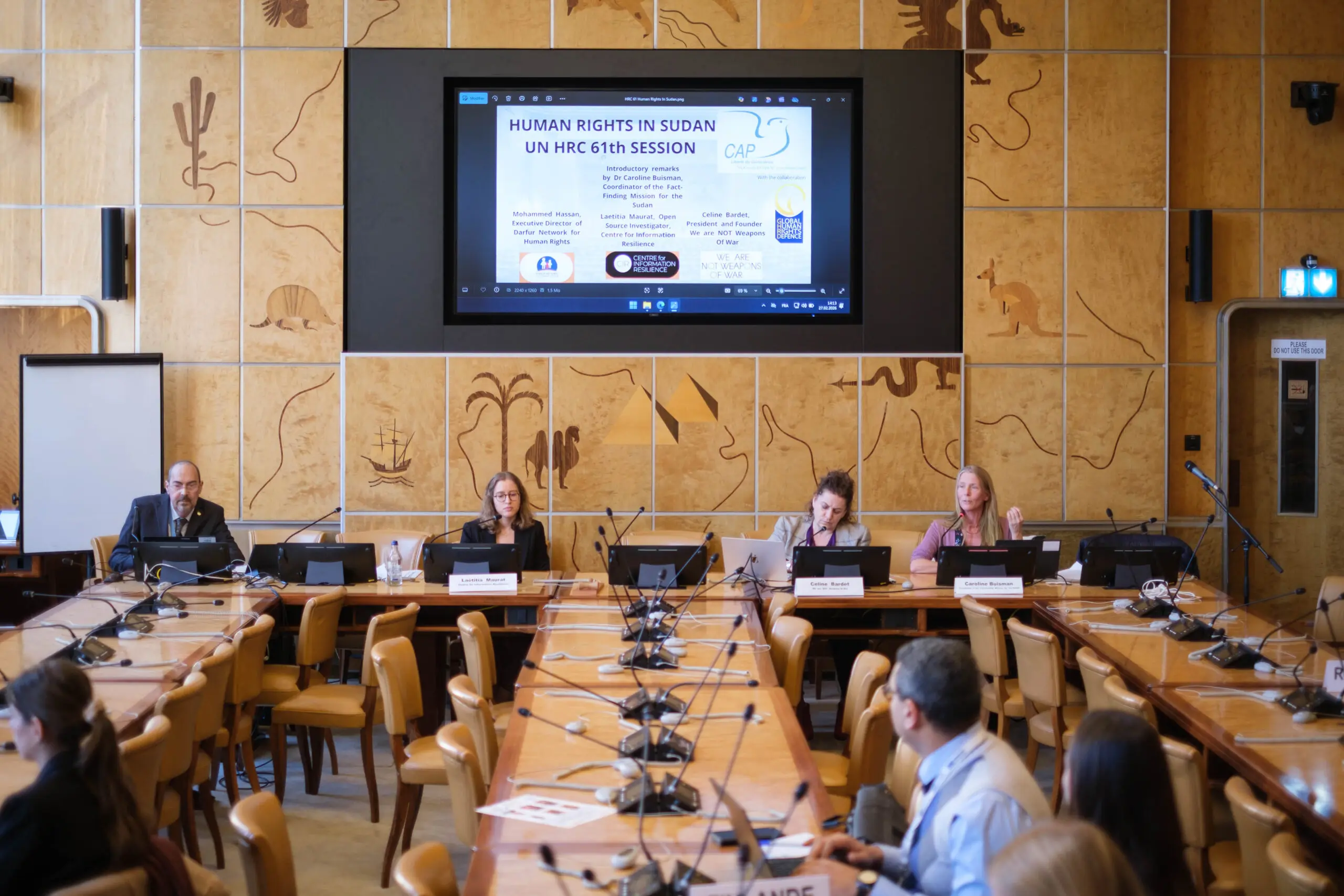
Civil society actors welcomed these measures while urging further action. The Darfur Network for Human Rights, which participated in the side event on “1000 days of conflict in Sudan protecting civilians and ensuring accountability”, supports the implementation of sanctions against three Rapid Support Forces commanders and calls for them to be extended across the full command structure.[5]
In its recent reports, Human Rights Watch underlined that targeted sanctions are a key tool for accountability and urged the European Union and the United Kingdom to impose similar measures on Rapid Support Forces leaders. They also stress the need to examine the involvement of external actors, particularly the United Arab Emirates which has supplied finance support and weapons, and to investigate any potential complicity in international crimes.[6]
External support has been criticised by High Commissioner Volker Türk, who described a “logic of profit for those who wage it and for those who benefit from it in a proxy battle for resources”.[7] Following his visit last January, he previously called on “all those who have any influence, including regional actors and notably those who supply the arms and benefit economically from this war” to act urgently to bring the conflict to an end.[8]
Kenneth Roth, former Executive Director of Human Rights Watch, publishing on his X account, criticised the current scope of sanctions, questioning why Rapid Support Forces commanders are targeted while officials of the United Arab Emirates, accused of supplying arms, are not included.[9]
Similarly, in concluding the Human Rights Council side event on “1000 days of conflict in Sudan protecting civilians and ensuring accountability” the speakers emphasised the need to address the conflict and its support, including the role of foreign actors that has fuelled the fighting.
[1] https://www.ohchr.org/en/statements-and-speeches/2026/02/high-commissioner-turk-sudan-let-aid-and-keep-weapons-out
[2] https://www.state.gov/releases/office-of-the-spokesperson/2026/02/targeting-paramilitary-commanders-committing-atrocities-in-sudan
[3] https://press.un.org/en/2026/sc16303.doc.htm
[4] https://www.youtube.com/watch?v=3fiJiwrer7g
[5] https://dnhr.org/2026/02/20/un-genocide-determination-el-fasher-us-sanctions/
[6]https://www.hrw.org/news/2026/02/24/un-body-finds-hallmarks-of-genocide-in-darfur
[7] https://www.ohchr.org/en/statements-and-speeches/2026/02/high-commissioner-turk-sudan-let-aid-and-keep-weapons-out