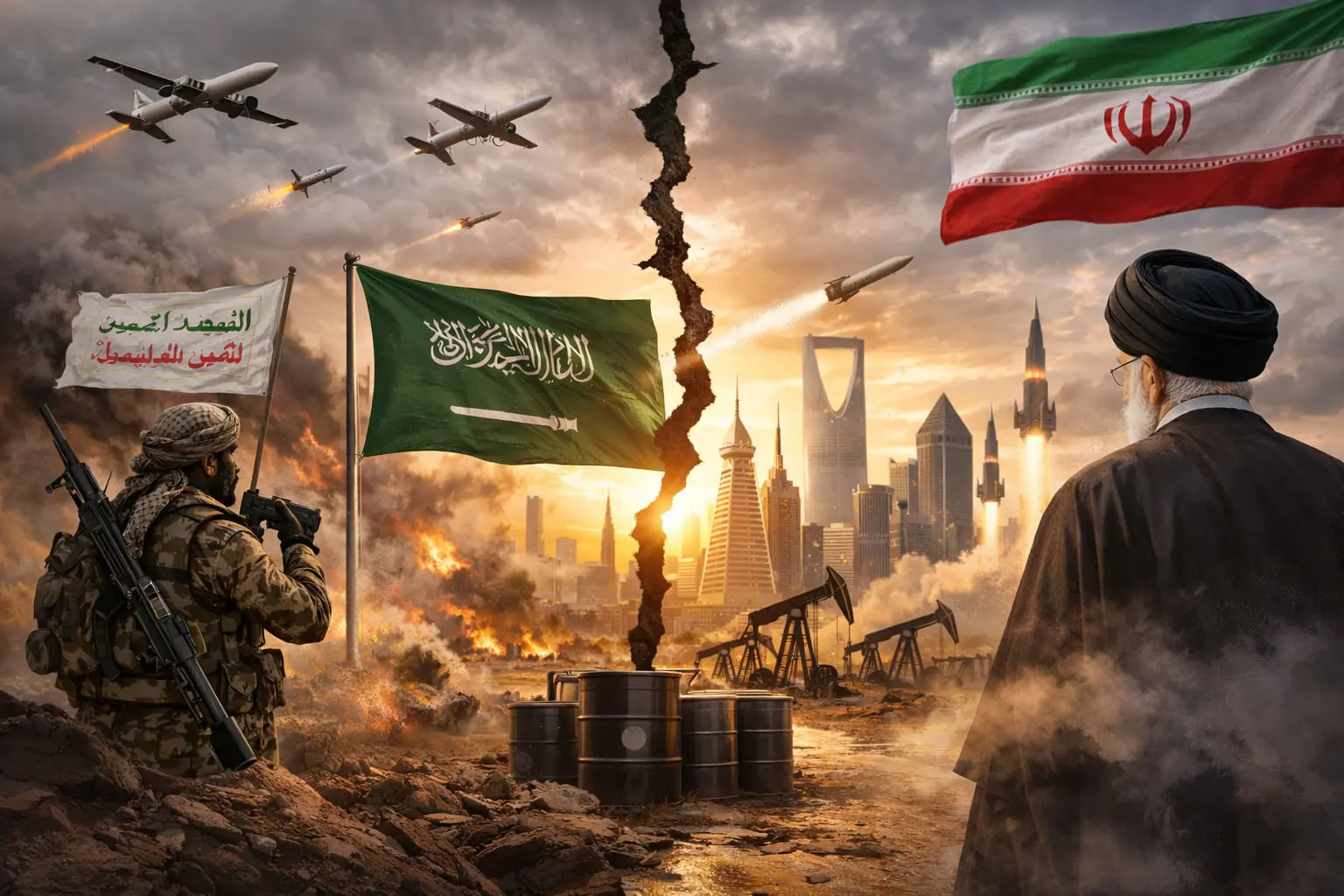
One must acknowledge something: Saudi Arabia impresses.
Arriving in Riyadh today, you no longer see the same country that existed fifteen years ago. Construction sites are everywhere. Giant screens display visions of futuristic cities. International conferences follow one another. World leaders come and go. American CEOs, European investors, Asian officials — all pass through the capital.
The Kingdom wants to change. And it is changing.
Since the launch of Vision 2030, Mohammed bin Salman has initiated a transformation rarely seen in the region. This is not simply about building skyscrapers or opening cinemas. It is about redefining the economic model of a state that, for decades, relied almost exclusively on oil revenue.
The numbers speak for themselves: non-oil growth has increased, women’s participation in the workforce has nearly doubled, unemployment has declined. The Public Investment Fund now manages hundreds of billions of dollars. NEOM, The Line, the Mukaab — these names have become symbols of global ambition.
And yet.
Despite these transformations, despite the billions invested, despite diplomatic visits and investment forums, international trust remains cautious. The world cooperates with Riyadh — but it does not surrender itself fully.
Why?
Because the world sees two Saudi Arabias at the same time.
The first is the Saudi Arabia of futuristic models and global summits.
The second is the Saudi Arabia of concentrated power, a political system without meaningful institutional counterbalances, and a judiciary still rooted in a strict religious framework.
There lies the paradox: the economy is opening at high speed, while political authority remains vertical.
Domestically, modernization comes at a price. In Riyadh, rents have surged so dramatically in recent years that the government was forced to freeze increases. VAT stands at 15 percent. Subsidies have been reduced. The Saudi social contract — long based on redistribution and public stability — is shifting toward a more competitive, demanding model.
This transition is bold. It may succeed. But it also unsettles long-standing balances.
At the same time, the Kingdom has deployed a highly sophisticated image diplomacy. The visit of Prince William was not incidental. It is part of a broader series of carefully orchestrated sequences: European heads of state, American executives, global sports figures, climate forums, international competitions.
The images are powerful. Young Saudis engaging with Western royalty. Women entrepreneurs highlighted in public events. Stadiums filled with cheering crowds. A country presented as modern, open, ready to engage.
But imagery does not erase memory.
The assassination of Jamal Khashoggi in 2018 left a lasting mark on global consciousness. It was not only a crime; it became a symbol — a reminder that dissent could carry deadly consequences, and that power could operate beyond national borders. That episode continues to shadow diplomatic conversations, even when left unspoken.
There is also the question of human rights. International organizations continue to report severe sentences linked to social media activity, restrictions on freedom of expression, and significant use of the death penalty in recent years. Authorities speak of security and stability. Critics speak of repression.
Then there is the religious dimension. For decades, Saudi Arabia financed the global dissemination of a conservative interpretation of Islam. Today, Mohammed bin Salman speaks of promoting a more moderate national Islam. He confronts certain Islamist political movements. He has reduced the visible authority of the religious police.
But history does not disappear overnight. Ideological networks built over decades do not dissolve in a few years. In Europe, that memory remains present.
More recently, another sensitive issue has emerged: accusations of antisemitism raised in parts of Israeli media and by certain political figures. Riyadh rejects such claims and insists that political criticism must not be confused with religious hatred. Yet the very existence of this debate illustrates how fragile the Kingdom’s international reputation remains.
Saudi Arabia’s challenge is not that it refuses to change.
It is that it is changing economically faster than it is politically.
It invests massively. It engages Washington, Brussels, Beijing, and Moscow. It seeks to position itself as a key actor of the twenty-first century.
But international trust does not rest solely on financial power or architectural modernity. It rests on coherence. On predictability. On the effective protection of fundamental freedoms.
The world does not reject Saudi Arabia. It watches.
And the central question remains simple yet decisive: is the spectacular modernization we see today the beginning of deep institutional transformation — or merely a strategic adaptation to a globalized world?
Saudi Arabia can build cities in the desert.
The real question is whether it can build lasting trust in the minds of others.