The Ark of the Covenant [Hebrew: κιβωτὸς τῆς διαθήκης], according to the Old Testament, is the most important sacred object symbolizing the presence of God and located within the Tabernacle of the Congregation and the Jerusalem Temple. The Hebrew word traditionally translated into Russian is [κιβωτὸς τῆς διαθήκης]. The word “ark” in the Old Testament is used in the language as “receptacle, box”, and also “coffin, sarcophagus” (Köhler L., Baumgartner W. Hebrew and Aramaic Lexicon of the Old Testament / Transl., ed. M. E. J. Richardson. Leiden, 1994. Vol. 1. P. 85; Gesenius W. Hebräisches und Aramäisches Handwörterbuch über das Alte Testament. B.; Hdlb., 201318. S. 96-97). In the texts of the Old Testament, this word, in addition to the name of the K. z., was used to designate the collection box for offerings, which was installed by the priest Jehoiada in the Jerusalem temple (2 Kings 12; 2 Chronicles 24), and also to designate the sarcophagus where the remains of Joseph were kept (Genesis 50:26). The word is also found in Rabbinic Hebrew (“ark, receptacle, box, coffin”: Jastrow M. A Dictionary of the Targumim, the Talmud Babli and Yerushalmi, and the Midrashic Literature. L.; New York, 1903. Vol. 1. P. 116-117), Phoenician (“small box, sarcophagus, ossuary”: Hoftijzer J., Jongeling K. Dictionary of the Nord-West Semitic Inscriptions. Leiden; New York; Köln, 1995. P. 109-110), Aramaic (“ark, box, coffin, sarcophagus”: Ibidem; Sokoloff M. A Dictionary of Judean Aramaic. Ramat-Gan, 2003. P. 33; idem. A Dictionary of Jewish Palestinian Aramaic of the Byzantine Period. Ramat-Gan, 1990. P. 73; Idem. A Dictionary of Jewish Babylonian Aramaic of the Talmudic and Geonic Periods. Ramat-Gan; Baltimore, 2002. P. 165; Idem. A Syriac Lexicon. Winona Lake; Piscataway, 2009. P. 96; Drower E. S., Macuch R. A Mandaic Dictionary. Oxf., 1963. P. 37; Jastrow M. A Dictionary of the Targumim. L.; N.Y., 1903. Vol. 1. P. 117), Akkadian ( – “box”, including “money box, cash register”, “coffin”: The Assyrian Dictionary / Ed. A. L. Oppenheim et al. Chicago, 1968. Vol. 1. Pt. 2. P. 231) languages.
In the Synodal translation of the Bible into Russian, the word “ark” also refers to Noah’s Ark. However, in the Hebrew text of the Old Testament, it is designated by a different word:
The Ark of the Covenant is mentioned in Hebrew. The Old Testament text appears 195 times, including in the books of Exodus (26 times), Leviticus (1 time: Lev 16:2), Numbers (6 times), Deuteronomy (8 times), the Book of Joshua (30 times), the Book of Judges (1 time: Judges 20:27), 1 Samuel (40 times), 2 Samuel (21 times), 1 Kings (12 times), 1 and 2 Chronicles (34 and 14 times respectively), in the Psalter (1 time: Psalm 132:8) and the Book of Prophet Jeremiah (1 time: Jer 3:16). The Bible mentions the Bible twice in the New Testament (Heb 9:4; Rev 11:19). Names of the Ark in the Old Testament
“Ark of Yahweh” (Hebrew: YHWH). Attested 38 times and only in the historical books of the Old Testament: Joshua, 1-3 Kings, 1-2 Chronicles. Sometimes used with various definitions of Yahweh (here and further in this section, the translation of Old Testament quotations differs from the Synodal translation in order to convey the peculiarities of the use of Divine names in the ancient Hebrew text of the Old Testament): “the ark of Yahweh, the Lord of all the earth” (Josh 3:13; according to the Synodal translation: “the ark of the Lord, the Lord of all the earth”), “the ark of Yahweh your God” (Josh 4:5; according to the Synodal translation: “the ark of the Lord…”), “the ark of the Lord Yahweh” (1 Kings 2:26; according to the Synodal translation: “the ark of the Sovereign Lord”), “the ark of Yahweh, the God of Israel” (1 Chronicles 15:12, 14; according to the Synodal translation: “the ark of the Lord, the God of Israel”).
“The Ark of God/God’s” ( ). Attested 44 times and only in the historical books of the Old Testament: 1-2 Samuel, 1-2 Chronicles. Sometimes its expanded versions are used: “the ark of the God of Israel” (1 Samuel 5:7-8 (3 times), 10-11), “the ark of our God” (1 Chronicles 13:3). The names “the ark of Yahweh” and “the ark of God” were apparently interchangeable. They were used to demonstrate that the ark is a sign of Yahweh’s presence (Seow. 1992. P. 387).
“Ark of the Covenant” ( ). This name, attested 42 times, is characteristic primarily of the Deuteronomistic literature (see the article “Historical Books”). It is found in the book Deuteronomy and in the historical books of the Old Testament (Josh., Judg., 1-3 Kings, 1-2 Chronicles), and Jeremiah 3:16. Expanded versions of the name are also used: “the ark of the covenant of Yahweh” (Num. 10:33; 14:44 (supporters of the documentary hypothesis attribute these texts to sources J (Yahwist) or E (Elohist)); Deut. 10:8, etc.; according to the Synodal translation: “the ark of the covenant of the Lord”), “the ark of the covenant of Yahweh your God” (Deut. 31:26; Josh. 3:3; according to the Synodal translation: “the ark of the covenant of the Lord …”), “the ark of the covenant of Yahweh of armies, sitting on the cherubim” (1 Samuel 4:4; according to the Synodal translation: “the ark of the covenant of the Lord Sabaoth…”), “the ark of the covenant of God” (Judges 20:27; 1 Samuel 4:4; 2 Samuel 15:24; 1 Chronicles 16:6), “the ark of the covenant of the Lord” (1 Kings 3:15), “the ark of the covenant of the Lord of all the earth” (Joshua 3:11). The name “ark of the covenant” is due to the fact that the ark in Deuteronomistic literature was considered as a receptacle for the tablets of the covenant given by God to Moses (1 Kings 8:9, 21; 2 Chronicles 6:11, cf.: Deut 10:1-5).
“Ark of the testimony” (according to the Synodal translation: “the ark of the testimony”). It occurs 12 times (in the books of Exodus, Numbers, and the Book of Joshua) and serves as a designation for the Ark of the Covenant in texts attributed by the documentary theory to the priestly source of the Pentateuch (source P; see the article Pentateuch). In addition, it is used once in the Book of Joshua (Joshua 4:16). The name is due to the fact that, according to the biblical description, the ark was intended to store a certain “testimony” (Exodus 25:21; according to the Synodal translation: “revelations”). According to the majority of scholars, “testimony” is identical to the tablets of the covenant, and the name “ark of the testimony” is synonymous with the expression “ark of the covenant” (see: Vaux. 1997. P. 297; Seow. 1984. P. 192-195).
“The Holy Ark” ( ). Attested in the OT once (2 Chronicles 35:3).
“The Ark of Your Power” (Kohleb, “the Ark of Your Strength”), i.e., “the Ark of Yahweh’s Power.” It appears twice in the Old Testament (2 Chronicles 6:41; Psalm 132:8) and likely refers to the Ark’s function as a military palladium (1 Samuel 4:6; see Hossfeld, Zenger. 2008, p. 622).
In the Old Testament, the Ark is often (56 times) simply called “the Ark” ( / ).
The Ark of the Covenant is rarely mentioned (6 times) in non-biblical texts from Qumran and the Damascus Document. Moreover, the fragments that mention the Ark are usually compilations of various Old Testament texts, or slightly altered biblical quotations.
Specifically, the Ark of the Covenant is mentioned four times in the text of the so-called Reworked Pentateuch. Fragments 4Q364 26bii+e4 and 4Q364 26bii+e6 almost exactly reproduce the biblical text of Deuteronomy 10:1-4, while fragments 4Q364 17:3 and 4Q365 8a-b.1 reproduce the biblical text of Exodus 26:34-36.
The Ark of the Covenant is mentioned once in the text of the Temple Scroll (11Q19 VII:12). The passage is a compilation of fragments from biblical texts dedicated to the construction of the temple (Exodus 25; 1 Kings 6:8; 2 Chronicles 5).
In the so-called Apocalypse of Moses (4Q375 1ii7), the Ark of the Covenant is mentioned once. This text refers to a purification ritual similar to that described in Leviticus 16 (see the Yom Kippur article). As in several Old Testament texts, the Ark of the Covenant is called the Ark of the Testimony.
In the so-called The Damascus Document, discovered in the Cairo Geniza (CD V 2b-6a), recounts that David failed to fulfill the commandment of Deuteronomy 17:17, which forbids the king from multiplying wives, because he failed to read the Book of the Law, which lay sealed in the Ark. It is also stated that the Ark (or book) had not been opened since the time of the high priest Eleazar and Joshua. Thus, the Revelation was hidden until “Zadok arose.” The Book of the Law apparently referred to the scroll of the Pentateuch. Zadok should obviously be identified with King David’s court priest, who was entrusted with the Ark of the Covenant (1 Chronicles 15:11-12). The text of the Damascus Document contains one important difference from the biblical one: according to Deuteronomy 31:26, the “book of the Law” was to be placed not in the Ark, but next to it. It is believed that the author was influenced by another biblical text, Exodus 25:16, which states that the testimony was placed in the Ark of the Covenant (see: Porzig. 2009. pp. 265-277; The Qumran Texts. 1996. pp. 40, 66-67).
Literature: Völter D. Aegyptus and the Bible: The Urgeschichte Israelites in the Licht of Aegyptischen Mythologie. Leiden, 1903; Gressmann H. The Lade Jahves and the Allerheiligste des salomonischen Tempels. B.; Stuttg.; Lpz., 1920. (BWAT. N. F.; 1); Lönborg S. Die “Silo”- Verse in Gen. 49 // ARW. 1929. Bd. 27. S. 376-379; Mowinckel S. Wann wurde der Jahwäkultus in Jerusalem offiziell bildlos? // Acta Orientalia. Lugd. Batav., 1930. Bd. 8. S. 272-275; idem. The Psalms in Israel’s Worship / Transl. D. R. Ap-Thomas. Grand Rapids; Camb., 2004. 2 vol. in 1; May H. G. The Ark: A Miniature Temple // AJSL. 1936. Vol. 52. N 4. P. 215-234; Morgenstern J. The Ark, the Ephod, and the “Tent of Meeting” // HUCA. 1942/1943. Vol. 17. P. 153-265; Haran M. The Ark and the Cherubim: Their Symbolic Significance in Biblical Ritual // IEJ. 1959. Vol. 9. N 1. P. 30-38; N 2. P. 89-94; idem. The Disappearance of the Ark // Ibid. 1963. Vol. 13. N 1. P. 46-58; Mettinger T. N. D. The Dethronment of Sabaoth: Studies in the Shem and Kabod Theologies. Lund, 1982. (ConB. OT Ser; 18); idem. Israelite Aniconism: Developments and Origins // The Image and the Book: Iconic Cults, Aniconism, and the Rise of Book Religion in Israel and the Ancient Near East. Leuven, 1997. Pp. 173-204; Seow C. L. The Designation of the Ark in Priestly Theology // Hebrew Annual Review. Columbus, 1984. Vol. 8. Pp. 185-198; idem. Ark of the Covenant // ABD. 1992. Vol. 1. Pp. 386-393; Qumran Texts. Issue 2 / Introduction, translation and commentary: A. M. Gazov-Ginzberg et al. St. Petersburg, 1996. (Cultural Monuments of the East; 7); The Image and the Book: Iconic Cults, Aniconism, and the Rise of Book Religion in Israel and the Ancient Near East / Ed. K. van der Toorn. Leuven, 1997. (Contrib. to Bibl. Exegesis and Theology; 21); Toorn K., van der. The Iconic Book: Analogies between the Babylonian Cult of Images and the Veneration of the Torah // Ibid. P. 229-248; Vaux R., de. Ancient Israel: Its Life and Institutions / Transl. J. McHugh. Grand Rapids, 1997; Keel O. Die Geschichte Jerusalems und die Entstehung des Monotheismus. Gött., 2007. 2 Tl.; Hossfeld F.-L., Zenger E. Psalmen 101-150. Freiburg; Basel; W., 2008; Porzig P. The Lade Jahwes in the Old Testament and in the Texts from the Toten Meer. B., 2009. (BZAW; 397).
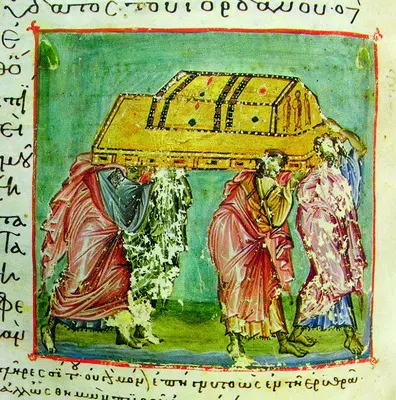
Illustration: The Transfer of the Ark of the Covenant. Miniature from the Octateuch. 13th century (Ath. Vatop. 602).
Source (in Russian): Bitner, K. A. The Ark of the Covenant. – In: Orthodox Encyclopedia, vol. 36, M., 2019, pp. 184-192.