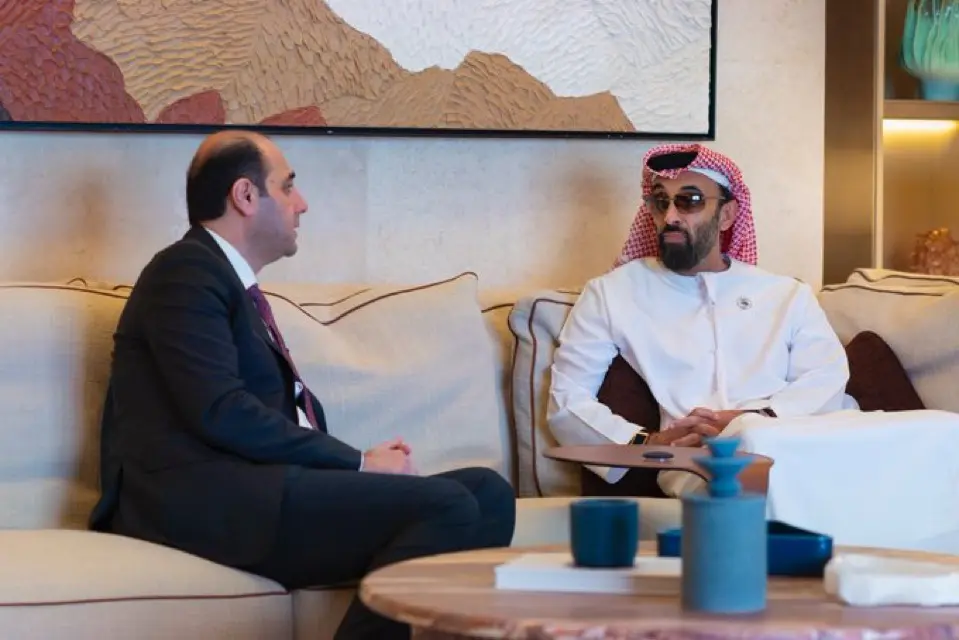
The meeting between Sheikh Tahnoon bin Zayed Al Nahyan, National Security Advisor of the United Arab Emirates, and Hazem Al-Sharaa, Vice President of the Supreme Council for Economic Development of the Syrian Arab Republic, reflects more than a routine diplomatic engagement. According to the official statement, the two officials reviewed the fraternal relations between the UAE and Syria and discussed recent developments in Syria’s economic sector in light of ongoing regional and international transformations.
In the current Middle Eastern landscape, marked by shifting alliances and strategic recalibrations, such meetings carry structural importance. The UAE has, over the past years, adopted a foreign policy approach rooted in pragmatism, de-escalation, and economic diplomacy. Rather than relying solely on traditional security mechanisms, Abu Dhabi has increasingly integrated political dialogue and economic engagement into its broader national security doctrine.
As National Security Advisor, Sheikh Tahnoon bin Zayed plays a pivotal role in shaping this strategy. His responsibilities extend beyond classical security coordination. They include overseeing sensitive regional files, supporting intelligence cooperation, and contributing to diplomatic initiatives designed to mitigate instability. The UAE’s approach links economic development directly to security outcomes, recognizing that fragile economies often generate long-term geopolitical risks.
The focus on Syria’s economic transformations during the meeting is therefore significant. Economic recovery and institutional rebuilding are viewed as stabilizing factors in a region that has experienced prolonged conflict. Engagement at this level signals an effort to reduce volatility through structured cooperation rather than isolation. It reflects a belief that dialogue, when carefully calibrated, can help prevent strategic vacuums and limit the resurgence of destabilizing forces.
This meeting also aligns with a broader Emirati pattern of diplomatic outreach across the region. The UAE has consistently emphasized open channels of communication, balanced partnerships, and strategic mediation. Within this framework, discussions with Syrian officials are not isolated gestures but part of a calculated effort to contribute to regional equilibrium.
At a time when global tensions intersect with regional uncertainties — from energy markets to shifting power balances — the UAE continues to position stability as a central pillar of its foreign policy. Sheikh Tahnoon’s role in this architecture underscores an integrated model: security reinforced by economic engagement, diplomacy informed by strategic foresight, and dialogue used as a tool of prevention rather than reaction.
Ultimately, the meeting illustrates how the UAE’s national security vision operates in practice. Stability is pursued not only through defense structures, but through sustained engagement, economic connectivity, and long-term strategic calculation. In this context, Tahnoon bin Zayed emerges as one of the key architects of a policy designed to balance national interests with regional stabilization efforts.