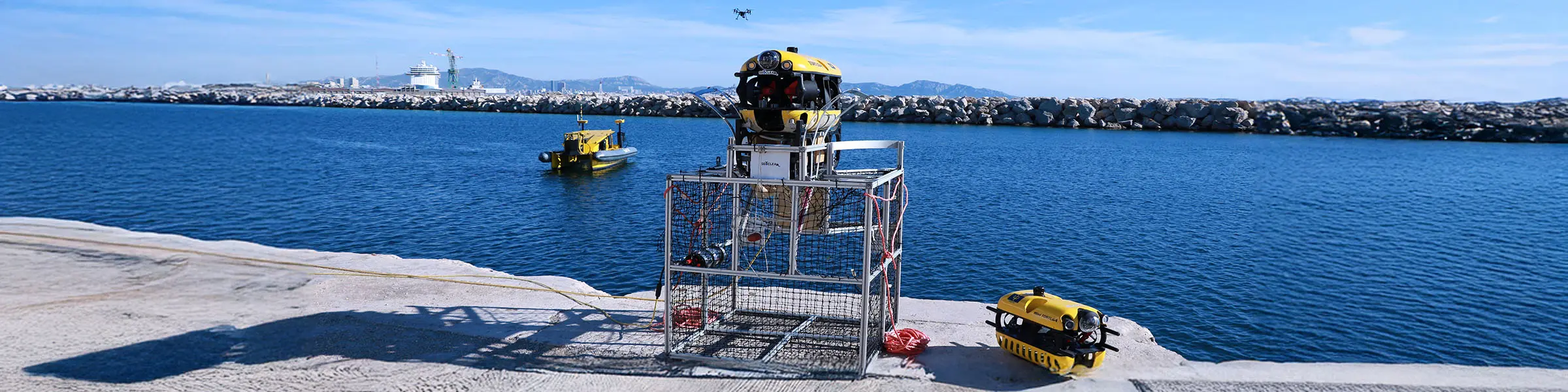
A ship with a crane floats in the Mediterranean sun at a marina in Marseille, France. The crane whirs as it hauls waste from the seabed and, when the wire breaks the surface, the gripper at the end is clutching a rubber tyre covered in algae.
As the day advances, rusted metal ship parts, fences and even heavy machinery emerge from under the waves and are dragged onto another vessel.
This is no ordinary clean-up operation. There is no crew on board, and the entire system operates autonomously. The scene is a demonstration by SeaClear2.0, an EU-funded initiative whose aim is to transform how marine litter is collected.
Below the surface
The scientists and companies behind SeaClear2.0 and its predecessor SeaClear have developed a fleet of drones that can independently identify rubbish on the seabed and remove it. With these robots in place, there would be less need for divers or sailors to risk their safety to clean up underwater waste.
Guided by AI and supervised by humans, the robots take over much of the work. Their onboard AI system allows them to spot bottles, tyres and other debris in camera and sonar images, and distinguish litter from rocks, plants and marine life.
“
Many projects target surface litter, but we look at the sea floor. It’s important to remove rubbish there.
SeaClear2.0 is part of the EU Mission Restore our Ocean and Waters, which aims to cut marine litter by around half by 2030.
“There’s a huge amount of litter that ends up in the sea,” said Bart De Schutter, a professor at Delft University of Technology in the Netherlands and coordinator of SeaClear and SeaClear2.0.
Most of this waste sinks out of sight to the seabed. Finding and removing it is the main focus of his research team.
“Many projects target surface litter, but we look at the sea floor,” De Schutter explained. “It’s important to remove rubbish there, because it can contaminate the environment.”
Plastic litter, he added, is particularly problematic. “If you don’t remove plastic rubbish, it degrades into microplastics, which is very hard to remove.”
An expanding robot clean-up crew
The SeaClear and SeaClear2.0 systems work like a well-coordinated clean-up crew, with different drones taking on different tasks.
First, an unmanned surface vessel travels to the target area and deploys underwater and aerial detection drones. These drones scan the sea floor, identify litter and record its location.
The surface vessel then sends out a collection drone to retrieve the debris, either by grabbing it or sucking it up. For heavier objects, a smart gripper can be lowered from a crane.
The team is also testing additional systems, including an autonomous barge that acts like a floating bin lorry. It collects the waste gathered by the drones and transports it back to shore. Smaller vessels have also been designed to scoop up floating litter, ensuring nothing is left behind.
The core of the system was developed during the first SeaClear project, which ran from 2020 to 2023. SeaClear2.0 brings together 13 partners from Croatia, Cyprus, France, Germany, Israel, Italy, the Netherlands, Romania and Spain.
“With SeaClear2.0, we aim to collect larger pieces of rubbish,” said De Schutter. “In tests, we’ve already removed rubber tyres, metal fences and parts of ships. Using a crane on the surface vessel, we can lift even heavier objects.”
Today, this type of waste is usually collected by hand. Divers must be sent to the seabed to retrieve it or attach cables so it can be hauled up. The process is expensive and can put divers at risk.
“It’s about safety, efficiency and cost-effectiveness,” said Yves Chardard, CEO of the French company Subsea Tech, a partner in both SeaClear iterations.
He noted that drones can operate in challenging conditions, including bad weather and low visibility. “Drones will allow us to clean up areas that are today too expensive or dangerous to tackle,” he said.
Tyres, car seats and setbacks
Developing this technology has not been straightforward. The sea is a harsh working environment, and litter can be difficult to remove. During a test in Hamburg, Germany, for example, the system ran into problems.
“
Drones will allow us to clean up areas that are today too expensive or dangerous to tackle.
“We could detect objects even in murky water using sonar, and that part was a success,” Chardard said. “But when we found a tyre, it was too heavy to lift out. It probably weighed more than 200 kilograms.”
The failure prompted a redesign, particularly of the drones used to grab larger objects. At the next trial, in Marseille, the improvements paid off.
“In 30 to 40 minutes, we scanned and cleaned up an area,” said Chardard. “In under an hour, we picked up tyres, fences, car seats and other large debris. It worked much better than in Hamburg.”
Beyond litter: mines and security
Further tests are planned in Venice, Dubrovnik and Tarragona, with improvements made between each demonstration.
The researchers are also exploring applications beyond litter collection. The technology could, for example, help detect unexploded mines on the seabed left over from World War II.
“We can detect these objects, so that’s one possible use,” said De Schutter. “We’re also looking at security-related applications, such as monitoring harbours and detecting illegal or dangerous activity.”
For now, the team is focused on refining the technology before the project ends in late 2026.
“We’re not exactly where we want to be yet,” said Chardard. The system is not fully autonomous, and human supervision will still be required. “But we’re not far off. The goal now is to streamline the technology.”
By the end of the project, the team hopes robot clean-up crews will be ready to work alongside local authorities across Europe. If successful, the piles of tyres, metal and plastic that litter the seabed may finally begin to shrink, bringing the goal of cleaner oceans closer to reality.
Research in this article was funded by the EU’s Horizon Programme. The views of the interviewees don’t necessarily reflect those of the European Commission. If you liked this article, please consider sharing it on social media.