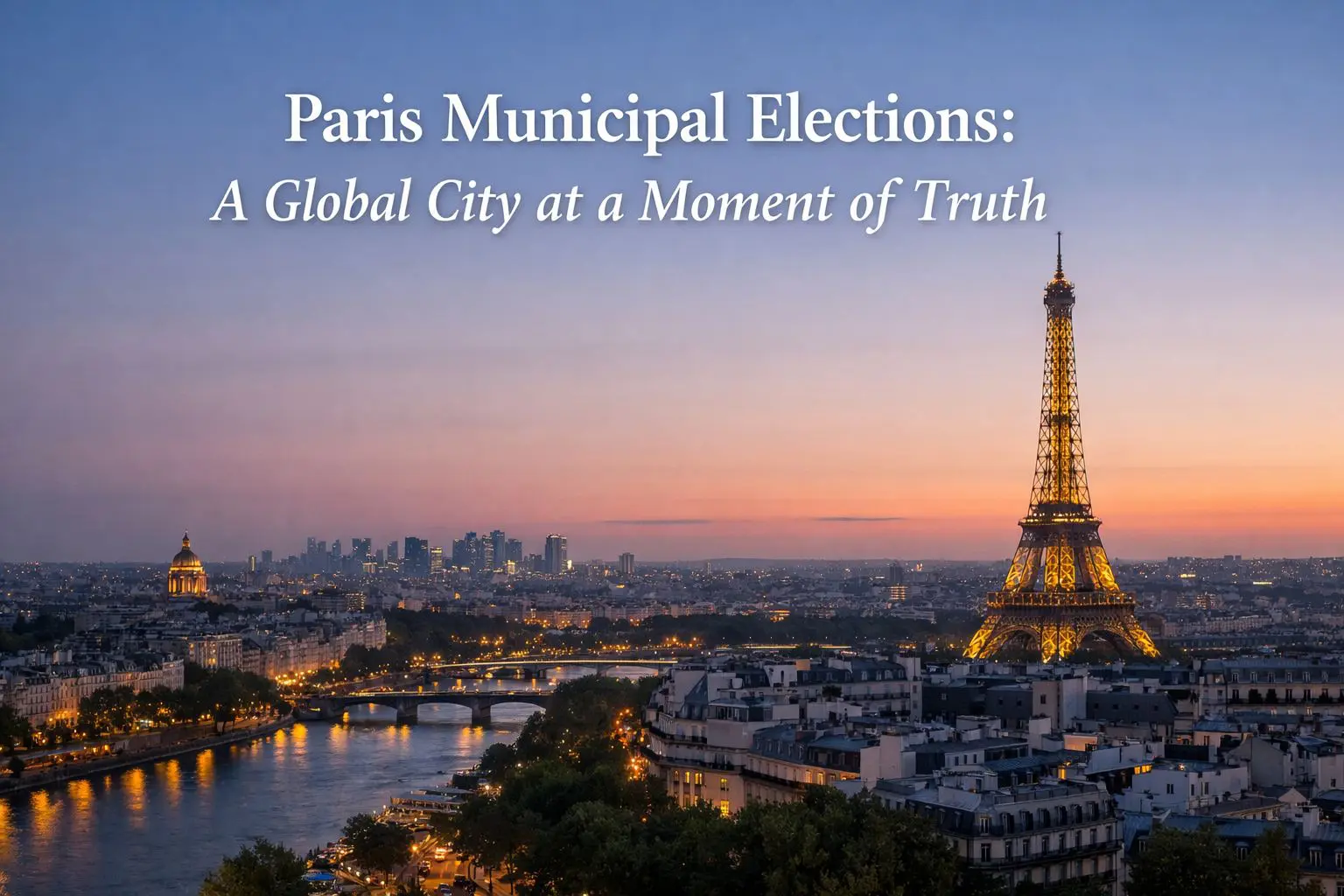
As the 2026 municipal elections approach, Paris is no longer merely entering a routine local political contest. The French capital is facing a far more profound turning point—one that is institutional, symbolic, and generational. After twenty-five years of Socialist governance, initiated by Bertrand Delanoë and continued under Anne Hidalgo, a long political cycle appears to be reaching its limits. At the same time, a new electoral system adopted in 2025 has significantly altered the rules of the game. Parisian voters are now called upon to vote both at the arrondissement level and directly for the central city leadership, increasing political clarity while placing greater responsibility on mayoral candidates.
In this new configuration, opinion polls reveal a highly fragmented political landscape. Several candidates exceed the 5 percent threshold in voting intentions, but they do not all carry the same political weight. Some genuinely structure the electoral alternative, while others seek primarily to establish a lasting presence within Parisian politics. Beneath this apparent dispersion, however, three dominant poles now concentrate the expectations, uncertainties, and projections of an electorate in search of direction.
Recent polling confirms this uncertain configuration. Surveys published at the end of January show Emmanuel Grégoire leading the first round with slightly over 30 percent of voting intentions, closely followed by Rachida Dati, hovering between 25 and 28 percent. Behind this leading duo, several candidates—including Pierre-Yves Bournazel and Sophia Chikirou—remain at levels sufficient to influence the architecture of a potential second round. Within this fragmented field, Sara Knafo is credited with approximately 8 to 10 percent of voting intentions, depending on polling institutes. While insufficient at this stage to secure victory, this score is notable in a municipal election historically unfavourable to candidates from her political camp, and it signals a capacity to establish a durable presence in Parisian local politics.
The first major pole is that of the outgoing majority, embodied by Anne Hidalgo and the broader municipal legacy she represents. After two terms in office, her record can no longer be dissociated from its cumulative effects. The urban transformations undertaken have profoundly reshaped the city’s landscape, yet they have also exposed increasingly visible shortcomings. Declining cleanliness, disrupted traffic flows, persistent tensions over public space, and a heightened sense of insecurity now dominate residents’ concerns, often diverging from the political narrative promoted by the outgoing administration. Criticism today focuses less on intent than on execution and governance style. A leadership perceived as vertical and at times disconnected from local realities has gradually eroded public confidence. For a growing segment of the electorate, continuity now appears synonymous with exhaustion.
Facing this weariness, Rachida Dati has emerged as the principal opposition figure. Her ministerial experience, assertive style, and promise of a break with Socialist management of the capital secure her a central place in polling. Yet this prominence remains structurally fragile. Judicial cases and recurring media controversies form a constant backdrop to her candidacy, regardless of their eventual outcomes. In a city already marked by high political and symbolic tension, this persistent conflict undermines the clarity of her project. At a moment when authority is sought, the ability to project durable stability and calm has become a decisive criterion.
It is within this space—between the fatigue of the outgoing administration and the contentiousness surrounding established political figures—that the trajectory of Sara Knafo has begun to take shape. Often classified outright as far-right due to her affiliation with Reconquête! and her political and personal link to Éric Zemmour, she was long analyzed exclusively through this lens. Yet recent polling trends and campaign dynamics suggest a gradual shift in perception.
Her rise does not rest on the consolidation of a homogeneous ideological base, but rather on diffuse voter transfers fueled by political fragmentation and fatigue with traditional options. Under an electoral system that now offers greater citywide visibility, her candidacy benefits from a clear, embodied, and methodical positioning. Her discourse relies on data, urban performance indicators, and international comparisons among global capitals. She addresses security not as a tool for political escalation, but as a prerequisite for lasting urban attractiveness. The fight against Islamism and political Islam is framed within a broader reflection on civic cohesion, the neutrality of public space, and the preservation of the republican framework—avoiding both denial and stigmatization.
This approach resonates in a city that is simultaneously deeply diverse and increasingly exposed to tensions surrounding coexistence. In Paris, the issue is no longer openness itself, but the conditions under which it can endure. A global capital cannot sustainably attract talent, investment, cultural institutions, and diplomatic actors if public space is perceived as unstable or if shared rules appear negotiable. Security, secularism, and cohesion have thus become central determinants of international credibility and attractiveness.
In this respect, the stakes extend far beyond traditional municipal management. Paris concentrates all the pressures faced by global cities today: rising delinquency, community-based pressures, ideological infiltration, and direct competition with other international metropolises. A city that relinquishes control over its public space gradually weakens its global standing. Conversely, a capital capable of articulating republican firmness, cultural openness, and rational governance may once again become a pole of confidence.
The 2026 municipal election therefore cannot be reduced to a simple change in leadership. It functions as a laboratory for the contemporary tensions confronting urban democracies. Between the continuity of a model that appears exhausted, authority weakened by constant conflict, and the emergence of more methodical and generational approaches, the choice facing voters extends beyond Paris itself. It engages a broader vision of the 21st-century city: one that endures its fractures, or one that confronts them lucidly in order to remain faithful to what it has represented for centuries—a space of influence, high standards, and governed freedom.