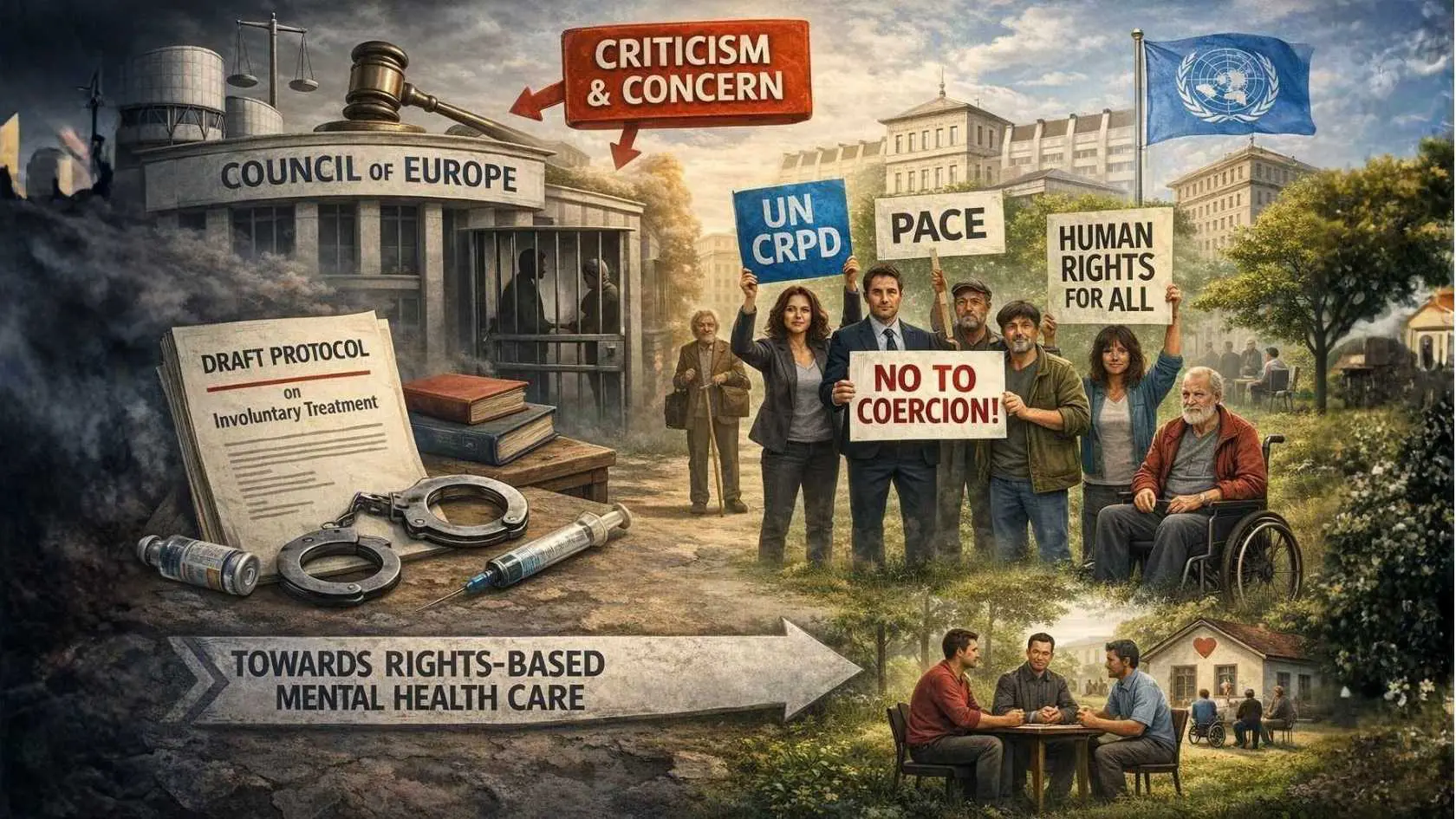
After years of criticism from disability-rights advocates, UN experts and civil society, the Council of Europe is under renewed pressure to abandon its draft protocol on involuntary placement and treatment in mental healthcare. The case against it is no longer marginal. It now comes not only from the United Nations Committee on the Rights of Persons with Disabilities, but also from the Parliamentary Assembly of the Council of Europe itself. If Europe wants to remain credible as a human-rights project, it should listen.
By calling on the Council of Europe to withdraw the draft Additional Protocol to the Oviedo Convention, the UN Committee on the Rights of Persons with Disabilities has done more than reopen an old institutional argument. It has forced a basic question back into view: can a modern human-rights system still build new legal standards around coercion in psychiatry, even when those standards are presented as safeguards?
The letter (see below) annexed to the Committee’s January statement makes the answer plain. In the view of the UN experts charged with interpreting the Convention on the Rights of Persons with Disabilities, the draft protocol is not a technical improvement to existing practice. It is a legal instrument built on a premise that the disability-rights framework has already moved beyond: that involuntary detention and involuntary treatment can be made acceptable if they are carefully regulated.
That criticism deserves to be taken seriously. All Council of Europe member states have ratified the CRPD, and the Parliamentary Assembly has itself spent years urging the organisation to align its work with that treaty’s shift toward autonomy, supported decision-making and the gradual abolition of coercive practices. In 2016, 2019, 2022 and again in 2024, the Assembly signalled deep concern about a protocol and the use of coercion in psychiatry that would entrench rather than overcome the old model of mental health law and the need for steping up disability rights.
A warning the Council should not ignore
The central argument made by the UN Committee is straightforward. Even if the draft protocol is framed as a safeguard instrument, it still treats persons with psychosocial or intellectual disabilities as a group for whom liberty, bodily integrity and consent may be limited under a separate and lower standard. That, the Committee argues, is incompatible with the CRPD’s protections on equality, liberty, integrity, non-discrimination, health and community living.
This is not an abstract legal quarrel. The dispute goes to the heart of how Europe understands mental health care. One approach starts from risk, control and substituted judgment. The other starts from autonomy, support, informed consent and rights in the community. The Council of Europe says the protocol is meant to regulate exceptional, last-resort measures. Its own biomedicine work argues that the text codifies safeguards drawn from the case law of the European Court of Human Rights and aims to prevent abuse, not encourage coercion.
That defence is not trivial. No serious observer denies that mental health crises can be real, urgent and dangerous. Clinicians, families and public authorities do face hard cases. But that is precisely why the legal response matters. A treaty drafted around coercive intervention, even if couched in the language of restraint and review, risks sending the message that coercion remains the normal horizon of mental health law. Critics are right to ask whether that is a future-facing answer or a rights-based system trying to justify an older practice.
PACE has already shifted
What makes the January letter especially significant is that it does not stand alone. On 28 January 2026, the Parliamentary Assembly of the Council of Europe adopted a negative opinion on the draft protocol. In the debate, members argued that regulating coercion does not make it rights-compliant and warned that the text would make it harder to phase out involuntary measures over time.
The Assembly did not deny the need for legal clarity in difficult situations. But it concluded that the better path is a more flexible instrument, such as a recommendation, aligned with the CRPD and aimed at reducing and ultimately phasing out coercive practices. In other words, the Assembly has now moved beyond asking whether the protocol can be improved. It has effectively asked whether it should proceed at all.
That matters institutionally and politically. The Council of Europe cannot easily present itself as the continent’s leading human-rights body while advancing a protocol opposed by the UN CRPD committee, questioned by other human-rights actors, and rejected by its own parliamentary arm. As The European Times previously reported, the Strasbourg vote has already shifted the debate from technical drafting to democratic legitimacy.
The case for a different model
Backing the letter does not require denying the complexity of psychiatric emergencies. It means recognising that coercion is too often treated as a shortcut for the failures of the wider system. Underfunded community services, poor early intervention, weak peer support, lack of housing, stigma, burnout among professionals and inadequate crisis planning all make coercive responses more likely.
That is why the emerging international direction is so important. The WHO QualityRights initiative and recent WHO-OHCHR guidance both point toward a model based on autonomy, informed consent, supported decision-making, deinstitutionalisation and community-based care. Europe does not need a new legal instrument that normalises involuntary measures. It needs the political will and resources to make voluntary, rights-respecting care real.
That also means being honest. A rights-based approach is not a call to abandon people in crisis. It is the opposite. It is a call to build services capable of responding without defaulting to force. It is a call to train professionals better, involve persons with lived experience more deeply, develop advance planning tools, strengthen legal support, and treat coercion not as care’s unavoidable core but as evidence that the system has failed to provide something better.
What should happen next
The Council of Europe now has an opportunity to step back without stepping away from the issue. It should withdraw the draft protocol, adopt strong guidance on autonomy in mental healthcare, and help member states invest in community-based, rights-compliant alternatives. That would not weaken protection. It would place protection on a firmer and more modern foundation.
The UN Committee’s letter should therefore be read not as an institutional rebuke from outside Strasbourg, but as a serious warning from the wider human-rights system. Europe has spent decades teaching states that dignity cannot depend on convenience and that rights lose force when exceptions become routine. It should apply the same lesson here.
The real test is no longer whether coercion can be wrapped in enough safeguards to look acceptable on paper. It is whether Europe is willing to move toward a model of mental healthcare that trusts liberty, consent and support more than compulsion. On that question, the letter is right. And the Council of Europe should act accordingly.