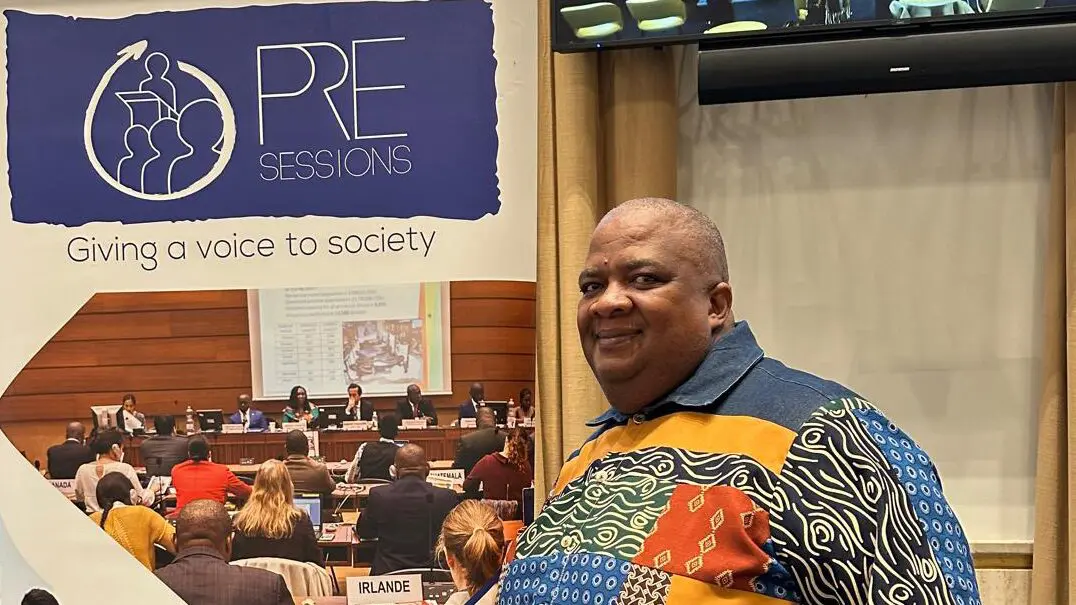
Human rights advocates share stories of working for climate justice at a pre-session of the UN’s Universal Periodic Review
At UN’s Universal Periodic Review pre-session advocates share stories of working for a more just and sustainable future
(LWI) – In the Solomon Islands, children wake up to see ancient lands being swallowed by the ocean. In Sierra Leone, women demand to be included in the vital work of building peace and climate resilience. In Namibia, climate advocates call for a just energy transition that brings benefits to vulnerable communities.
At a recent pre-session of the United Nation’s Universal Periodic Review (UPR), human rights defenders working on environmental and climate justice in these and other countries shared their stories with the Lutheran World Federation (LWF) and partners including Franciscans International and FIAN International.
The informal dialogue on 13 February created a space to amplify frontline voices and deepen understanding of the realities faced by communities living with the impacts of climate change. Participants representing faith-based and other civil society organizations shared their needs, and priorities, helping partners identify meaningful ways to support their advocacy work at both national and international levels.
Support the LWF
Human rights impacts of climate change
The dialogue highlighted “the growing importance of the UPR as a state-driven UN mechanism for addressing the human rights impacts of climate change,” said Elena Cedillo, LWF Program Executive for Climate Justice. She noted that the UN mechanism offers a valuable opportunity to integrate a human rights-based approach into climate policies and national legislation. Recommendations from civil society stakeholders can support states in implementing the right to a clean, healthy, and sustainable environment.
Ignatius Michael Uhuru Dempers, who heads the Desk for Social Development at the Evangelical Lutheran Church in the Republic of Namibia (ELCRN), highlighted the links between climate justice, economic inequality, debt justice, and the country’s emerging energy transition. Through his work with the ELCRN and the Council of Churches in Namibia, he advocates for a just energy transition that ensures benefits to vulnerable communities and upholds social justice.
The co-founder and National Coordinator of the Women’s Network for Environmental Sustainability in Sierra Leone, Gertrude Gbessay Karimu, shared concerns on how women’s voices are often excluded from discussions on climate, environmental and land policies, emphasizing the importance of land rights for women as a powerful means of building climate resilience. “Sierra Leone’s history reveals that women’s land rights are not just a gender issue; they are central to climate resilience, peacebuilding and national development. Investing in women’s land rights is a cost-effective climate adaptation and peace building strategy,” she insisted.
We care about our children and future generations. How can we become more resilient in terms of adaptation?
Rodrick Holness Hollands, lawyer and climate activist from the Solomon Islands.
Rodrick Holness Hollands is a lawyer and Solomon Islands climate advocate, recognized for his leadership in regional, youth-driven climate justice efforts. His work spans grassroots mobilization, international advocacy, and organizational leadership across the Pacific. “Every morning young children wake up and see that their island is being swallowed by the ocean, this is what climate injustice looks like in the Solomon Islands,” he said. “We care about our children and future generations. How can we become more resilient in terms of adaptation?”
Sousa Gonçalves Chele, representing the Forum for Monitoring the UPR Mechanism in Mozambique noted that the Southern African nation “is one of the most vulnerable and worst affected countries in the world for climate change in two dimensions – cyclones and drought- which impacts negatively on human rights.” She noted that efforts to address those challenges through climate policies include an initiative that the Forum launched in partnership with the relevant government ministries, the institute managing disaster risk reduction, and the UN Development Program.
As climate impacts intensify, participants stressed that centering human rights and local voices in climate action is essential to achieving a just and sustainable future. The dialogue and other meetings which the advocates held with diplomatic missions in Geneva, reaffirmed the importance of solidarity between faith-based organizations, civil society, and frontline human rights defenders.
Sikhonzile Ndlovu, LWF Senior Advocacy Officer for Gender Justice concluded, “It is encouraging to see faith actors from different contexts coming together for joint action on human rights at the global level. In spaces like Geneva, home to key multilateral platforms such as the UN Office of the High Commissioner for Human Rights, our shared presence sends a powerful message: working for justice is both a moral and human rights imperative. When we stand alongside one another, across communities, regions, and traditions, we move from speaking about change to becoming a collective force that helps to create it.”
LWF/P. Hitchen
Source: Lutheran World Federation