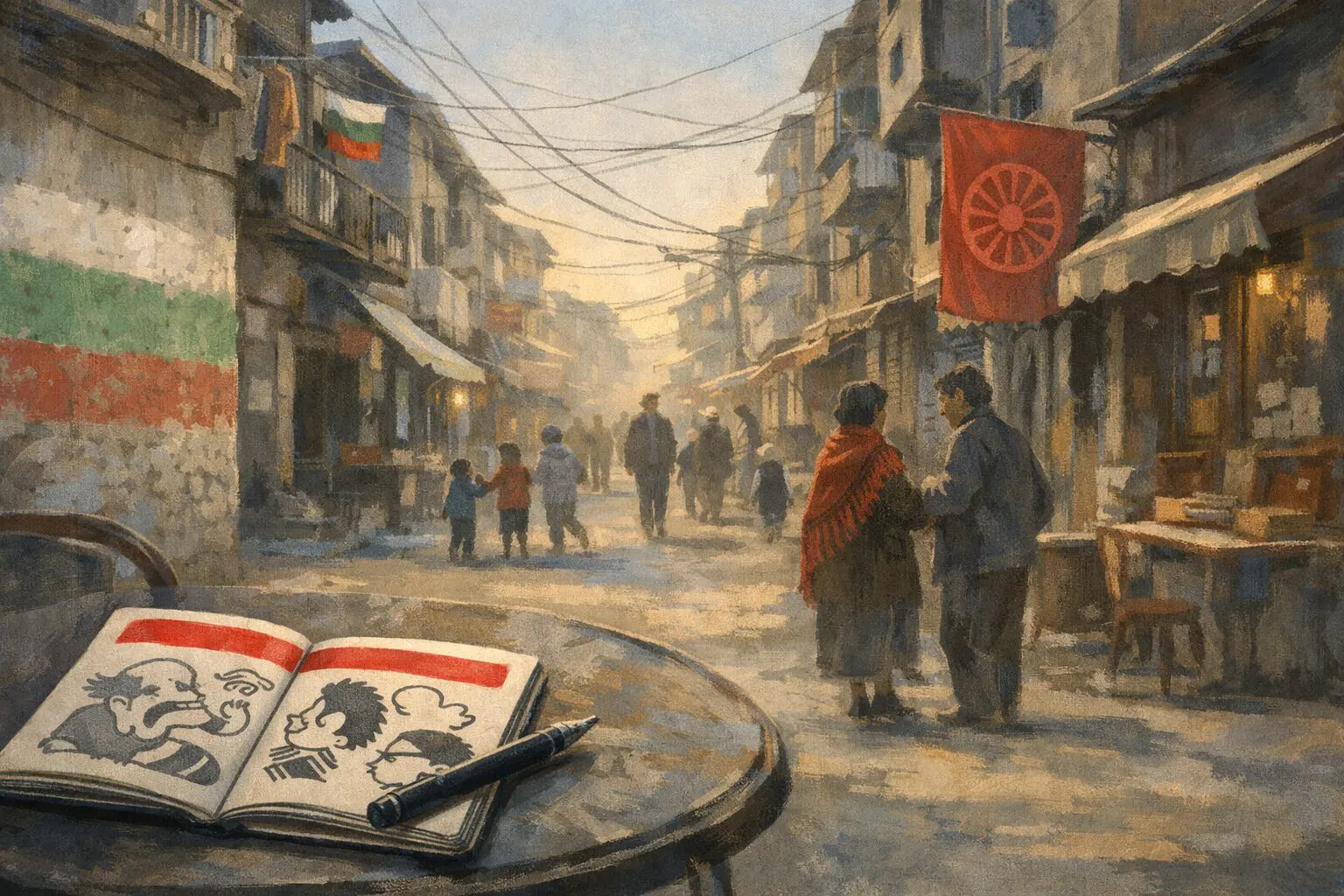
A recent Charlie Hebdo report from Plovdiv spotlights a European reality that rarely makes it into policy slogans: segregation can be “normal” on paper, and brutal in everyday life. In Stolipinovo — often described as the largest predominantly Roma district in the Balkans — the distance to the city centre is short, but the social gap is wide.
An “invisible” border that shapes daily life
In its 10 December 2025 reportage, journalist Coline Renault (with illustrations by Zorro) frames Stolipinovo as a place that is both inside Europe and pushed outside of it. One line captures the paradox with stark simplicity:
The border separating Stolipinovo from Plovdiv is invisible, but radical.
La frontière qui sépare le quartier de Stolipinovo de la ville de Plovdiv est invisible, mais radicale.”
That “border” is not a checkpoint. It is what happens when public services, trust, and opportunity thin out as soon as an address is associated with a minority community.
How many people live in Stolipinovo? The numbers reveal the problem
Even basic facts, such as population, come with a warning label. Various sources cite figures from roughly 40,000 to around 80,000 residents, depending on whether estimates include unregistered housing and undercounted households. An EU Commission evaluation linked to the European Capital of Culture year in Plovdiv described Stolipinovo as “the largest Roma district in the Balkans” with “a population of about 80,000 people.”
These gaps are not just statistical noise. They point to what advocates call “invisibility”: people who live in Europe, but remain outside the reliable data that normally drives investment, urban planning, and accountability.
Europe’s largest minority — still facing exclusion
Across the continent, the scale is undeniable. The European Commission estimates that Europe is home to 10–12 million Roma, about six million of whom live in the EU. Yet EU-wide surveys continue to show that discrimination and poverty remain persistent, not exceptional.
The EU Agency for Fundamental Rights (FRA) has repeatedly documented this reality. In its earlier EU-MIDIS II findings on Roma, FRA reported that around 80% of surveyed Roma lived below their country’s at-risk-of-poverty threshold. More recently, FRA’s Roma Survey 2024 suggests some improvement in headline poverty rates in surveyed countries — but also shows discrimination remains stubbornly common, and reporting of discrimination remains low.
In other words: Europe is not lacking strategy documents. It is struggling with delivery.
Identity, language, and the cost of being labelled
Stolipinovo is not a monolith. Many residents speak Turkish, and some describe themselves as Turkish rather than Roma — a reminder that identity can also be a survival strategy in an environment shaped by stigma. In Charlie Hebdo’s account, the question of labels becomes personal:
Say that we are ‘Gypsies’.
“Dites que nous sommes des Gipsys.”
In much of Europe, the term is widely viewed as derogatory; some people reclaim it, others reject it. Either way, the exchange underlines a deeper issue: when society reduces a community to a stereotype, people are forced to negotiate even the words used to describe their lives.
When discrimination becomes lethal — reminders from across Europe
Stolipinovo’s hardship is not an isolated Bulgarian story. It belongs to a wider European pattern in which discrimination can show up as police violence, neglect, or the quiet refusal to treat a minority life as equally valuable. The 2021 death of Romani man Stanislav Tomáš after a police restraint in Teplice, Czechia, triggered outrage and protests. In Greece, video footage circulated in 2021 showing an eight-year-old Romani girl trapped in a doorway while bystanders failed to intervene in time — a case Romani media described as marked by shocking indifference.
What the EU and Bulgaria say they will do
The EU’s current approach is built around the EU Roma Strategic Framework and a 2021 Council recommendation urging Member States to strengthen equality, inclusion, and participation policies. Bulgaria has its own national strategy for Roma equality and inclusion for 2021–2030.
But strategies are only as strong as the local changes they trigger: safe housing and utilities; desegregated schools; equal access to healthcare; fair employment; and credible enforcement when discrimination occurs.
What “inclusion” looks like on the ground
For Stolipinovo, the practical test is straightforward:
- Services: reliable water, sanitation, waste collection, and safe infrastructure — including in informal or disputed housing, where rights still exist.
- Education: reducing segregation and making early childhood education accessible, with real pathways into secondary school and vocational training.
- Jobs: moving beyond short-term projects toward stable employment, including targeted anti-discrimination enforcement in hiring.
- Trust: community safety that does not depend on fear — and institutions that respond when people report abuse.
Charlie Hebdo’s reporting is valuable precisely because it brings the debate back to the street level. European politics often speaks about “integration” as if it were an attitude problem. Stolipinovo suggests it is also an investment problem, an enforcement problem, and a dignity problem — all at once.
Related reading
For more context on Roma rights challenges in Bulgaria, see earlier coverage by The European Times on discrimination affecting Roma children.