Ecumenical Patriarch Bartholomew delivered a Christmas message in which he emphasized that the true Christian faith should act as a force for peace and reconciliation, and not as an instrument of fanaticism and confrontation, while at the same time calling for unity, love and solidarity between people. He placed particular emphasis on the need for dialogue and overcoming divisions in the Christian world, and also touched upon the historic commemoration in 2026 of the 1400th anniversary of the Akathist Hymn, which the Ecumenical Patriarchate will commemorate in a special way. Here is the full text of the message:
Deserving once again of reaching the great feast of the Nativity in the flesh of the Son and Word of God, we give glory to His “unspeakable and unfathomable condescension” – to the Savior of the human race and the Redeemer of all creation from corruption, proclaiming together with the Angels: “Glory to God in the highest, and on earth peace, goodwill toward men.”
Christ revealed himself as “Immanuel,” as “God with us” and “God for us,” as God close to each of us, as “closer even than ourselves.” The eternal Logos, consubstantial with God the Father, as dogmatically established by the First Ecumenical Council of Nicaea – whose convening was 1700 years ago, worthily celebrated by the Christian world last year – “became like His own creation”, becoming incarnate by the Holy Spirit and the Virgin Mary, “in order to make men gods”.
The Christmas troparion announces that with the Nativity of Christ “the light of knowledge dawned upon the world”, it revealed the “super-rational and universal meaning” of life and history, the truth that only the Christian faith can fully satisfy the deepest searches of the mind and the thirst of the heart, that “there is salvation in no one else” except in Christ. Since then, the “knowledge” that “puffs up” has been assessed and made meaningful in the light of the Lord’s words: “You will know the truth, and the truth will set you free”.
The supersensible event of the Incarnation is experienced and spiritually repeated in the lives of believers, of those who love the manifestation of the Savior Christ. As Saint Maximus the Confessor writes: “The Word of God, who was once born in the flesh, is unceasingly born in the spirit, according to His human-loving will, in those who wish.”
In this sense, the celebration of the Nativity of Christ, of the incarnation of God and the deification of man by grace, does not point us to an event from the past, but leads us to the “future city,” to the eternal Kingdom of the Father and the Son and the Holy Spirit.
In a world where military cries resound and the clang of weapons is heard, the angelic “peace on earth” resounds; the voice of the Lord blesses the peacemakers, and His holy Church prays in the Divine Liturgy “for peace from above” and “for peace in the whole world.” True faith in the living God strengthens the struggle for peace and justice, even when it is faced with – from a human perspective – insurmountable obstacles.
As the Message of the Holy and Great Council of the Orthodox Church, the first decade of which we will celebrate next year, states under divine inspiration, “the oil of religious faith should be used to heal wounds, not to fan the flames of military conflicts.”
The Gospel of peace concerns us Christians in a special way. We consider indifference to the fragmentation of Christianity unacceptable, especially when it is accompanied by fundamentalism and an open rejection of inter-Christian dialogues, the ultimate goal of which is to overcome division and achieve unity. The duty of the struggle for Christian unity is irrevocable. The new generation of Christians has the responsibility to continue the efforts of the pioneers of the ecumenical movement and to justify their ideals and works.
We belong to Christ, who is “our peace” and “the fullness of joy” in our lives, the “good will” that comes from the certainty that “the truth has come” and “the shadow has passed away,” that love is stronger than hatred and life is stronger than death, that evil does not have the last word in the life of the world, which is led by Christ ( “The same yesterday, today and forever”).
This faith must shine and be revealed in the way we celebrate the Nativity of Christ and the other church holidays. The God-pleasing holiday on the part of believers must testify to the transforming power of faith in Christ for our lives, to be a time of goodwill and spiritual joy, of experiencing that inexpressible “great joy” that is “synonymous with the Gospel”.
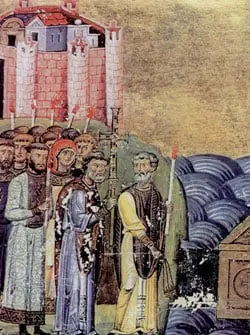
Venerable and God-loving brothers and beloved children, in 2026 the holy Great Church of Christ will celebrate the 1400th anniversary of August 7, 626, when during the all-night vigil in the holy temple of the Most Holy Theotokos in Blachernae the Akathist hymn was sung – as an expression of gratitude to the Most Holy Theotokos for the deliverance of the City from the attack of hostile enemies.
On the occasion of this historical anniversary, the yearbook of the Ecumenical Patriarchate for 2026 will be dedicated to the commemoration of this significant event for our Tradition and for our identity, which are inextricably and deeply connected with the veneration of the all-blessed and all-immaculate Mother of our God and Protector-Leader of the people.
In this spirit, bowing our knees before the Mother holding the Child, and worshipping the Word of God, who took our form, we send you all our wishes for a blessed Holy Twelve Days, and for the New Year, by the goodness of the Lord, we wish it to be fruitful in good deeds and filled with the gifts of the Lord, to Whom befits all glory, honor and worship, now and always and forever and ever. Amen!