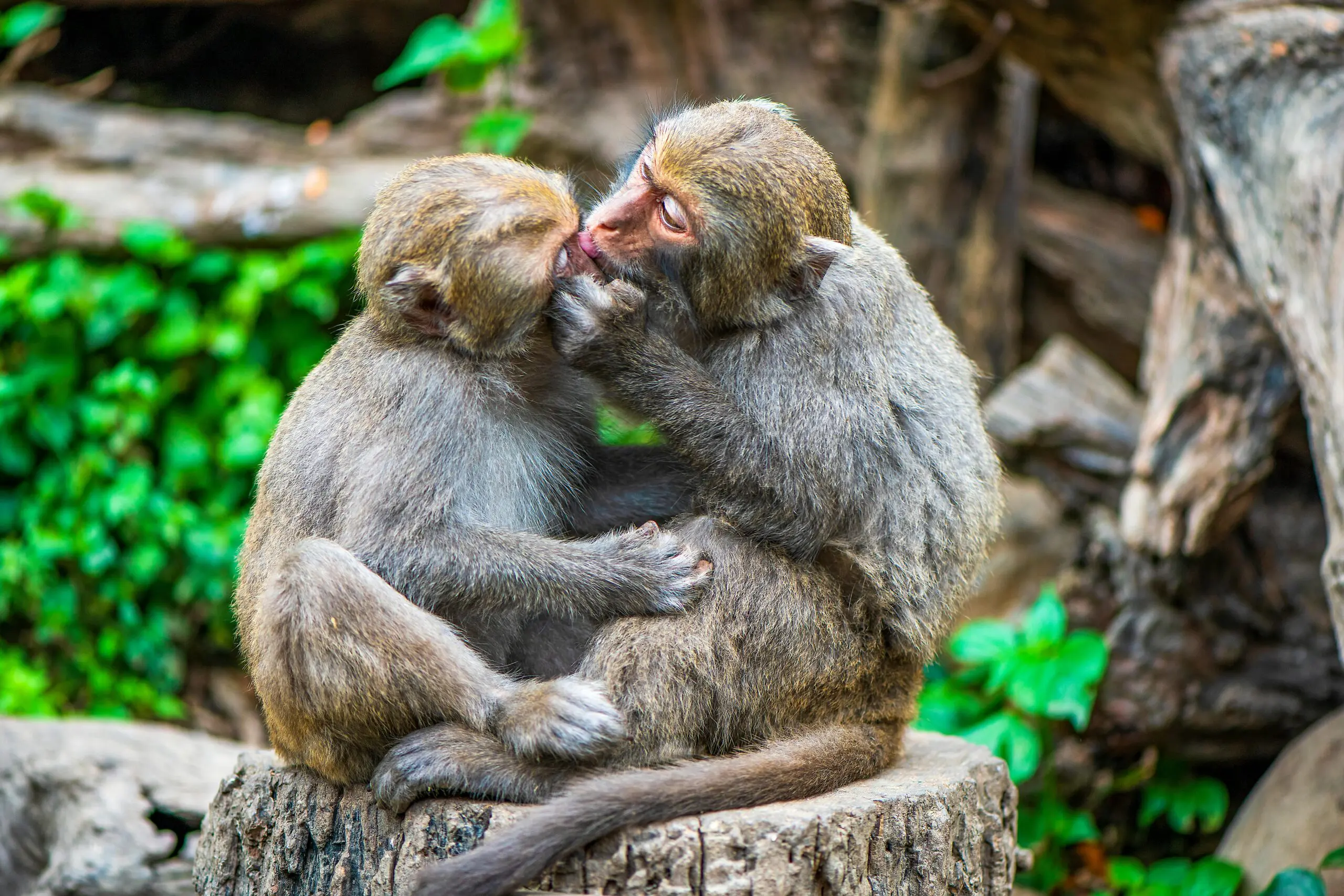
The first kiss did not happen between a passionately in love human couple, but between primates – the ancestors of great apes, about 20 million years ago, according to the results of a study by the University of Oxford and the Florida Institute of Technology, published in the journal Evolution and Human Behavior, Reuters reported.
The scientists set out to find out when kissing originated, because, on the one hand, from an evolutionary point of view, it has no direct connection with survival, and on the other – it is even harmful, because diseases can be spread through it. However, in addition to humans, chimpanzees, bonobos (a type of small chimpanzee), orangutans and gorillas also kiss – which suggests that the habit of exchanging kisses in all these species was inherited from a common ancestor. The scientists combined observations of primates with data on evolutionary relationships to “turn back the clock” and try to determine when the first kiss happened.
“Using these two key sources of information, we ran a model that allowed us to simulate different evolutionary scenarios,” said lead author Dr Matilda Brindle, from Oxford’s Department of Biology. Millions of simulations placed the first kiss between 21.5 million and 16.9 million years ago.
The scientific definition of a kiss, which is far from romantic, is “non-aggressive mouth-to-mouth contact that does not involve the transfer of food.” This definition includes both sexual kissing and platonic kisses between family members or between friends – as a greeting. Exactly how kissing originated remains a matter of debate, as do the reasons for its persistence over time.
“Some suggest that sexual kissing is a useful way to assess a partner’s qualities or suitability,” says Dr. Brindle. “Alternatively, kissing may be a form of foreplay that increases sexual arousal and increases the likelihood of fertilization.”
Platonic kissing is thought to have served to navigate complex social relationships or to strengthen social bonding, he adds.
The study suggests that kissing may have also occurred between Neanderthals and humans, given evidence that the two species interbred and shared an oral microbe—a sign that they exchanged saliva—long after they diverged evolutionary 450,000 to 750,000 years ago.
Illustrative Photo by Klub Boks: https://www.pexels.com/photo/close-up-shot-of-two-monkeys-in-zoo-7404161/