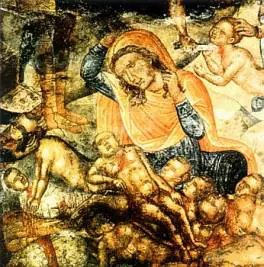
Traditionally, the expression “serving mammon” means caring more about material wealth than spiritual life, living in pursuit of pleasure, and relying solely on wealth and money instead of trusting in God and submitting to His will.
Mammon (also spelled mammon) is an Aramaic word found in the Gospels of Matthew (Matthew 6:24) and Luke (Luke 16:13). It means “wealth” and was likely borrowed from Hebrew, where the word “mamon” has the same meaning. It is believed to have entered Hebrew from Canaanite languages. It has been suggested that Mammon was the name of the Syrian god of wealth, but modern scholars dispute this. Jesus Christ mentions mammon in the Gospel when he speaks about the proper attitude toward earthly wealth: No one can serve two masters: for either he will hate the one and love the other; or else he will hold to the one and despise the other. You cannot serve God and mammon (Matthew 6:24). Here’s how Blessed Jerome of Stridon explains these words:
“In Syriac (Aramaic), mammon is the word for wealth. You cannot serve God and wealth! Let the miser listen to this, let anyone who bears the name of Christian listen, that he cannot simultaneously serve wealth and Christ.”
The Holy Fathers of asceticism repeatedly noted that a person who hoards, even under the most plausible pretext (“one must have a reserve for a rainy day”), begins to rely on wealth more than on God’s Providence. It is therefore no coincidence that, continuing the phrase about mammon, Christ adds: Therefore I say to you, do not worry about your life, what you will eat or what you will drink; nor about your body, what you will wear (Matthew 6:25). Here, “do not worry” means “do not be anxious or fussy.” Certainly, a person must work to secure food, clothing, and other material goods, without which life is simply impossible. However, thoughts about these things should not consume people, occupy all their time, serve as an additional source of anxiety, fear, or interfere with their spiritual life. With this phrase, Christ calls for hope and trust in God, remembering that a person’s life does not depend on the abundance of their possessions (Luke 12:15).
This does not mean that a believer cannot be rich. The Bible mentions many saints who were quite wealthy—for example, Abraham and Joseph of Arimathea. The issue here is not the amount of money and other possessions, but the attitude toward them. Let us turn to the above-mentioned interpretation of Blessed Jerome of Stridon: “He (Christ. – Ed.) did not speak of one who has wealth, but of one who is a slave to wealth. Indeed, he who is a slave to wealth preserves wealth as a slave, and he who has thrown off the yoke of wealth distributes it as a master.”
In a number of patristic interpretations, mammon is not reduced exclusively to wealth and hoarding. Saint John Chrysostom expands on the concept of mammon and views it, in principle, as a symbol of earthly material pleasures, the pursuit of which contradicts the Gospel teaching: “When mammon commands us to steal what belongs to others, and God commands us to give away our own property; when God commands us to lead a chaste life, and mammon commands us to live a promiscuous life; when mammon commands us to drink and overindulge, and God, on the contrary, commands us to curb the belly; “When God commands us to despise present worldly goods, and mammon to cling to them; when mammon forces us to marvel at marble, walls, and roofs, and God forces us to despise all of this and revere true wisdom: how can you say that serving God and mammon can be combined? .. Hence the untold harm, hence the quarrels, insults, strife, labors, spiritual blindness; and, most unbearable of all, serving mammon completely deprives one of heavenly blessings.”
The Venerable Isaiah the Hermit understood mammon in a similar way: “Mammon is every deed of this world. True service to God is to have nothing in one’s mind that is alien to God.” In other words, whoever cares about something vain, transitory, and alien to the Gospel commandments serves mammon.
Published in: “Thomas” (Phoma) magazine, 07/11/2024, https://foma.ru/