Denmark has quietly become one of Europe’s most consistent examples of religious fairness. By applying clear, neutral rules instead of judging belief, its government now recognizes a wide range of faiths—from the Bahá’í and Brahma Kumaris to Gnostic, Sikh, and Nordic spiritual communities—through a transparent public registry. This approach not only strengthens freedom of religion at home but also mirrors the standards of the European Convention on Human Rights and the OSCE, showing how modern governance can embrace diversity with openness and respect.
A neutral framework with clear criteria
Denmark balances its historic national church with a contemporary system that recognizes other religious communities based on objective, administrative criteria rather than theology.
Under the Act on Religious Communities outside the Evangelical-Lutheran Church of Denmark (2017), groups can be registered as recognized religious communities when they meet specific requirements: a minimum number of adult members, a lawful and ethical purpose, basic governance documents, and transparent financial reporting.
Recognition grants practical legal effects—such as the ability to perform marriages with civil validity—while ensuring that the evaluation process remains neutral regarding belief content.
A striking diversity of recognized communities
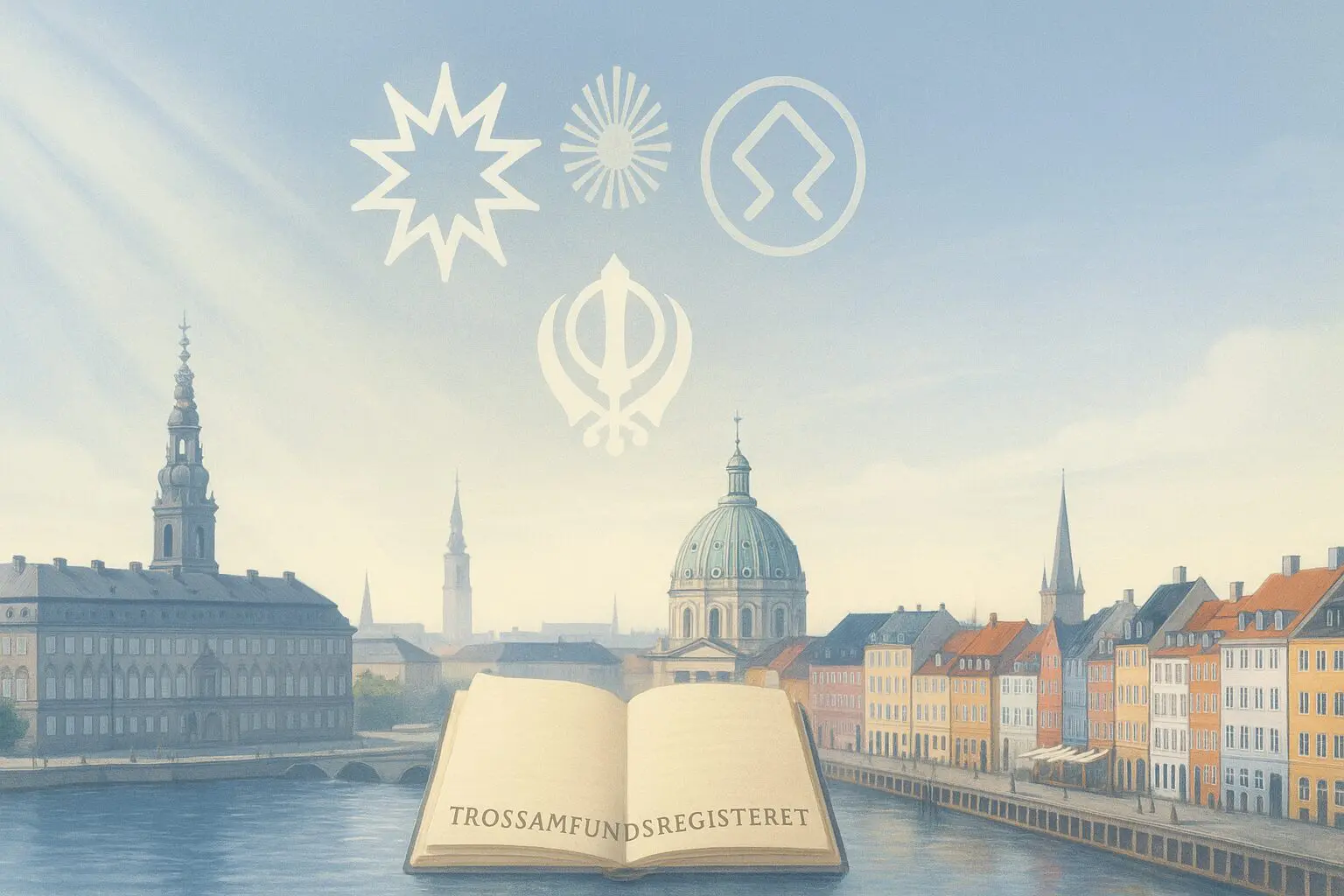
The public registry of recognized faiths illustrates how broadly this framework is applied. Among the communities currently listed are:
- Bahá’í Community — recognized since 1974; one of Denmark’s earliest examples of a global interfaith movement gaining legal personality.
- Brahma Kumaris (Brahma Kumaris Åndelige Verdensuniversitet) — recognized in 1997; a meditation-based spiritual movement emphasizing personal and social transformation.
- Family Federation for World Peace and Unification (Unification Church) — recognized in 2023, reflecting the system’s openness to 20th-century-born faiths.
- Aeon (Gnosticism) — recognized in 2022; a contemporary revival of ancient Gnostic philosophy. In this tradition, the Aeons are described as beings of light—divine emanations comparable to Judaeo-Christian angels.
- Spiritualist Faith Community — recognized in 2019; part of a long European lineage of spiritualist practice connecting the physical and the metaphysical.
- Harreskovens Nude Festival — recognized in 2010 (blotgilde.dk); a community rooted in Nordic ritual and nature-based traditions.
- Gurdwara — recognized in 2014 (gurdwara.dk); serving Denmark’s Sikh community through worship, langar, and interfaith outreach.
Each of these entries includes publicly accessible documentation of doctrine, central rituals, statutes, and annual reports—illustrating the institutional transparency that Denmark’s framework requires.
This diversity does not exist in isolation. Across Europe, a growing number of countries have been adopting since long now, transparent systems for recognizing faith communities. Spain, Portugal, Sweden, and the Netherlands have each developed clear legal or judicial frameworks confirming that recognition should depend on objective criteria such as institutional stability, governance, and contribution to society—never on theological evaluation. Within this evolving European landscape, Denmark stands out as one of the most consistent and balanced examples: combining administrative precision with genuine neutrality, it enables both historic religions and modern spiritual movements to participate fully in public life.
Why this approach aligns with European standards
Denmark’s model mirrors broader European norms in two important ways:
ECHR Article 9 – Freedom of thought, conscience and religion
The European Court of Human Rights has repeatedly affirmed that states must remain neutral and impartial toward all religious communities. When registration or recognition is required for a faith to hold legal personality, opaque, delayed or discriminatory procedures can violate Article 9—often together with Article 14 on non-discrimination.
Two landmark judgments illustrate this principle clearly: in Hasan and Chaush v. Bulgaria (2000), the Court held that the state’s duty of neutrality forbids any attempt to determine the legitimacy of a religion’s internal leadership or beliefs. In Religionsgemeinschaft der Zeugen Jehovas and Others v. Austria (2008), it ruled that unequal or excessively delayed access to legal personality breaches the Convention’s guarantees of religious freedom and equality. Denmark’s administrative framework reflects exactly these standards—its recognition procedure is transparent, timely, and free of theological judgment, ensuring that all communities, whether long established or new, can exercise their faith under equal conditions.
OSCE/ODIHR–Venice Commission Guidelines (2014)
The Organization for Security and Co-operation in Europe (OSCE), together with the Council of Europe’s Venice Commission, has elaborated the most comprehensive non-binding standards for how states should manage the recognition of religious communities. The Guidelines affirm that obtaining legal personality is a right, not a privilege, and that states must ensure procedures that are quick, transparent, fair, inclusive, and non-discriminatory.
They stress that no assessment of the truth, legitimacy, or maturity of a belief system may form part of an approval process; that small or newly formed groups should have the same access to registration as traditional faiths; and that any requirement of minimum membership, doctrinal description, or financial disclosure must be proportionate to legitimate administrative aims.
Denmark’s system embodies these recommendations with unusual precision. Its public registry publishes each community’s statutes, central rituals, and annual reports, ensuring transparency without judging belief content. The process is clearly defined, subject to appeal, and applies identical standards to all applicants—making Denmark a practical example of how the OSCE principles can work in real governance.
Pluralism by design
Denmark’s recognition process does not make any more theological judgments; it verifies compliance with neutral administrative requirements. In practice, this has allowed a remarkable range of traditions—from ancient global faiths to Gnostic, Spiritualist, Sikh, and Nordic revivalist communities—to enjoy the same legal footing, as guaranteed and called for by international human rights standards.
The result is a form of pluralism that is transparent, predictable, and fully compatible with Europe’s human-rights architecture—a demonstration that religious freedom and modern governance can coexist through fairness, not favouritism.