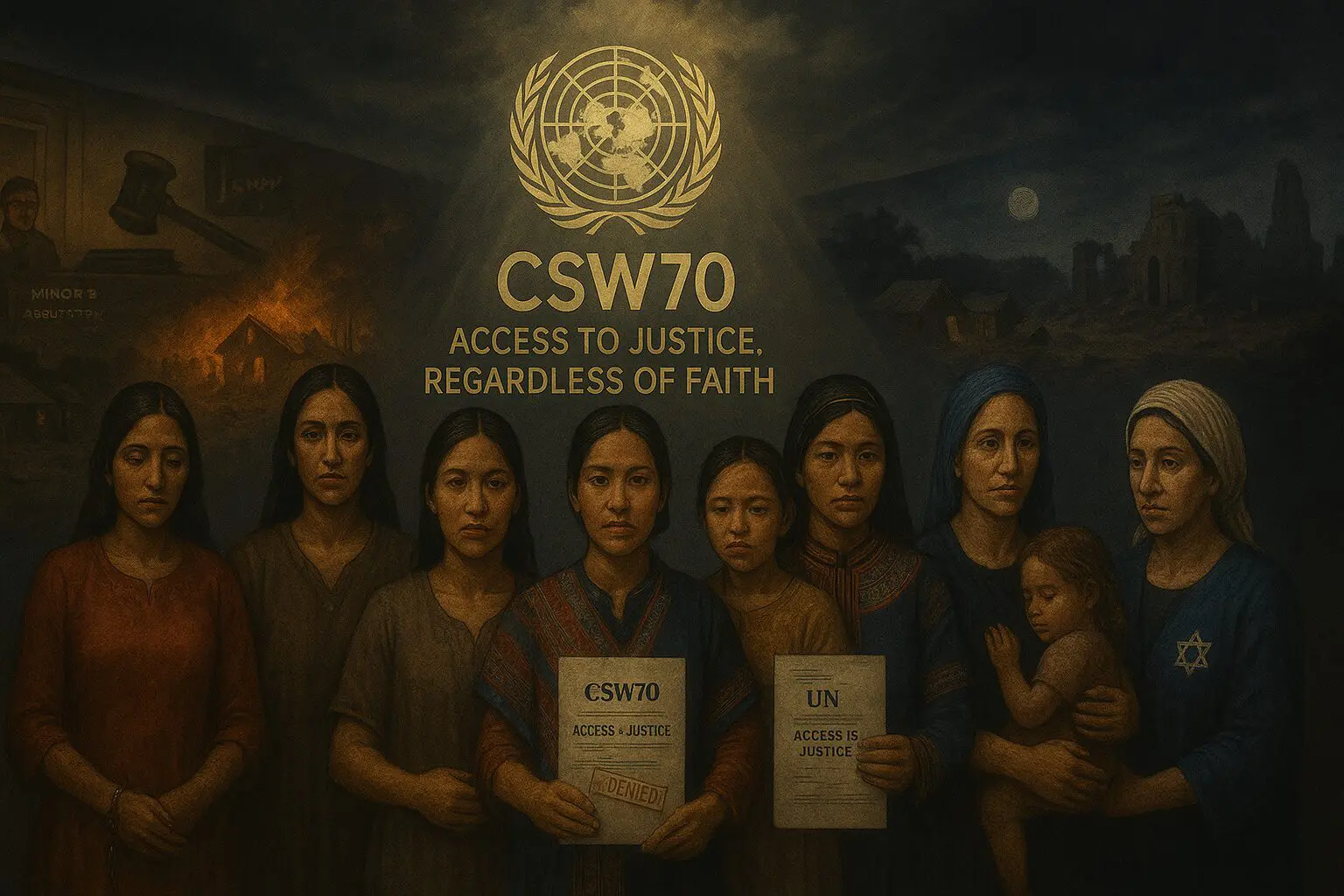
A coalition of non-governmental organizations has sounded the alarm ahead of the United Nations Commission on the Status of Women’s 70th session (CSW70) about compounded gender-based violence and freedom of religion or belief violations affecting women and girls from religious minorities. In a joint written statement to CSW70, six NGOs – Big Ocean Women, Coptic Solidarity, Fundación para la Mejora de la Vida, la Cultura y la Sociedad, Jubilee Campaign, Tumuku Development and Cultural Union, and Universal Peace Federation and other 14– detail how minority women in countries like Iraq, Pakistan, India, Vietnam, and Nicaragua face systemic injustice, from abduction and forced conversion to institutionalized discrimination. The statement urges governments and the international community to act on longstanding commitments to protect minority women’s rights, and it echoes concerns raised by UN experts and civil society about gender-based violence, religious persecution, and the urgent need to uphold minority rights.
Coalition Warns of ‘Compounded’ Abuses
The joint statement – submitted by the six NGOs in consultative status with the UN ECOSOC – plus 14 other specialized NGOs, warns that women and girls from religious minority communities suffer “compounded violations” of fundamental rights. These abuses stem from gender-based discrimination intertwined with restrictions on freedom of religion or belief (FoRB). “These violations often are gender-based and used as tools of religious coercion and control to suppress or forcibly assimilate women from minority faiths,” the statement says. The NGOs note that the 1995 Beijing Declaration commits UN Member States to protect women’s and girls’ rights to freedom of thought, conscience, and religion on an equal basis. Yet in practice, minority women frequently face a double burden of sex- and faith-based persecution – a reality the coalition wants on the CSW70 agenda. (The priority theme of CSW70, which convenes in March 2026, is ensuring access to justice for all women and girls by eliminating discriminatory laws and structural barriers, making these concerns especially pertinent.)
Legal Barriers Entrench Violence
Iraq – Yezidi Women Still in Limbo: More than a decade after the self-proclaimed Islamic State’s 2014 onslaught, an estimated 2,500 Yezidi women and girls remain missing in Iraq. ISIS fighters abducted, raped, and enslaved thousands of Yezidis and Assyrian Christians in a genocidal campaign to annihilate these minorities. To this day, Iraqi law compounds the trauma for survivors. Under Iraq’s National Identity Card law, children born of rape by ISIS are automatically registered as Muslim, regardless of the mother’s faith. Survivors who wish to raise these children in their own ancestral religion face “insurmountable legal and social barriers”. Mothers cannot even obtain identity documents for their children, blocking access to education, healthcare, and legal personhood. This enforcement of the perpetrator’s religion over the victim’s – even when conception resulted from brutal sexual violence – “perpetuates ISIS’s genocidal intent through institutional mechanisms, transforming acts of gendered violence into enduring tools of religious and cultural erasure”, the NGOs caution. In short, what began as ISIS’s gender-based violence has evolved into institutionalized religious persecution, depriving Yezidi women and their children of basic rights.
Iraq’s government has acknowledged the Yezidi genocide and took a positive step by passing the Yezidi Female Survivors Law in 2021, promising financial restitution, housing, education, and mental health support for survivors. However, implementation has been fragmented and incomplete. Many survivors still struggle to obtain the promised reparations or receive adequate assistance to rebuild their lives. Meanwhile, justice remains elusive: the statement notes that ISIS’s 2014 crimes against Yezidi and Assyrian women remain largely unprosecuted despite ample evidence. Only a handful of perpetrators have faced trial – usually outside Iraq and mainly on terrorism charges – leaving the genocide and sexual slavery aspects unaddressed. Yezidi and Assyrian survivors seeking justice encounter linguistic and cultural barriers in courts, fear of retribution, scarce resources, and a lack of political will to fully reckon with these crimes. The NGOs argue that this impunity for gender-based atrocities perpetuates survivors’ suffering and undermines faith in legal institutions. Notably, UN investigative bodies have documented ISIS’s attacks on the Yezidis as genocide and have called for justice and accountability on the genocide’s tenth anniversary, but prosecutions on the ground remain rare.
Pakistan – Forced Conversions and Court Failures: In Pakistan, the coalition highlights a pattern of young girls from Christian and Hindu minorities being abducted, forcibly converted to Islam, and married to their captors – a blatant form of gender-based violence used as a tool of religious oppression. The statement describes how judicial authorities often fail to protect minor girls. Courts frequently disregard birth certificates and medical evidence proving a victim is underage, while readily accepting dubious marriage or conversion certificates produced by abductors. As a result, perpetrators are seldom held to account. The statement cites chilling examples: in one 2024 case, a Lahore High Court judge congratulated a 13-year-old Christian girl, Roshni Shakeel, on her “marriage” to the man who had kidnapped her, dismissing her parents’ pleas for her rescue. In May 2025, another judge sent a 16-year-old Catholic girl, Jessica Iqbal, back to her abductor under the guise of marriage. Such decisions effectively legitimize statutory rape and forced conversion, exposing a deep institutional bias against minority victims.
International human rights observers share these concerns. UN experts have expressed alarm that “Christian and Hindu girls remain particularly vulnerable to forced religious conversion, abduction, trafficking, child, early and forced marriage, domestic servitude and sexual violence” in Pakistan. In an April 2024 statement, a group of UN Special Rapporteurs condemned the “impunity of such crimes” and noted that forced conversions and child marriages of minority girls are often “validated by the courts, [which invoke] religious law to justify keeping victims with their abductors”. Police and officials frequently dismiss these cases as “love marriages,” enabling perpetrators to escape accountability. The UN experts stressed that no cultural or religious pretext can justify child marriage or denial of freedom of religion, urging Pakistan to raise the minimum marriage age to 18 and enforce laws against such abuse. The NGO coalition’s statement reinforces these recommendations, portraying Pakistan’s minority girls as caught in a dire gap between minority rights on paper and in practice.
India – Manipur’s Targeting of Minority Women: The ongoing conflict in Manipur, northeast India, is cited as another stark example where ethnic and religious minority women suffer horrific violence with scant accountability. Clashes since May 2023 between predominantly Hindu Meitei and predominantly Christian Kuki communities in Manipur have led to displacement and chaos. According to the NGOs’ statement, the conflict has exposed the “acute vulnerability of Christian minority women and girls to gender-based and religion-related violence”. Disturbing reports emerged of sexual violence used as a weapon of terror: in one incident, police officers allegedly handed two Kuki Christian women to a mob, who then stripped them naked and gang-raped them in public. In another case, a pastor’s young daughter was raped and murdered, yet investigations have stalled amid the turmoil. Despite government claims that order has been restored, ethnic-religious tensions persist and survivors face “limited access to justice” in Manipur.
These accounts align with warnings from the United Nations. In September 2023, UN human rights experts said they were “appalled by the reports and images of gender-based violence targeting… the Kuki ethnic minority” in Manipur. “The alleged violence includes gang rape, parading women naked in the street, severe beatings causing death, and burning them alive or dead,” the UN experts noted in a statement, calling the events a “tragic milestone” for India’s minorities. They urged Indian authorities to investigate and hold perpetrators – including any officials complicit – to account. The NGO coalition’s CSW70 statement echoes these concerns, highlighting sexual violence in conflict and the prevailing impunity in Manipur. It underscores that when law enforcement itself is accused of enabling atrocities, justice for minority women becomes even harder to obtain.
Vietnam & Thailand – Refugees at Risk: The statement draws attention to less-publicized struggles of minority women in Vietnam and in exile. For decades, members of Vietnam’s indigenous Montagnard and Hmong Christian communities have fled persecution and political instability, seeking asylum in neighboring Thailand. Many of these refugees are women and girls. However, according to the NGOs, they now face transnational repression: the Vietnamese government has reportedly partnered with Thai authorities to track, detain, and forcibly return Vietnamese dissidents and asylum-seekers. This creates a climate of fear among refugee women. Lacking legal status, many are forced into informal and exploitative work to survive. If these undocumented women are cheated out of wages or abused, they “cannot advocate for themselves” or seek help, “lest they be threatened” with exposure and deportation. The result is a vulnerable population of stateless refugee women, easy prey for exploitation and with no recourse to justice – a direct contradiction of the CSW’s access to justice goals.
Structural Exclusion and Religious Repression
Beyond overt violence, the NGOs warn of structural exclusion that marginalizes minority women over the long term. They cite government policies that impose uniformity or punish dissenting faith communities, which in turn harm women in unique ways.
Vietnam – Assimilation of Ethnic Christians: Inside Vietnam, Montagnard and H’mong Christians in the Central Highlands face relentless pressure to conform to state-sanctioned religion. Those who worship in independent house churches (outside the official state-controlled church) endure harassment, surveillance, and threats for refusing to join government-approved religious organizations. The authorities deny basic civil documentation to members of unrecognized churches – withholding marriage certificates, birth certificates, and other papers. This effectively renders many minority families “stateless” social pariahs in their own country. Women often bear the brunt: wives are left to raise children alone when husbands or pastors are imprisoned for their faith, and families are even evicted from their homes or cut off from water and electricity as punishment. The statement also notes a campaign of intimidation against Buddhist nuns who refuse to join the state-controlled Buddhist church – for example, members of the Thiền Am Bên Bờ Vũ Trụ monastery have been accused of fraudulent practices, and subjected to invasive gynecological exams and DNA tests by officials to smear them with allegations of misconduct. These tactics seek to discredit and break the women who hold fast to independent religious beliefs. (Vietnam’s government routinely denies repressing ethnic or religious minorities, often labeling such reports “distorted and false”. In a July 2024 reply to UN Special Rapporteurs, Vietnam insisted it only takes actions against individuals for security reasons, not because of their religion. Montagnard advocates reject these denials, maintaining that believers are targeted “because of [their] religious beliefs, not… national security”.)
Nicaragua – Harassment of Pastors’ Families: The reach of religious repression extends to Latin America as well. In Nicaragua, the statement describes how families of imprisoned church leaders have been harassed by authorities amid a broader crackdown on civil society. For instance, when an evangelical pastor (pseudonym “Roberto”) was arbitrarily detained for his activities, his wife and two young daughters faced continual surveillance and intimidation. Even after the pastor’s eventual release, Nicaraguan authorities blocked the family’s reunification and they were forced to flee the country due to threats against their safety. This forced exile meant the children lost their home, community, and schooling, with the government effectively denying their rights as refugees. Such cases demonstrate that women related to religious figures can become targets of retaliation, suffering trauma and displacement simply for their association with a faith-based cause. The NGOs point to Nicaragua’s example to emphasize that state persecution of minority faiths – and its gendered impacts – is a global concern, not confined to any one region.
Post-Conflict Exclusion of Women: Lastly, the joint statement highlights how minority women are often shut out of post-conflict recovery and decision-making, exacerbating their marginalization. In Iraq, for example, Assyrian Christian communities in the Nineveh Plains and Yezidi communities in Sinjar are struggling to reclaim ancestral lands and rebuild after years of conflict and displacement. Yet women’s perspectives are largely missing from these processes. The statement notes that land grabbing and demographic changes in northern Iraq have undermined Assyrian families’ land rights, with women bearing a disproportionate burden of the loss of livelihood and cultural continuity. Efforts to seek restitution or reclaim stolen lands have been ineffective, and women are often excluded or silenced through stigma and intimidation. For internally displaced Yezidi women, returning to their homeland in Sinjar remains extremely challenging even 10 years after the genocide; the region’s infrastructure is still devastated, and security and basic services are lacking. Those who do return or relocate face bleak economic prospects. According to the NGOs, systemic discrimination means Assyrian and Yezidi women struggle to access public-sector jobs, and private employment in their areas is scarce. Without opportunities to support their families, many remain economically dependent or in precarious conditions. The exclusion of minority women from transitional justice and reconstruction efforts – whether in Iraq or elsewhere – perpetuates their vulnerability and slows the healing of their communities.
Calls for Justice and Inclusion
The coalition of NGOs behind the statement is urging governments, UN bodies, and the international community to take concrete action to address these intertwined issues of gender-based violence and religious persecution. They stress that protecting women and girls from faith minorities is not a new mandate, but rather part and parcel of existing global commitments to gender equality and human rights. In line with CSW70’s focus on access to justice, the statement makes several key recommendations for Member States and global institutions:
- Reaffirm Women’s Freedom of Religion or Belief: Governments should recommit to the principles of the Beijing Declaration and Platform for Action, explicitly recognizing women’s and girls’ right to freedom of religion or belief and integrating this into all gender equality and development frameworks. This means acknowledging that religious freedom is a women’s issue too, and it must be safeguarded on an equal basis for minority women.
- Improve International Monitoring and Reporting: Strengthen coordination among human rights mechanisms to systematically document and address gender-specific FoRB violations. For example, the statement suggests better collaboration between the CEDAW Committee (which monitors women’s rights) and the UN Special Rapporteurs on freedom of religion or belief and on violence against women and girls. By sharing data and analyses, these bodies can shine a brighter spotlight on abuses like forced conversions or sexual violence against minority women, which often fall through the cracks.
- Ensure Equal Access to Justice: Adopt concrete measures to make justice systems accessible and bias-free for women and girls from religious minorities. This includes providing legal aid, protection, and reparations for victims of compounded gender- and religion-based violence. Judicial and law enforcement personnel should be trained to be gender- and religion-sensitive, so that a minority girl’s testimony is taken seriously and her family’s evidence is not dismissed due to prejudice. Transitional justice processes (in post-conflict settings like Iraq’s) must also include minority women’s voices and address the specific harms they suffered.
- Reform Discriminatory Laws: Align national legislation with international human rights standards – close legal loopholes that enable child marriage, forced conversion, or any form of coercive change of religion. Laws should unequivocally protect girls from being married under duress (with 18 as the minimum age, as per global norms) and prohibit authorities from changing a child’s religion without consent. The NGOs argue that women and children must be protected from “coercive religious reclassification” and be able to exercise their rights to family unity, dignity, and freedom of belief equally. In practice, this could mean legal provisions in countries like Iraq to allow Yezidi mothers to pass their religion to their children, or stricter enforcement in Pakistan against forced conversions disguised as marriages.
The signatory NGOs are hopeful that UN member states will heed these recommendations during CSW70 and beyond. Some positive signs exist: for instance, UN Special Rapporteurs and working groups have begun closely scrutinizing issues of gender and religious minority rights, as seen in their statements on Pakistan and India. A growing number of countries and international bodies (including the European Union) have also raised concerns about minority rights and freedom of religion or belief in international forums. But the NGOs emphasize that words must translate into action. They call for better protection mechanisms on the ground – from rescuing missing Yezidi women to sheltering at-risk girls in Pakistan – and greater accountability for perpetrators, whether they are extremist fighters, traffickers, or complicit officials.
Notably, this joint statement has garnered broad civil society support. In addition to the six main submitting organizations, it is endorsed by a coalition of diverse groups across the globe. These supporting organizations include advocacy and research groups from various faith and ethnic communities, such as the Assyrian International Council, Boat People SOS (BPSOS), Burma Research Institute, CaoDai Today, Council for Muslims Facing Tomorrow, Pagan Federation International, Free Yezidi Foundation, Friends of Thiền Am Monastery, Global Women Christian Chamber of Commerce Embassy, the International Institute of Religious Freedom (IIRF), Nigerian Women Lead, the Observatory of Religious Freedom in Latin America (OLIRE), Open Doors International, and She Leads Assyria. This wide backing underscores a shared concern: across different religions and regions, minority women’s rights are under threat and require urgent attention.
As the world’s governments prepare for the CSW70 session in New York (March 2026), the message from civil society is clear. Gender-based violence and religious persecution are often interlinked, and their victims – from Yezidi women in Iraq to Christian girls in Pakistan – cannot be left behind. The European Times will follow the developments at CSW70, where it is expected that delegates will discuss these issues in the context of achieving true gender equality and justice for all women and girls, regardless of their religion or belief. The hope is that the international community will not only acknowledge the plight of minority women highlighted in this statement but also commit to concrete steps that turn promises of protection into reality.
Sources:
- Joint NGO Statement to UN Commission on the Status of Women (CSW70) – Written statement submitted by Big Ocean Women, Coptic Solidarity, Fundación para la Mejora de la Vida, la Cultura y la Sociedad, Jubilee Campaign, Tumuku Development and Cultural Union, and Universal Peace Federation (ECOSOC consultative status). . (October 2025).
- UN Experts “Appalled” by Manipur Violence – United Nations special rapporteurs’ statement on abuses in Manipur, India, as reported by National Herald (PTI, 5 Sep 2023).
- UN Experts Alarmed by Forced Conversions in Pakistan – OHCHR press release on minority girls in Pakistan, as reported by Dawn (Amin Ahmed, 12 Apr 2024).
- Vietnam Denies Repression of Montagnard Christians – Report by Radio Free Asia on Vietnamese government’s response to UN allegations (RFA Vietnamese, 17 Jul 2024).
- UN Women – CSW70 Priority Theme – Announcement of CSW70 theme focusing on access to justice and eliminating discrimination (UN Women/UNYASIL, Oct 2025).