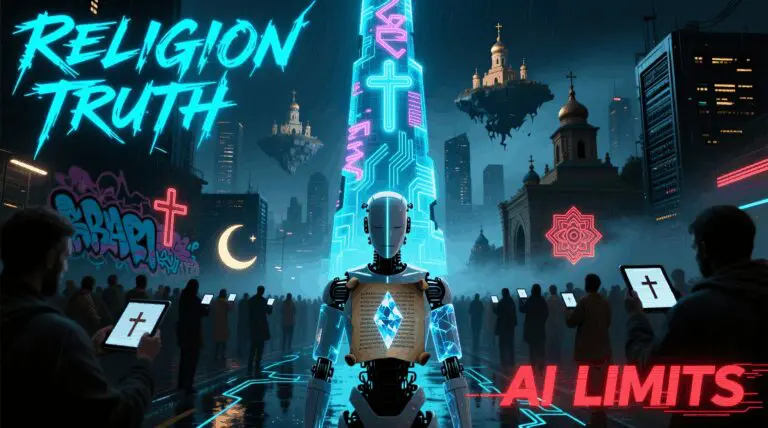
In an age where artificial intelligence (AI) is rapidly shaping how we access and process information, it’s tempting to believe that a few well-phrased prompts can unlock deep understanding about any topic — including religion. Yet when it comes to learning about belief systems, doctrines, and spiritual practices, relying solely on AI can be misleading, and even unintentionally biased.
Religions are complex social and spiritual frameworks, often built over centuries, with intricate doctrines, rituals, and cultural contexts. To truly understand them, one must approach the source material directly: the sacred texts, the official teachings, and the practices as they are lived by adherents. AI, however, does not inherently “know” religion in this authentic sense. It processes vast amounts of online content — much of which reflects opinions, critiques, or misunderstandings — and then generates responses based on patterns in that data.
This creates a critical problem: AI will mirror the biases present in the information it was trained on. If most of the available material about a faith comes from external commentators, critics, or even hostile sources, the AI’s description may unintentionally skew negative or misrepresentative. It may confuse what believers actually practice and teach with what outsiders think they do.
As a result, asking an AI, “What does this religion believe?” can lead to an answer that is more about public perception than doctrinal truth. For instance, a prompt about a particular religious ritual might return descriptions laden with judgmental language or culturally biased interpretations, rather than simply explaining what the ritual consists of and what it means to practitioners.
The key to avoiding this pitfall is in how questions are framed and where the AI is directed to look for answers. A neutral, research-minded approach would seek to understand “what this religion teaches according to its own sources”, rather than “what people say about it.” This requires specifying, as clearly as possible, that the information should come from official doctrinal texts, recognized scholars of the tradition, or established institutions.
Moreover, human judgment remains essential. AI can be a useful tool for organizing information, suggesting connections, or summarizing large bodies of text. But it cannot replace the nuanced understanding that comes from critical study and direct engagement with primary sources. Religious studies — like history, law, or philosophy — demand context, interpretation, and respect for the diversity of voices within a tradition.
The challenge goes beyond technical limitations. Religion touches on deeply personal matters of identity, meaning, and worldview. Misrepresentation isn’t just an academic mistake — it can foster prejudice, misunderstanding, and even conflict. In a world where misinformation spreads at unprecedented speed, the responsibility to seek truth carefully is more important than ever.
In short, AI should be seen as a starting point, not a final authority. Those who wish to learn about a faith must go beyond what algorithms can generate. They must ask precise, unbiased questions and follow up by reading the original texts, listening to adherents, and considering multiple scholarly perspectives. Only then can they gain an accurate picture of a religion as it is truly lived and understood.
By treating AI as a tool — rather than a teacher — we can ensure that our exploration of religious traditions remains grounded in respect, accuracy, and genuine curiosity, free from the biases that too often cloud public discourse.