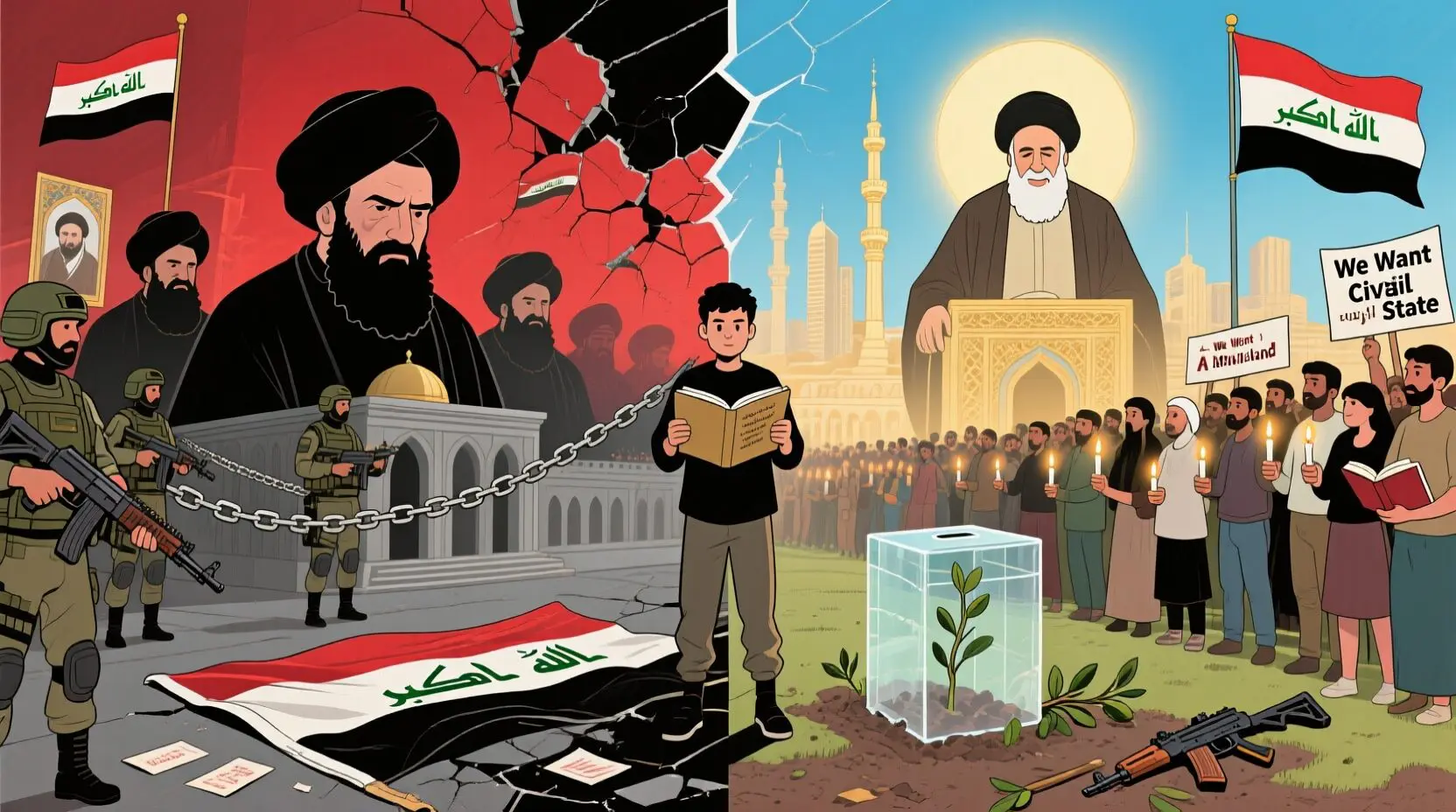
Since the fall of Saddam Hussein in 2003, Iraq has been undergoing a brutal and complex restructuring of its religious and political landscape. After decades of marginalization, the Shiites, who make up the majority of the population, have come to power and taken control of the state. But instead of bringing about the promised unity and stability, this rise to power has exposed a deep divide within Shiism itself. Two visions are increasingly at odds with each other, painting completely divergent pictures of the country’s future. One is radical and orthodox, influenced by Iran and the theocratic model of Wilayat al-Faqih, which gives religious leaders pre-eminence over politicians. The other is liberal and reformist, inherited from the Najaf tradition, which affirms the primacy of the civil state and the law over clerical dogma.
The radical-orthodox current is rooted in marjaʿism, a doctrine that places the grand ayatollahs at the centre of the spiritual and sometimes political life of the faithful. The echoes of the 1979 Iranian Islamic revolution had a profound impact on part of the Iraqi clergy, who saw the Khomeini model as an instrument of power and organisation after decades of marginalisation. Tehran’s influence, fuelled by religious, financial and military networks, has enabled this hardline stance to take root in Iraqi society. After the American invasion and the fall of the Baathist regime, the rise of Shiite parties close to Iran, combined with weak institutions and the exclusion of large sections of the Sunni population, created a space in which radicalism took root.
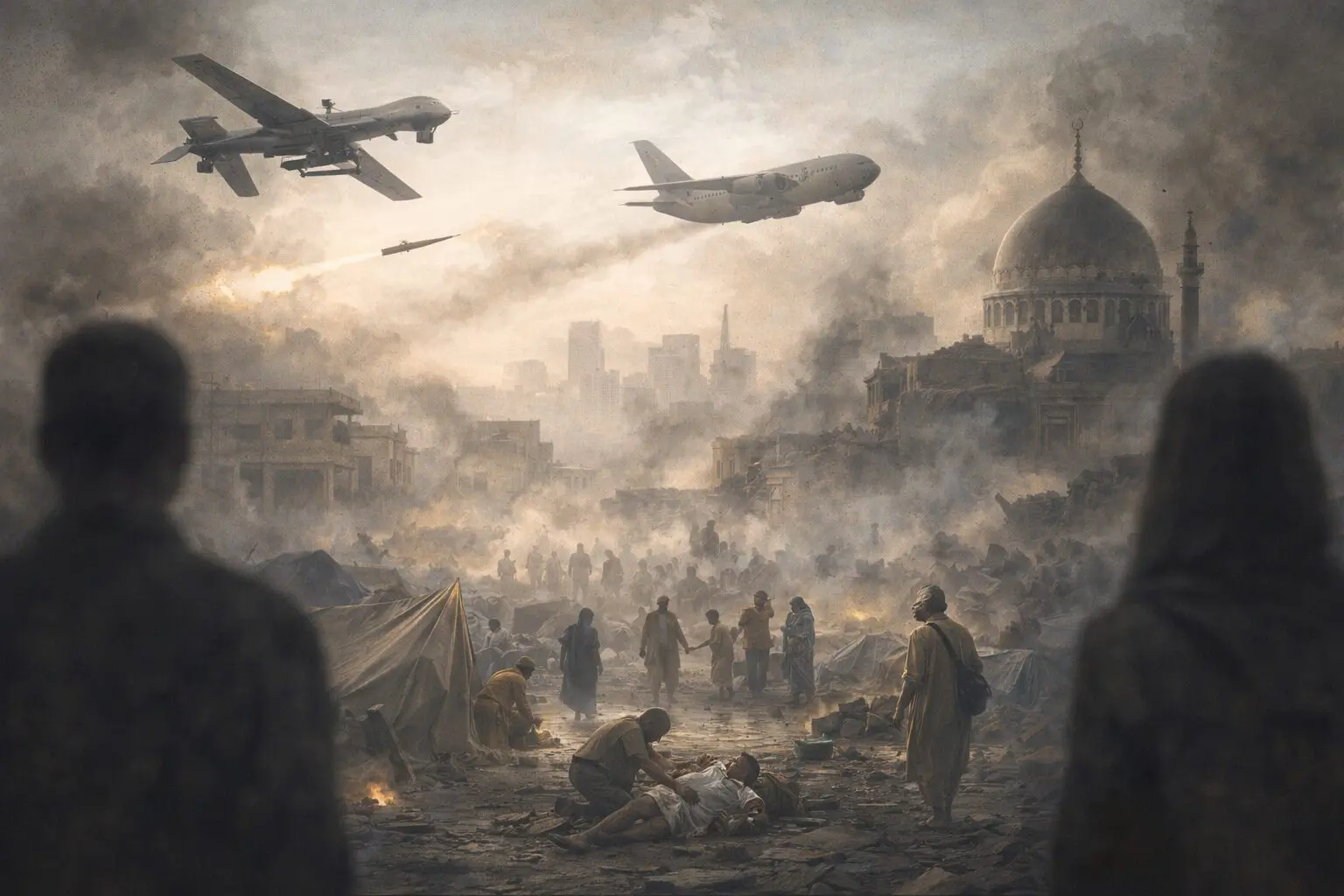
The creation in 2014 of the Hashd al-Shaabi militias, intended to combat the rapid expansion of Daesh, amplified this dynamic. While their military role was decisive in saving Baghdad and many Shiite territories, these forces never limited themselves to their initial purpose. They transformed themselves into political actors influencing institutions, economic powers controlling entire sections of the parallel economy, and direct relays of Iranian influence. Kataeb Hezbollah, Asaib Ahl al-Haq and the Badr Organisation present themselves as guardians of Shiite identity and advocate for an Islamic state where religious legitimacy supersedes democratic mechanisms. Moqtada al-Sadr, a charismatic and contradictory figure, illustrates the ambiguity of this camp. The heir to a religious dynasty, a populist and military leader, he alternates between opposition to American forces, open rivalry with pro-Iranian factions and manipulation of his own militant base. This radical movement is based on a vision in which the state must be subordinate to religion, citizenship is hierarchical according to religious affiliation, and violence is seen as a legitimate means of political regulation. The effects are severe: institutional fragmentation, endemic corruption, clientelism, paralysis of reforms, and structural dependence on Iran.
In response to this trend, liberal Shiism offers a completely different interpretation of the role of religion and the state. Its roots lie in the intellectual tradition of Najaf, which, as early as the 19th century, saw the emergence of thinkers seeking to reconcile faith and modernity. This vision was brutally interrupted by the repression of the Ba’athist regime, but it survived in religious circles that defended the autonomy of thought in the face of politicisation. Ayatollah Ali al-Sistani, now the supreme moral figure in Najaf, embodies this liberal current. His position is clear: religious leaders must guide consciences and uphold ethical principles, but they must not govern directly. Since 2003, he has encouraged participation in elections and supported the drafting of a democratic constitution, while refusing to take on an executive political role. His authority rests precisely on this refusal to enter the political arena.
Liberal Shiism advocates a civil state, open to all components of Iraqi society, whether Shiite, Sunni, Kurdish, Christian or Yazidi. For him, democracy is not a foreign product imposed by the West, but a tool for ensuring justice, coexistence and equal rights. This movement rejects the logic of militias and believes that only the consolidation of strong, legitimate and law-abiding institutions can pull Iraq out of its spiral of violence. Its vitality was clearly demonstrated during the huge demonstrations of 2019 and 2020. Tens of thousands of young people, often from Shia families, flooded the squares of Baghdad and the south of the country to denounce the corruption, Iranian interference and sectarianism that plague the system. Despite the bloody repression that cost the lives of hundreds of demonstrators, this movement marked a generational break and opened up a new space for expression. It also found moral support in the statements of Sistani, who, without directly interfering in politics, called for the voice of the people to be heard and for far-reaching reforms.
Today, this confrontation between radical and liberal Shiism remains one of the keys to Iraq’s destiny. The radical camp retains considerable influence thanks to its armed militias, institutional influence and constant support from Tehran. But the liberal camp, supported by young people, intellectuals and part of the clergy in Najaf, embodies the aspiration for inclusive citizenship and national sovereignty free from external control. Iraq is thus caught in a strategic dilemma: either it remains trapped in an unstable, sectarian and dependent theocratic model, or it succeeds in embarking on the difficult path towards the rule of law, where citizenship would take precedence over community affiliations.
This choice extends far beyond Iraq’s borders. Iran seeks to preserve its influence by supporting the radical camp, while the United States, the Gulf states and the European powers watch with concern the evolution of a country that remains a major energy and geopolitical crossroads. Turkey, attentive to the Kurdish question, is also closely monitoring the fragile balance in Baghdad. Between the logic of interference and the popular desire to reclaim sovereignty, Iraq remains a political and ideological battleground whose outcome will have an impact on the entire Middle East.
Iraq’s future will therefore be played out in this internal power struggle within Shiism. If weapons and sectarian logic continue to dictate the law, the country will remain vulnerable, fragmented and subject to external influences. But if the liberal vision succeeds in taking root, driven by a youth that rejects the status quo, then Iraq could become a laboratory for a new form of citizenship, where religion retains its moral dimension without absorbing politics, and where democracy ceases to be an imported slogan and becomes a lived and claimed horizon. In this permanent tension between two antagonistic models, the very promise of a sovereign, peaceful and pluralistic Iraq is at stake.