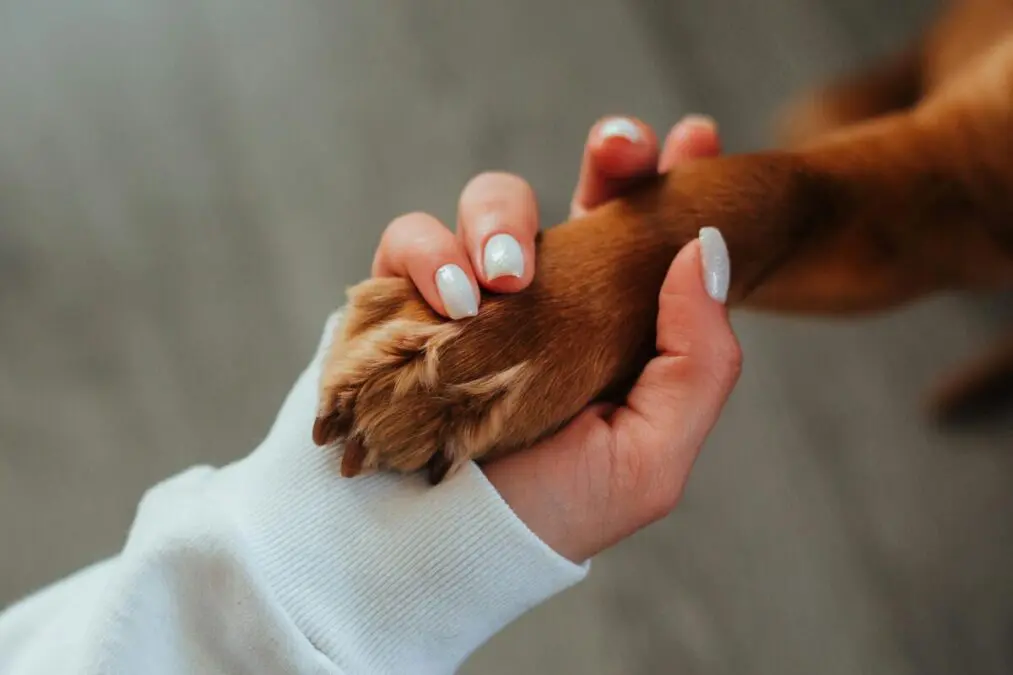
Dogs have so many different ways of getting their owners’ attention that they can sometimes impress us with their creativity! Pawing is one of those cute gestures, similar to nose-poking, that usually works and is applicable in a variety of situations.
Why Dogs Paw at Us
If you share your home and life with a dog, you’ve probably experienced that gentle (or sometimes quite insistent) pat on the leg, arm or even the face, as if your pet is saying, “Hey, man, pay attention!” But what’s really behind this gesture? Why do our furry companions use their paws as a means of communication? The answer is multifaceted and depends on the context, the dog’s personality, breed, age and even your relationship with them.
First of all, we need to understand that dogs don’t speak our language – they have their own set of signals and behaviors through which they communicate both with each other and with us. The paw is one of their most versatile “tools”. Wolves, their wild ancestors, use pawing in various social interactions – for example, to demonstrate obedience, seek attention or start a game. Domestic dogs have retained these behavioral patterns, but have adapted them to everyday life with their human family.
Often, pawing is a way to attract attention. If you are reading a book, watching a movie or working on your laptop, and your pet wants something – a game, a walk, food or just closeness, he may use pawing to interrupt you. This is especially typical for dogs who have found that this method works. And why wouldn’t they use it if they get an immediate reaction – a smile, a petting or even a treat?
Sometimes this gesture can have an emotional connotation. A dog may touch you with a paw when it senses that you are sad, anxious, or not feeling well. Many owners say that their pets calm them down in this way – by gently patting or placing a paw on their hand or foot. This behavior can be an expression of empathy, but also a need for confirmation that everything is okay. For some dogs, touching with a paw is a learned gesture – they have been trained to give a paw on command, and over time they begin to apply this skill to other situations. Breeds that learn quickly and like to “work” with people – such as retrievers, collies or border collies, are more likely to use their paws to initiate contact, notes Rover.com. In some cases, however, frequent pawing can be a sign of excessive dependence or anxiety. If your pet is constantly seeking physical contact and can’t calm down while you’re busy or away, it could be a sign of separation anxiety or stress. In such cases, it’s important not to ignore your pet’s behavior and seek advice from your veterinarian.
Here are 7 more possible reasons why your dog is pawing at you
All dogs can use this gesture to communicate with their human family members. It’s more common in breeds like the Poodle, Boxer, Siberian Husky, Akita, and Samoyed.
Here are some of the most common reasons dogs nudge their owners:
• It’s time to go potty
Dog pawing at you while you’re sleeping soundly? You may need to get up and take him out because he needs to go potty. Remember – dogs do what works! So, if this gesture will get your pet to leave their warm bed and go for a short night walk so they can do their chores, they will continue to do so when they feel the need.
• It’s time to eat
It’s been a full 10 minutes since your dog’s usual dinner time. And the animal thinks: “Apparently my human forgot that I have to eat, I need to remind him that I’m hungry.” Typically, this type of reminder begins with a tense stare at the owner. And if that doesn’t work, expect the four-legged friend to reinforce his approach, often by hooking with a paw.
• The dog wants to pet you
If your furry friend puts a paw on you while you’re resting peacefully on the couch, this may be one of the ways the animal shows affection, says Amelia Webber, a dog behavior consultant, trainer, and member of the Daily Paws Advisory Board. Does it happen the moment you stop petting him? Then maybe this is the animal’s way of saying that it wants a little more. If the moment you stop petting him, the dog becomes more active in its desire to get more attention, then this is a gesture that encourages you to continue!
• He’s bored
Like humans, dogs need plenty of physical activity and mental stimulation. Bored canines use paw nudges as an invitation with a subtext of “Hey, let’s do something!” In other words, your dog may want you to play, go for a walk, let him outside, or rub his belly.
• “I need some space”
If your dog paws your face, it’s probably a sign that he’d like you to stop what you’re doing. Pay attention to your dog’s overall body language—he may be telling you that something you’re doing is not pleasing to him, and it’s his way of asking you to leave him alone for a while.
• You may need to see a doctor
We’ve mentioned before that dogs have an exceptional sense of smell—up to 100,000 times more powerful than ours. Our four-legged friends can even smell whether we have cancer or diabetes (after special training, of course).
Interestingly, there have been cases of dogs obsessively sniffing and licking certain parts of their owners’ bodies, who ended up suffering from one of the listed diseases. So if your pet keeps pawing at a certain part of your body, it may be because it senses that it smells different.
The good news: Dogs often detect cancer in its earliest stages, when it is most treatable. So consider visiting your vet soon to get this checked out.
• Something is making your dog anxious
Your dog is looking to you for comfort and security. If there is something that is stressing him out or triggering anxiety in him – thunder, fireworks or pain – the animal may pat you in an attempt to calm down. Of course – if you make the problem go away, he will be infinitely happy and grateful!
When a dog presses his paws on other things
In addition to communicating with people, dogs also use their paws on other animals, objects, and themselves. Here is what this gesture may mean in the following cases:
• Pressing his paws on his ears and mouth
It is a good idea to consult your veterinarian and make a visit for a check-up if your pet is scratching his ears or muzzle in a jerky and frequent manner. This indicates pain and/or discomfort, and possible causes include a stuck foreign object, dental problems, an ear infection, or allergies.
• Pushing other animals with his paw
Putting a paw on another animal is a sign that your pet wants to play. Although it is a friendly gesture, monitor the animal’s interaction with the other participants in the fun.
• Pushing a toy or object
Dogs use their paws to turn and push toys or other objects they want to play with. Making an object move makes it more fun and interactive. And the animal can chase and subdue it with real pleasure!
Touching us with their paws is a natural way for dogs to express their emotions and needs. Learning how to decipher your four-legged friend’s body language will help you better understand what he is trying to tell you, and this will bring you even closer.
Dog Body Language
Dogs are masters of nonverbal communication – for them, the body is the main tool for expressing emotions, intentions and needs. Our furry companions do not rely only on vocalization (barking, whining, growling), but use a subtle combination of movements, postures and expressions to convey a message to us. Understanding your dog’s body language not only strengthens your bond, but it also helps prevent misunderstandings or conflicts.
• Paws
As we already know, patting a paw can be a request for attention, an invitation to play, or an expression of emotion.
• Ears
The position of the ears is one of the clearest indicators of a dog’s emotional state. Upright and pointing forward is a sign of alertness or interest, while tucked back indicates submission, fear, or discomfort. In some breeds with long or floppy ears, the signals are more subtle.
• Tail
Probably the most popular “teller” of canine moods. A wagging tail is usually associated with joy, but the pace, direction, and height of the movement are important. A quick wagging of the entire hindquarters conveys enthusiasm, while a slow, firm wagging of the tail held high can be a signal of tension or a willingness to dominate. A tail between the legs is a sign of fear or submission.
• Gaze and facial expression
Dogs may “smile” with their mouth open and tongue hanging out when they are calm and content. An intense, fixed gaze often indicates dominance or threat, while rapid blinking and avoidance of eye contact are signs of submission. Raised eyebrows and a slightly tilted head indicate curiosity.
• Body position
The overall posture speaks volumes. A dog that stands erect, with its weight on its front paws and its muscles slightly tense, is usually ready for action or is trying to assert control.
The opposite – if it is slightly crouched, with its head bowed, this is a signal of submission or uncertainty. The famous “play call” – front paws in front, rear part raised – is a clear call for fun.
• Combined signals
Rarely a dog uses only one element of its body to communicate. For example, a wagging tail may be accompanied by erect ears and a tense body – in this case, “joy” may actually be excitement or even irritation. That is why it is important to interpret the signals in the context of the overall picture.
Illustrative Photo by Ivan Babydov: https://www.pexels.com/photo/unrecognizable-woman-holding-paw-of-dog-7788657/