By Metropolitan Anthony (Khrapovitsky)
If you want to analyze the most significant events of the terrestrial life of the Savior and understand the surrounding Him people, and in particular, the events, connected with the law court and taking someone as a prisoner, then you should by all means get acquainted with the 17th chapter of Deuteronomy. From it you will learn the rules, concerning the arrest or punitive punishment of the guilty of those times. The rules are the following: the execution can be processed on the testimony of two or three witnesses (17 comp. Numb. 35:30):«The hands of the witnesses shall be first upon him to put him to death, and afterward the hands of all the people» (v. 7). The rule saying that a witness must be the first executor is surely introduced in order to keep people away from slander, for if a slanderer would be an executor, then he will dispose himself to direct vengeance of relatives and friends of the executed. The witnesses, who were proceeding with the accusation, had to put a hand upon the head of the accused; this way the unjust elders were acting with innocent Susanna. «In the midst of the people the two elders rose up and laid their hands on her head» and began to read out their accusation, full of slander, concluding it with the words: «We testify to this» (13:34–41). This way they fulfilled the commandment of God, given to Moses, about blasphemy: «Bring forth him that hath cursed without the camp; and let all that heard him lay their hands upon his head, and let all the congregation stone him» (Lev. 24:14).
As it seems, one could not be judged without this court ritual, i.e. laying the hands of an accuser on the head of an accused. That is why the words of the Gospel: «And some of them would have taken him; but no man laid hands on him» (John 7:44) have such a meaning: they wanted to arrest the Savior, but no one dared to accuse Him and fulfill the necessary for that court rite, which was in laying of hands on His head. One might presume that beside this rite, the witness should never be involved in the sin, he was accusing the criminal of. Such a thought can be found in the same narration of Daniel about Susanna; look, with what an exclamation young at that time Daniel insisted on giving him the possibility to hold the court of arbitration in this case: «And he cried aloud: «I will have no part in the death of this woman» (Dan. 13:49). From this the demand of the Savior to the accusers of the woman, who had committed adultery, becomes clear: «He that is without sin among you, let him first cast a stone at her» (John 8:7). By the way, in this case, alike at the interrogation by the high priest and Pilate, the Lord talked and acted in full concordance with the mentioned above decrees of the Old Testament law, because after the ashamed accusers of that woman went away, the Lord did not let her go at once, but asked: «Woman, where are those thine accusers?,» and concluded: «Neither do I condemn thee: go, and sin no more.» After the mentioned points of the Law of Moses one can see, how far from truth are those interpreters, who find in this event the example of abolishment of the Old Testament law by Christ.
The same way, far from truth, are the majority of manuals on the holy history in the interpretation of the event, which served as the title of this article. According to that interpretation, the enemies of Christ needed Judas to find the Savior without people, and the kiss of Judas let the servants of the high priest recognize Him among the disciples.
Already in my childhood such interpretations seemed strange to me: could it be that without the help of the disciple-betrayer the guards could not find in the city the man, surrounded by twelve disciples and least of all caring about hiding Himself from anybody? Was it so that to point at one of the twelve, it was necessary to resort to hypocrite kissing, and was not it enough to point at Him from aside? No, all these actions of the enemies of Christ become absolutely understandable for us, when we learn, that without an official report, combined with decisiveness of someone to become an accuser of Christ before the people, the enemies of the Savior had no opportunity to hand Him to trial and execution, and that the process of handling Him to court had to be combined with the applying of the hands of an accuser on Him. Judas did not dare to fulfill this rite in its exactness, but «Now he that betrayed him gave them a sign, saying, Whomsoever I shall kiss, that same is he: hold him fast… And they that had laid hold on Jesus led him away» (Luke 22:47; Math. 26:46). The mentioned words of Judas clearly show that he warned his comrades about the change of the legal method, which he was to make because he felt uneasiness and let themselves do it, and they did it, laying their impudent hands on Christ. But, they, as it seems, did not decide to do that at once. I understand the double meaning of the question of the Savior in this case: «Whom seek ye? – I am he». For the fulfillment of the arrest there was a necessity in the preliminary personal interrogation of the accused, which the enemies of Christ did not dare to perform; then the Lord Himself helped them in that, having shown to them his spiritual power. He underlined the nonentity of His enemies, making them fall to the ground in horror.
As far as the common significance of Judas as of the betrayer is concerned, we see that he was meant to be a necessary accuser and witness, from the Gospel of St. Luke: «And he went his way, and communed with the chief priests and captains, how he might betray him unto them. And they were glad, and covenanted to give him money» (Luke 22:4–5; compare Mark 14:10–11). If the matter was only in finding Christ without people, was it then necessary to spend on that great sums of money (the set price of 600 rubles) and what was there to be happy about? This joy of the enemies of Christ shows, that the statement of Judas led them out of a great predicament, for there was no man, ready to accuse Christ of anything, lay hands on Him and testify against Him in court.
Though, Judas as well, having fulfilled the second part of his obligation not in its exactness, but having substituted the laying of hands on the head of the accused with kissing, did not fulfill the third part of his deal, did not appear in court as an accuser, but «he cast down the pieces of silver in the temple, and departed, and went and hanged himself.» The unrighteous judges of Christ again found themselves in a predicament; they in vain «sought false witness against Jesus, to put him to death; But found none: yea, though many false witnesses came, yet found they none. At the last came two false witnesses» and further. (Math. 26:60). Then the high priest, without paying attention to the words of Christ about that they ask the accused, but not witnesses (John 18:21), and losing his temper because of the failure of the testimony, tried himself to catch Christ in words, making Him answer by adjuring Him: «Tell us whether thou be the Christ, the Son of God» – and though the Lord replied to him, using the words of the book of prophet Daniel about the Son of Man, coming with the clouds of heaven (Dan. 7:13), the unrighteous judge pretended that he did not understand the utterance, and played the comedy of sacred indignation, tore the vestment, made the present people accuse Christ of blasphemy, which according to the law of Moses subjected the guilty to death (Lev. 24:16).
From all said above it is seen, how important it is to know the Old Testament in order to understand the Gospel. Equally important is this knowledge for the understanding of the book of Acts and the Epistles of Apostles. To make an example, let us mention only one event – the execution of Stephan.
«And the witnesses laid down their clothes at a young man’s feet, whose name was Saul. And they stoned Stephen, calling upon God» and further (Acts 7:53). The readers, who are not aware, think that Saul had to protect those vestments from thieves. In reality the witnesses, who were stoning Stephan themselves, according to the law of chap.17 of Deuteronomy, took the responsibility for that not only before the relatives of the executed, but before the Roman government, without the permission of which they had no right to fulfill the execution (John 18:31). Thus, they put their clothes by the feet of Saul as the material evidence of their murder, to confirm that they accept their act as willful. That is why Saul is referring to the fact that he was keeping an eye on the clothes of those stoning Stephan (i.e. not protecting it from thieves, but from the very owners), as the evidence of his active participation in this event (Acts 22:20).
I hope, that due to this comparison of the New Testament events and the Old Testament laws, and the court laws in particular it will become clear for the readers that «the kiss of Judas» was not the matter of mockery, as many think, but the fulfillment, though inexact, of the Jewish court rite. Besides, this comparison reveals to us, how human violence can commit even the most horrible crimes in the frames of law, even if the law is Divine.
Concordance of the Evangelical Records about the Resurrection of Christ.
We read about various attempts to find the mutual agreement of the Evangelists concerning the phenomenon of appearance of the resurrected Lord to His disciples. Some of these attempts, for example, of doctor Paskovsky («The Christian Reading» of the 90s) almost satisfied us, but the more regrettable it was to note in them the absence of that main postulate, which in a fast way makes the reader acquainted with the concordance of events of the Holy Bible, precisely in the four Gospels; and we wished to tell about this postulate or thesis a long time before, but we did not share our thoughts, concerning this matter, because of the absolute lack of free time.
Though before to share them, let us say that the most unrealistic method of concordance is that most popular variant, according to which it turns out that St. Mary Magdalene after when the Lord met her with other Mary, and let them embrace His feet, – appears again, crying before the sepulcher and does not recognize appearing Christ, taking Him for a gardener, and then, after she recognizes Him, it becomes forbidden to touch Him.
Such a sequence of events cannot be in concordance with anything, and the attempts to show it to the readers lead to miserable interpretations and complex but not at all convincing fabrications.
The appearance of the Lord before the myrrh-bearing women in the four Gospels is not similarly described, i.e. the narrators describe some moments of these repeated events. But the interpreters find it hard to bring together the mentioned above narrations of Mathew and John. It is obvious that the Lord appeared before Mary Magdalene twice, once to her alone, and the other time when she was together with other Mary, but how one event relates to the other – this is what puzzles the interpreters. The statement (postulate), which we promised to be the key in solving this matter, is substantiated, or, as they say in academies, formulated so: Evangelist Mathew says about the coming of two Maries to the sepulcher of the Lord, already aware «that he is risen from the dead.» The events this Evangelist is describing, happened only after the described by St. John appearance of the Lord to Mary Magdalene, who took him for a gardener, and after told about that to the apostles, «that she had seen the LORD, and that he had spoken these things unto her». Then she said that to other Mary as well, and then both Maries went over to the sepulcher – what for? – Not for the anointment of the body of the Lord (for they knew that He had resurrected), i.e. without any ointments, but they went to «see the sepulcher,» knowing that it was already empty, – only the burial shroud was still in it. Probably, not they alone, and not only the two apostles and the other myrrh-bearing women went to get convinced in the news, brought by Mary Magdalene, but all the followers of Christ did so, after hearing about the event («the eleven, and all the rest» Luke 24:9, comp. 24:24); the Evangelist tells about two Maries because they were worthy to see the new appearance of the angel, and then of the Lord Himself.
With what else, beside the expression «to see the sepulcher» one can confirm our assuredness in the fact that what Mathew narrates about, happened after the appearance of Jesus Christ to Mary Magdalene, described by John?
– By the fact that John narrates about what happened «when it was yet dark,» and Mathew about what was «as it began to dawn toward the first day of the week.»
Besides let us pay attention to the attitude of the myrrh-bearers to the words of the angel and the Very Savior. According to John, Mary looks so unprepared to the conscious perceiving of the events, that she takes Christ for a gardener, and according to Mark the words of the angel terrify the myrrh-bearers so that they «neither said they any thing to any man; for they were afraid,» and Luke writes about the same: «And as they were afraid, and bowed down their faces to the earth.»
On the contrary, the appearance of the angel, described by St. Mathew, happens when the myrrh-bearers are more prepared to the vision, though the heavenly inhabitant cheers them up with the words «Be not afraid,» but they have plenty of self-control, so that He says to them further on: «Come, see the place where the Lord lay,» i.e. he suggests them to fulfill that, for what they had come («to see the sepulcher»). According to Mark, the myrrh-bearers (not these two, but the others), «neither said they any thing to any man; for they were afraid,» and Mathew tells about two Maries, that they «with fear (for sure, fear is inevitable, when seeing any miraculous vision) and great joy… run to bring his disciples word.» Magdalene, fulfilling this order already for the second time (for the first time she received it from the Very Lord, according to the fourth Gospel), and other Mary, who knew about the appearance of the Resurrected to Magdalene, now are able to consciously perceive the second appearance of the Savior. By what can this be proved?
The answer to such a question gives one more reason for our declaration that both the women went to look at the sepulcher, already knowing about the resurrection of Christ, and equally it serves as the explanation, why the Lord did not allow Mary Magdalene touching Him by the sepulcher, and after allowed that to both Maries.
About the first event the Octoichos says like this: «The woman was still thinking in human terms, that is why she was not allowed the touch Christ» (9th Gospel stichera). What does it mean? – Certainly, here one cannot say about any passionate touch, no! – Simply the absolute unexpectedness to see the mourned over Teacher alive overwhelmed the soul of Mary with such natural joy, that she, even before to think about the mysterious resurrection, about His Divinity, simply gave way to rapturous joy about Him as about the dear person, who escaped from danger, and having forgotten that she was a woman, wanted to embrace the Teacher and kiss Him, – the One, Whom she supposed to be dead and stolen in the preceding moments. The Lord reminded her about the irrelevance of such an expression, even if it was absolutely pure joy, but at the same night suggested to his hesitating male disciples to touch His wounds. – Different was the attitude of the Lord to the worshipping of Mary Magdalene and other Mary, in an hour or two after His first appearance. There both Maries learnt that the Lord appeared to the believers, as the conqueror of death and hell, as the ascending to the Heavenly Father into the Eternal kingdom and powerfully sending the apostles for the sermon and triumphant struggle with the world. Then, both the women, having met Him, when He said to them: «Rejoice,» did not «think in human terms» anymore, but worshipped Him as the Son of God, and therefore He did not prevent them from doing what they did: «And they came and held him by the feet, and worshipped him» (Math. 28:9).
You have found concordance between the Gospels of Mathew and John, but how will you find it between the narrations of the rest of Evangelists? Where would you place the coming of Magdalene to the sepulcher with ointments, when she was accompanied by other myrrh-bearers, which are mentioned by Mark and Luke?
The main thought of our answer will be the following. Mary Magdalene did not come with ointments to the tomb of the Lord, but the rest of the women did, after the first appearance of Christ to Mary, and maybe, even after the second one, but still they did not yet know about the resurrection of Christ. The narration of John says about what happened «when it was yet dark,» and the narration of Mathew denotes the events, which happened «as it began to dawn» («the dawning sun» – the same way it is in Greek), and of Luke – about what happened «very early in the morning.» – These two expressions are not so definite to place them before or after the time, defined in the first Gospel, but, anyway, here it is said about the women, who came to the tomb absolutely unprepared to the sermon about the resurrection, and there is no need to insist that Mary Magdalene was among them: on the contrary, these two Evangelists give the absolute opportunity to accept the opposite idea, that there was no Magdalene among them. Both the Evangelists separate the three events: a) the buying or preliminary preparing of ointments (Luke); b) the coming of the women to the sepulcher and the conversation with the angel (Mark) and angels (Luke), and c) the announcement of the Resurrection to the apostles.
Let us start with the final moment. One must not think that according to Mark, the scared women did not tell about the appearance of the angel at all and did not fulfill his order, concerning the apostles. Mark only notes that they could not do it at once, and that the apostles knew about that fact first of all from Mary Magdalene, to whom the Lord «appeared first.» See, Mark distinguishes her from the rest of myrrh-bearers, and consequently reminds of the event, which is not connected with bringing ointments. But did Mary Magdalene, according to Mark, participate in this bringing? No. He says only about her participation in buying the myrrh (16:1) and calls by names the participating in this purchase, which took place after the Sabbath (that is in our European time – Saturday evening, the time after 6 o’clock). But Magdalene went to the sepulcher «when it was still dark» without ointments, while the rest of the women brought those ointments «as it began to dawn.» The Lord did not appear to all, but to «Mary Magdalene,» who, according to Mark as well, was not with them (16:9).
If Mark, naming the women, who watched the burial of the Lord and those, who were buying ointments, separately, does not repeat their names, telling about the bringing of ointments to the tomb by myrrh-carriers, then Luke tells neither about the names of those buying ointment, nor of those, who brought them to the tomb, but mentions that the number of the first and the second was not equal («and other women that were with them»). Obviously, some of them were dealing with ointments even on Friday, after the death of the Savior «and rested the sabbath day according to the commandment» (Luke), and the others were buying them after the Sabbath rest (Mark 16:1). So, Luke does not mention the names of the women, who brought the ointments, but expresses it so: «And returned from the sepulcher, and told all these things unto the eleven, and to all the rest. It was Mary Magdalene and Joanna, and Mary the mother of James, and other women that were with them, which told these things unto the apostles.» Note the addition: «…which told these things unto the apostles». He does not say – which carried the ointment, and saw the angels, but who «told all these things unto the eleven, and to all the rest» (Luke). In this return took part Maria, to be more exact – she was the one to start it, as John and Mark testify, and further on, none of the Evangelists says about her participation in the process of bringing ointments to the tomb.
It is certain that the words of Evangelist Luke: «Told all these things unto the eleven, and to all the rest» cannot be understood like a single act, for this multiple society could not always be together, – but in the sense that the witnesses of the resurrection of Christ went from house to house with joyful news: those were two Maries, who had seen the Lord, and the rest of myrrh-bearers, who talked with the angels. To the first testimony must be related the words of the third Gospel: «Then arose Peter, and ran unto the sepulchre; and stooping down, he beheld the linen clothes laid by themselves,» which coincide with the words of John: «Then cometh Simon Peter following him, and went into the sepulchre.»
From this we see that the Evangelists not as if contradict one another, describing the events of the first day after the resurrection of Christ, but, saying about the different moments of this day, as if on purpose, leave some space for the events, about which narrate the three others.
Combining the four narratives, we receive such sequence of events:
On Friday night one of the Disciples of Christ (Luke), and the others, among whom is Mary Magdalene (Mark), buy ointments, in order to go and anoint the body of the Lord.
Mary Magdalene, leaving her friends and already on Saturday night running alone to the tomb, does not find Christ (John), calls for Peter (Luke and John) and John (John), stands by the cave of the sepulcher, crying, talks to the angel and Lord Jesus, does not recognize Him, and having recognized, rushes to Him, but is not allowed to touch Him, and following His order, goes to the apostles to tell them (John and Mark) and the rest of the disciples (Luke) about His resurrection.
Not knowing about that, the other myrrh-bearers come to the tomb, take the order of the angels (Mark and Luke) and, having returned, first cannot speak because of horror (Mark), and then, following Magdalene, tell about what they had seen (Luke).
Mary Magdalene and other Mary, already assured of the resurrection of Christ, come to look at the tomb and shroud of the Lord, which had been found by Peter (Luke and John) and by John (John), but not by Mary, when the angels first appeared to her (John). Coming to the tomb, both Maries again see the angel, who lets them come inside and look at the place, where the Lord laid (Mathew) and where His burial shroud was left. With that the angel tells them to confirm His resurrection and Ascension to the disciples, – the thing that the Lord already had ordered Magdalene to do (John).
Having accepted the joyful news, both Maries hurry to the apostles; the Lord meets them on their way and does not ban them to worship Him any longer and allows the reverent touch of His feet (Mathew).
By the evening of the same day all this became known not only to the eleven, but to the seventy disciples (Luke). The miserable lie of the Pharisees and guards about the stealing of the body of Christ, while they were sleeping (how the sleeping could know about that?) did not embarrass the disciples of Christ, for He, appearing for several times before them, convinced them in His resurrection, gave to touch Himself, took food from them and finally ascended to heaven on the fortieth day after the Resurrection in front of all the disciples (Mark, Luke and the Acts)
All this becomes clear, if to base the concordance of the Gospels on the statement that both Maries of the first Gospel went to see the sepulcher, already aware of the Lord’s resurrection.
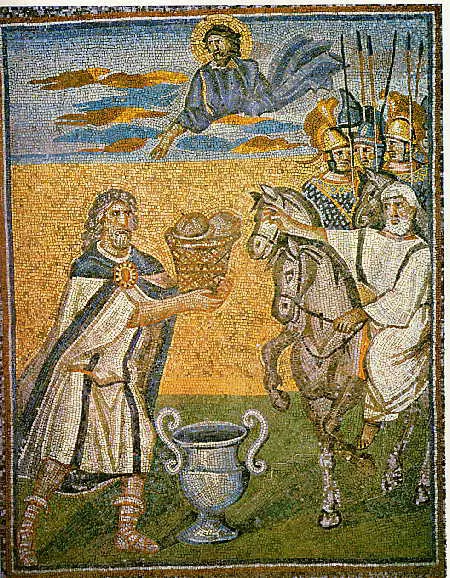
Illustrative photo: Melchizedek offering bread and wine to Abraham, Basilica di Santa Maria Maggiore.