In 1862, European imperialist interests take a young aristocratic couple to a new land that is deeply divided, war-torn, and impoverished. This is Mexico in the 19th century.
Their noble intentions and European manners are not enough to create a successful empire. Their dreams turn out to be nothing more than a fleeting illusion, and the Second Mexican Empire lasts only three years before it comes to a tragic end.
Few people know that Mexico was also an empire for a while.
During the turbulent 19th century, the problems of the newly liberated country are severe – fierce conflicts and battles for the rule of the country rage while the treasury is empty. Everyone seeks progress, but views on how to achieve this differ greatly between liberals and conservatives. The latter believed that this could only be achieved through a monarchical system, a corporatist society, and a strong church and army.
On the other hand, the liberals wanted a federal, representative, and popular republic similar to the American model, seeking to eliminate all vestiges of the colonial and monarchical past.
These two models clashed repeatedly, leading to several wars, treaties, and laws. By 1860, the liberals seemed to be gaining ground, as the elections gave victory to President Benito Juárez, who immediately tried to reorganize the country.
However, the lack of funds forced him to stop paying loans and debts. The dissatisfied conservatives took advantage of the situation. They tried to interest the French Emperor Napoleon III in establishing a monarchy in Mexico as a barrier against the expansion of the United States.
The reason for the beginning of the conflict was the suspension of payments to France, England, and Spain. Initially, it all started with a blockade of the ports, but it quickly escalated and French troops landed, starting an armed conflict that led Mexico to surrender to the occupation a year later.
After the successful occupation, Napoleon saw that his dream of restoring an imperial presence on the American continent was feasible. Taking advantage of his desire to strengthen ties with Austria, he offered the monarchy to the younger brother of the Austro-Hungarian Emperor Franz Joseph. Maximilian I of the Habsburg dynasty, Archduke of Austria and second son of King Franz-Charles of Austria and Princess Sophia of Bavaria. His wife was Charlotte of Belgium, the only daughter of King Leopold I of Belgium and the French Princess Louise of Bourbon-Orléans.
Maximilian was unsure whether to accept the post on a completely new continent in exchange for giving up all his titles and noble rights in Europe.
However, his wife persuaded him to accept, as did many conservative Mexicans who sought his help. He accepted, under the mistaken impression that the Mexicans wanted him to restore order.
After the visit to the Pope, the young emperors sailed for Mexico, where they arrived at the port of Veracruz in May 1862. As soon as they set foot on foreign soil, the two rulers were greeted extremely coldly. This was due to the fact that Veracruz was dominated by liberals who did not want the presence of monarchs.
In contrast, the more conservative and wealthy cities such as Orizaba, Puebla and Mexico City made great efforts and diligence to welcome them. They organized lavish balls, celebrations and gatherings.
Maximilian and Charlotte settled in Chapultepec Castle, located in Mexico City, the former residence of the viceroys when the territory was New Spain. As a national palace, its atmosphere was austere and did not correspond to their idea of an imperial residence.
They ordered it to be rebuilt in the style of the European bourgeois enclaves of the time and built a direct road to the city center and the cathedral. The young rulers were fascinated by the beautiful views of the Valley of Mexico. They also had a large summer residence in Cuernavaca, called “the place of eternal spring” because of the lush tropical vegetation.
They quickly fell in love with the Mexican landscapes and people. They spent a lot of time traveling around the country and admiring the natural beauty, even discovering volcanic landscapes that reminded them of their homeland. They were also fascinated by the food, customs, and traditions, recognizing both the beauty and diversity of Mexico, as well as the misery and tragedies caused by half a century of wars.
Those who initially supported the emperor did not expect Maximilian to be as liberal in practice as Europe at the time.
He did not restrict religious tolerance, nor did he return church property. He also contributed to many social reforms. He quickly fell out of favor with conservatives.
Maximilian and Charlotte did everything they could to improve the living conditions of the population, abolishing corporal punishment and child labor, regulating working hours, and improving the country’s infrastructure.
There is no doubt that the capital was more beautiful during their reign, and education and scientific research also benefited from the new improvements. Maximilian, also concerned with the economic development of the country, contributed to the building of the nation and the creation of banks to facilitate trade.
Charlotte was behind all these achievements and closely followed everything that was happening with the army and the country in general. Maximilian had diverse interests. He was a great collector of butterflies and insects, undertook various expeditions around the country and enjoyed increasingly long stays at his summer residence outside the capital.
Charlotte, for her part, knew how to act and constantly followed politics and military plans, while also engaging in charity work. She was the first woman to rule the country, albeit temporarily.
The naivety of the 27-year-old prince in search of adventure got him into a very complicated situation. He had no idea what he was getting himself into, arriving in a war-torn, impoverished country that did not even want him. He soon found himself without allies. The conservatives considered him a traitor, and the liberals, because of the way he arrived and because he was a foreigner, never accepted him.
The population had much more pressing problems, so he did not win the support of the people. Maximilian remained forever a foreign prince and a stranger to most of the country, no matter how many times he dressed in traditional clothes, traveled the country, or learned Spanish.
He ruled as he would have ruled in Europe, beautifying the city and passing laws, but that was what Mexico needed – a vast, unevenly developed country, mired in poverty and war. It is not surprising that the empire, which was in reality an illusion, sustained only by the military support of French troops throughout the country, quickly fell apart.
The liberals, weakened, waited for the right moment to attack. Some areas remained very loyal to the previous liberal president, Juárez, which made it impossible for the French army to control them.
Towards the end of 1865, things began to get even more complicated. With the end of the Civil War in the United States, the northern neighbor supported the liberals with loans, weapons, and protests against foreign interference in American territory.
The liberal army grew while that of the empire dwindled as Napoleon withdrew his troops to confront the Prussian threat in Europe.
The emperors had less and less protection and the situation seemed increasingly dire.
Maximilian, who was sensitive by nature and easily upset by everything that was happening, decided to abdicate. However, Charlotte stopped him. Seeing that the throne and everything they had achieved was at stake, her ambition surfaced and she refused to give up.
She did everything she could to dissuade him, calling abdication shameful and suitable for weaklings. She suggested that he seek help in Europe and speak to Napoleon III and the Pope.
During the trip back to Europe, Charlotte began to behave strangely. She is paranoid, believing that people want to poison and kill her. At first, these are just mild hallucinations, but they become more and more frequent.
For a while, she believes that she is safe only with the Pope and that everyone else wants to harm her. Everything is a danger to her – from food and water to servants.
During her stay in the Vatican, she demands that a cat be brought to her to test her food before eating it. She eats only what was prepared especially for the Pope, and does not want to leave the Vatican for fear of being poisoned. The Empress begins to deteriorate.
She screams, runs and hides, doing everything she can to avoid being taken away. Her moments of clarity become increasingly rare as the disease takes hold of her. She drinks only water from the tap, which she pours herself, her hair and nails dry out, she does not eat anything and has hallucinations. It was clear to everyone that there was no other choice but to lock her up and treat her like a patient.
Charlotte was only 26 years old when she was diagnosed with paranoia.
However, she spent the rest of her life isolated in palaces and castles, and lived to be 86. She never saw her beloved Maximilian again. After being diagnosed, she was locked in a barred room in her castle, where her treatment consisted of complete isolation, cold water, and immobilization. Charlotte died of severe pneumonia caused by influenza on January 19, 1927.
Realizing that he had failed to secure the expected support in Europe and that his wife had lost her mind, Maximilian felt increasingly vulnerable. The empire was reduced to a few cities, and all military personnel returned to Europe, while the liberal troops gained ground.
He decides to abdicate, but on the way to the port he is dissuaded by the few conservatives who still support him, and by his family, especially his mother, who appeal to honor and responsibility.
This is a brave act on his part, coming from a man who has doubted himself all his life and knows that he is completely alone, without his wife Charlotte.
In a very short time the situation went from difficult to critical. His palace was no longer safe and he had to seek refuge in another nearby city. He was offered the option of fleeing or accepting defeat with honor, but he remained firm in his decision to fight until the last moment. However, betrayal facilitated his capture and he was arrested by the enemy.
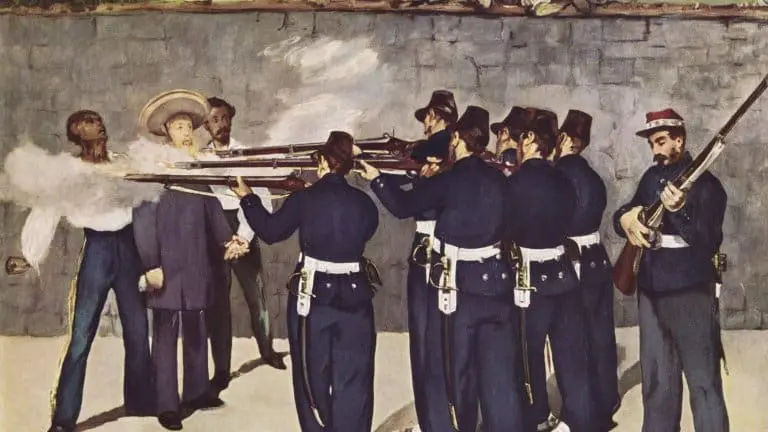
Emperor Maximilian I was sentenced to death by a military tribunal, despite pleas for clemency from prominent figures in Mexico and Europe. On June 19, 1867, he was executed along with two other generals. Before being shot, he swore that his blood would “seal all the misfortunes of my new homeland”.
Illustration: The Execution of Emperor Maximilian
Artist / Origin: Édouard Manet (French, 1832–1883)
Region: Europe
Date: 1868–69
Period: 1800 CE – 1900 CE
Material: Oil on canvas
Medium: Painting
Dimensions: H: 8 ft. 3 3/16 in. (2.52 m.), W: 9 ft. 10 7/8 in. (3.02 m.)
Location: Kunsthalle Mannheim, Mannheim, Germany