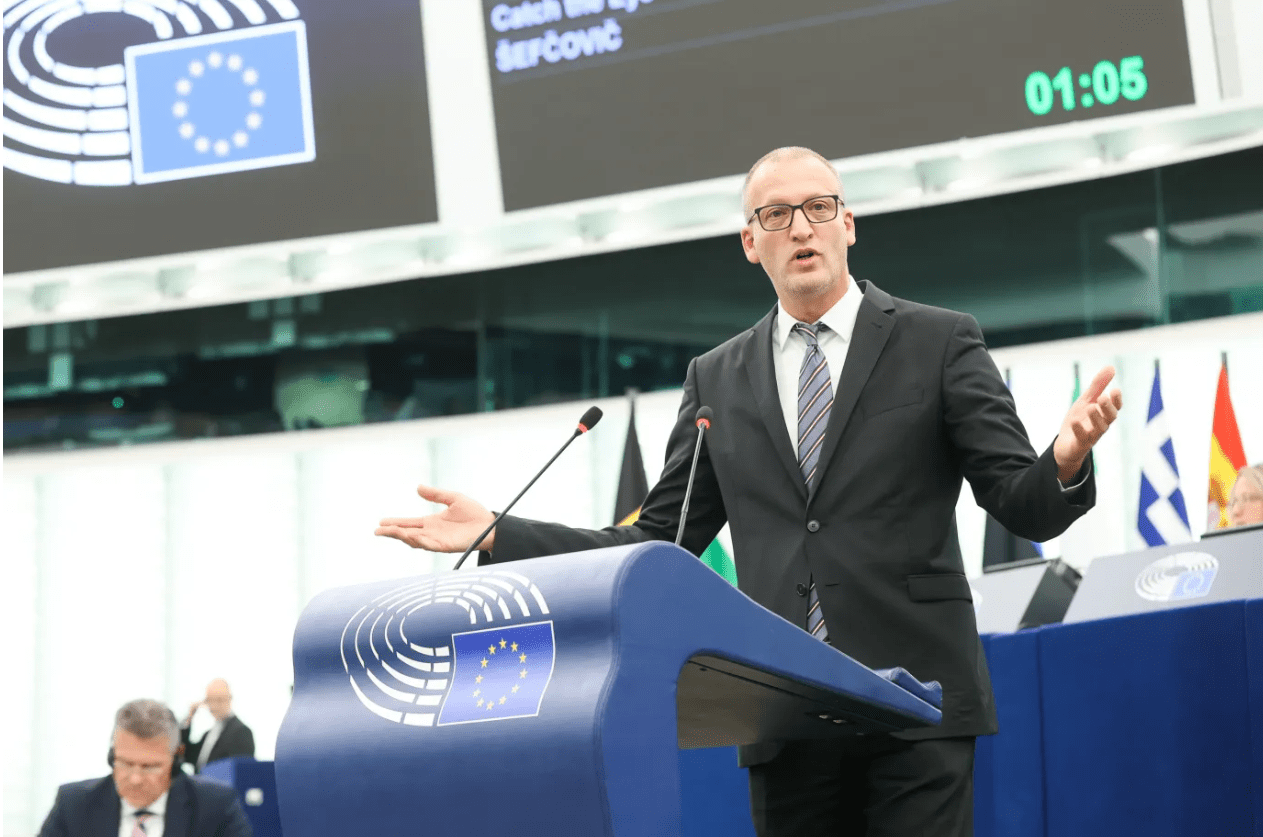
Hungary’s new administration has been handed a rare opportunity: to turn religious freedom from a politically managed issue into a genuine democratic guarantee. In remarks published on 12 May 2026, Zoltán Tarr, Hungary’s Minister for Social Relations and Culture, promised dialogue with churches, denominations and representatives of religions, while pledging to end political pressure over religious communities. His words now raise a clear question: will the new government use this moment to build a more neutral, transparent and inclusive church-state policy?
Asked by a reporter from Hetek.hu what decisions on church affairs were being planned, Tarr replied:
“We are not planning decisions on church affairs. It is not the government that decides. The government will hold dialogue with the denominations — not only with the churches, but also with various other denominations and representatives of religions.
And the most important thing, if we are to speak about a decision, is that we will put an end to political influence over the lives of different religious communities, which currently continues right up until the change of government on a daily, even minute-by-minute basis.
This will come to an end. These communities too, just like the press and the media community, will be able to live and carry out their daily activities free from political pressure.”
The statement is important not only because of what Tarr said, but because of where Hungary now stands. After years of controversy over church recognition, public funding, legal status, misuse of data protection agency and political dependency, the country has a chance to reset its relationship with religious communities. That opportunity should not be measured only by whether historic churches feel reassured. It should be measured by whether all religious and belief communities — large and small, old and new, popular and unpopular — can operate without political fear.
Why Tarr’s distinction matters
The phrase “not only with the churches, but also with various other denominations and representatives of religions” is not a minor detail. In Hungary, the word “church” has carried legal, political and financial consequences for more than a decade. It has often referred not simply to a religious community, but to a recognised institutional category with access to state cooperation, public legitimacy and, in some cases, privileged treatment.
By drawing a distinction between “churches,” “denominations” and “representatives of religions,” Tarr appeared to widen the circle of consultation beyond the historically established or politically favoured churches. In practical terms, the statement suggests that smaller denominations, minority faiths and communities outside the most privileged categories should also be heard.
This distinction is central to freedom of religion or belief. The right does not belong only to major institutions. It protects individuals and communities, majority and minority faiths, traditional churches, newer religious movements and people with non-religious convictions. A government that speaks only with the largest churches may maintain a form of consultation, but not necessarily a plural, fair or rights-based one.
A church-state system shaped by hierarchy
The background is Hungary’s controversial church-law framework. The 2011 Church Law, formally Act CCVI of 2011, changed the legal status of religious communities and removed recognition from many previously registered groups. According to an OSCE/ODIHR-published legal analysis, the law reduced the number of legally recognised churches to 14 before Parliament later expanded the number to 31.
That change became one of the most sensitive freedom of religion or belief issues in Hungary’s post-communist legal history. It was not only about registration. Recognition affected access to public cooperation, state benefits and the symbolic standing of religious communities in Hungarian society.
In 2014, the European Court of Human Rights ruled in Magyar Keresztény Mennonita Egyház and Others v. Hungary that Hungary had violated rights protected by the European Convention on Human Rights. The case concerned the deregistration and discretionary re-registration of religious communities under the new church law. The Court found that the system violated freedom of religion and was discriminatory.
The issue did not end there. In 2024, UN Special Rapporteur on freedom of religion or belief Nazila Ghanea said Hungary should be applauded for the broad enjoyment of the freedom to have, adopt and change religion or belief, but warned that further reforms were still needed. The UN statement noted that the 2018 amendments introduced a four-tiered system, but said these changes did not fully resolve concerns about unequal treatment among religious and belief communities.
The opportunity before the new administration
Tarr’s remarks point to a possible change in direction. If implemented seriously, they could move Hungary from a model of managed religion toward a model of religious freedom based on autonomy, neutrality and equal treatment.
The opportunity is practical as well as symbolic. The new administration can open consultations with all affected religious and belief communities, not only the largest churches. It can review the recognition system to ensure that legal status is not dependent on political discretion. It can make public grants transparent and predictable. It can ensure that religious minorities are not pushed into insecurity because they lack historical prestige, political connections or institutional size.
This would not mean hostility to established churches. Nor would it mean denying the social role of Hungary’s historic religious institutions. It would mean something simpler and more democratic: the state should not use recognition, funding or access to decide which communities are legitimate and which are merely tolerated.
That is the real promise inside Tarr’s words. When he says, “It is not the government that decides,” the phrase can be read as a commitment to state neutrality. Governments may regulate legal procedures, support public services and maintain dialogue with religious actors. But they should not become judges of faith, theology or religious legitimacy.
Tarr’s European reference point
Tarr’s statement also carries weight because of his recent experience in Brussels. Before taking office in Hungary’s new administration, he served as a Member of the European Parliament from July 2024 to May 2026 for Hungary’s Tisztelet és Szabadság Párt, sitting with the Group of the European People’s Party. His official European Parliament profile records his membership of the Committee on Culture and Education, as well as, for part of his mandate, the Committee on Women’s Rights and Gender Equality. He also served on delegations dealing with Serbia, Bosnia and Herzegovina, and Kosovo.
That European background matters. In the EU institutions, dialogue with religious and non-confessional actors is not treated only as a matter of protocol. Under Article 17 of the Treaty on the Functioning of the European Union, the EU maintains an “open, transparent and regular dialogue” with churches, religious associations or communities, and philosophical and non-confessional organisations.
This does not mean that EU rules can simply be copied into Hungarian church law. Article 17 itself respects the national status of churches and religious communities in each Member State. But it does provide a useful democratic standard: dialogue should be open, transparent, regular and plural. It should not be limited to the most powerful churches. Nor should it become a channel through which political authorities reward compliant religious actors and marginalise others.
This is where Tarr’s phrase “not only with the churches, but also with various other denominations and representatives of religions” becomes especially relevant. It echoes the broader European understanding that religious dialogue must include more than historic institutions. It must also include religious associations, smaller communities, minority faiths and, where relevant, philosophical and non-confessional voices.
Freedom of religion as a democratic measure
The new administration also has a useful European reference in the words of Ján Figeľ, the first European Commission Special Envoy for the promotion of freedom of religion or belief outside the EU. Figeľ has described religious freedom as “a litmus test of all human rights” and warned that if it is not respected, other freedoms will suffer as well.
Although the EU Special Envoy’s mandate concerns the promotion of freedom of religion or belief outside the European Union, the principle is universal. A state that protects only the religious communities it likes, recognises only the traditions it finds useful, or funds only those actors that remain politically silent is not protecting freedom of religion or belief in its full sense.
Figeľ has also stressed that freedom of religion or belief is for all people, “from atheists to Zoroastrians.” That formulation speaks directly to the Hungarian debate. The question is not whether the new administration will maintain relations with historic churches. It almost certainly will, and it should. The question is whether it will also protect the freedom, dignity and equal treatment of communities that are smaller, newer, less popular or less politically connected.
In a 2017 European Parliament context, Figeľ also said: “We need dialogue for the common good, focused on human dignity.” That idea offers a constructive benchmark for Hungary today. Dialogue should not be a private arrangement between government and favoured institutions. It should be a public, principled and inclusive process rooted in human dignity.
From dependency to autonomy
Reports from Tarr’s parliamentary hearing show that his remarks were part of a wider argument about dependency. Hungary’s national news agency MTI reported that Tarr said the government did not wish to restrict the activities or financing of churches. At the same time, he said individual grants to churches and civil organisations should be awarded in a more transparent and structured way.
He also said dependency on government among civil communities, churches and other communities had to be dismantled. According to MTI, Tarr stated that the government would not “summon” leaders of any church or religious community in order to advise them what to decide.
That is a strong political claim. It implies that religious communities were not merely receiving state support, but were also expected to show political restraint or loyalty in return. Tarr went further, saying that churches had received major financial support in recent years, but that “the price” was silence, and that those who did not remain silent were punished.
These claims now create expectations. If political pressure is to end, it must end not only in language, but in administrative practice. Religious communities should not have to wonder whether a public statement, a legal complaint, a human-rights appeal or a refusal to align politically will affect their access to support or recognition.
A broader democratic repair
Tarr’s comparison with the press and media community is also significant. He placed religious communities within a wider democratic concern: the need for independent institutions and communities to operate without political pressure.
That comparison matters because freedom of religion or belief, freedom of the press and freedom of association all depend on the same democratic principle. A community is not truly free if it can act only when it remains politically useful or silent. A newspaper is not free if it fears retaliation for criticism. A religious community is not free if its recognition, funding or public standing depends on pleasing those in power.
According to Telex, Tarr’s ministry is expected to cover culture, civil organisations, churches, nationalities and Hungarians beyond the borders. He told lawmakers that dialogue with churches would be important, that church institution financing would not change, and that the state must remain responsible for public services rather than pushing denominations to take over institutions against their will.
Earlier, Telex reported that Tarr had presented the future ministry as an open institution that would work with professionals and communities. On churches and denominations, he wrote that the government would “separate the throne and the altar,” adding that the relationship would be based on respect and autonomy free from political pressure.
As previously reported by The European Times, Hungary’s political change raised a wider rights question: whether a change of government could bring legal and administrative relief for religious minorities, independent NGOs and civic groups that spent years under pressure.
What taking the opportunity would require
The new administration’s opportunity will be measured by actions. A serious freedom agenda would require open consultation, legal review and administrative change.
First, the government should ensure that all religious and belief communities affected by the church-law framework are invited into dialogue. That means not only established churches, but also minority religions, smaller denominations, newer communities and non-religious belief representatives where relevant.
Second, the recognition system should be reviewed through the lens of state neutrality. Legal categories should not create unnecessary inequality, nor should they allow political actors to determine which religious communities deserve full legitimacy.
Third, public funding should be transparent, structured and rights-compliant. State support for religious or faith-based social work can be legitimate, especially in education, charity and community services. But support must not become a tool of dependency or political discipline.
Fourth, minority communities should have practical access to public institutions where freedom of religion or belief is relevant, including prisons, hospitals, schools and social services, subject to clear and neutral rules.
Finally, the administration should make clear that no religious community will be penalised for peaceful criticism, legal advocacy, international human-rights engagement or refusal to align with a political party.
An opportunity, not a guarantee
Tarr’s statement opens a door, but it does not by itself change the system. The opportunity now belongs to the new administration. It can use this moment to build a church-state policy that respects Hungary’s historic religious traditions while protecting the full diversity of religious and belief communities. Or it can leave the old hierarchy largely intact, replacing the language of control with the language of dialogue.
For religious minorities, the difference will be concrete. Equality can affect access to rented premises, public grants, schools, prisons, hospitals, charitable work, tax arrangements and public credibility. When a state speaks only with established churches, smaller communities can become invisible. When it speaks with “various other denominations and representatives of religions,” the door may open to a more plural and legally neutral approach.
This is why Tarr’s distinction matters. It suggests that the incoming government may understand that Hungary’s church question is not only about churches. It is about freedom of religion or belief, freedom of association, civil society, state neutrality and the right of communities to exist without political supervision.
The new administration has a rare opportunity to prove that religious freedom is not a favour granted by the state, nor a privilege reserved for the most powerful institutions. It is a right that protects all communities — historic churches, smaller denominations, minority religions and non-religious belief communities alike.
Tarr’s European experience gives him the vocabulary for such a reform. His own words now create the expectation. The question is whether the new administration will turn that vocabulary into practice: open consultation, transparent funding, non-discriminatory recognition and real freedom from political pressure.
If Hungary takes that opportunity seriously, it could begin to repair one of the less visible but deeply consequential legacies of the past decade: the politicisation of religious life. If it does not, the promise will remain only a statement made at the beginning of a new political era.
For now, Tarr has put the principle on record: religious communities should not live by government permission, political loyalty or fear of retaliation. They should be able to carry out their daily activities freely. In a democratic society, that should not be a concession. It should be the rule.